
The field guide · Sun
What does the Kp index mean?
Kp is a planetary index of geomagnetic activity on a scale from 0 to 9. It summarizes magnetic observations over three-hour intervals. It is not a magnetic-field reading in nanotesla, a solar-flare class or a direct forecast of aurora at your location.
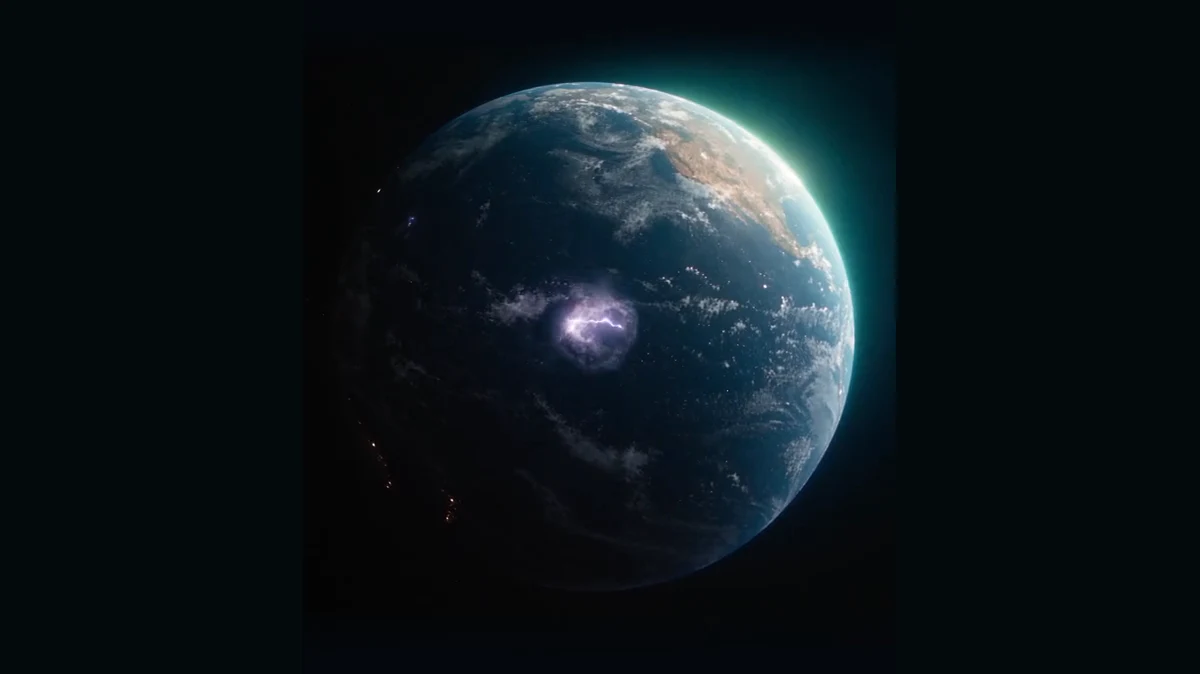
What Kp summarizes
GFZ produces the internationally recognized Kp index from a network of 13 geomagnetic observatories. The index, introduced by Julius Bartels in 1949, gives a standardized view of planetary magnetic disturbance. GFZ’s overview identifies the network and the official data source.
A useful analogy is a summary score assembled from several measuring sites. That summary is valuable precisely because it is not just one local trace. In return, it cannot tell you every detail of conditions at a particular place.
Read the three-hour window
 Open chart at full size ↗
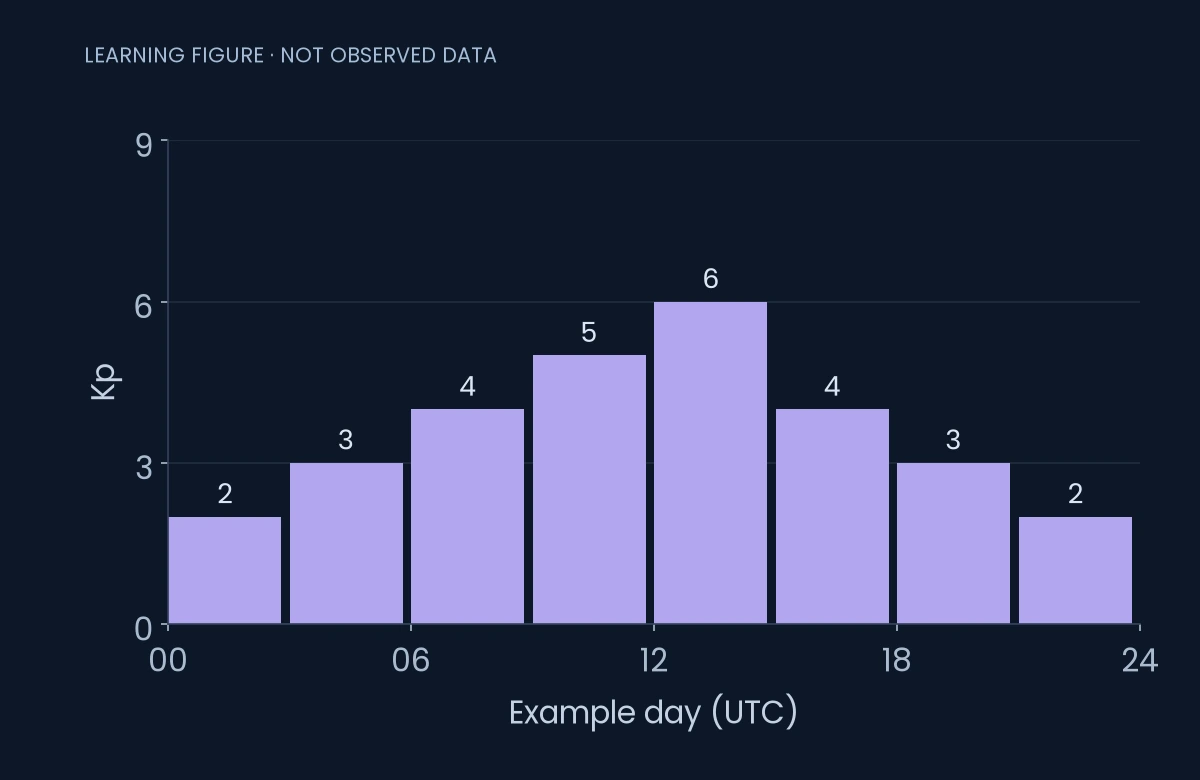
The bars are an invented teaching day, not a forecast or historical event. Each bar covers a complete three-hour interval. The first bar refers to 00:00–03:00 UTC, not an instantaneous measurement exactly at midnight.
The example values are 2, 3, 4, 5, 6, 4, 3 and 2 for the eight successive intervals. Its highest value is 6; its final interval is 2. Calling the entire day “Kp 6 now” would erase the distinction between a past maximum and the latest interval.
What do 5− and 5+ mean?
Kp conventionally uses thirds, including minus and plus forms around integers. A display may show 5− as approximately 4.67 and 5+ as approximately 5.33. These are representations of the index, not uncertainty bars around a measured field.
Do not invent a NOAA storm category by naively rounding or flooring a displayed decimal. Preserve the source’s notation and classification. The G-scale guide links to NOAA’s published associations, including its explicit treatment of 9−.
Estimated is not the same as definitive
GFZ distinguishes near-real-time nowcasts from definitive monthly values. Other services also publish estimated products. Differences in availability, processing or later corrections can produce differences between an early display and a final archive.
For a comparison, keep the product name with the number. “Kp, definitive, 12:00–15:00 UTC” says more than an isolated “6.” If a dashboard uses a shorter-cadence Kp-like index, do not silently call it the standard three-hour Kp.
Is Kp enough to predict northern lights?
No single index guarantees a local view. Kp summarizes planetary disturbance; aurora also depends on where the oval lies, local darkness, clouds and the evolution of the event. A predicted Kp is one piece of context, not a reservation for a visible display.
Use a current aurora product alongside local observing conditions. Our aurora guide explains what the light is and why a high number can still produce a disappointing night from one location.
Sources
- GFZ: planetary Kp, history and data access.
- GFZ: production, nowcast, definitive values and station network.
- GFZ: standardized index conversion and thirds.
Keep exploring
Make room for your own observations.
Schumann Pulse brings environmental readings and your personal journal into one place. The app is coming soon for iPhone.
Explore the app