
The field guide · Sun
What causes the northern lights?
Aurora is light emitted by the upper atmosphere after energetic particles excite its atoms and molecules. The northern lights are aurora borealis; the southern lights are aurora australis. Geomagnetic activity helps shape the display, but local visibility depends on much more than one index.
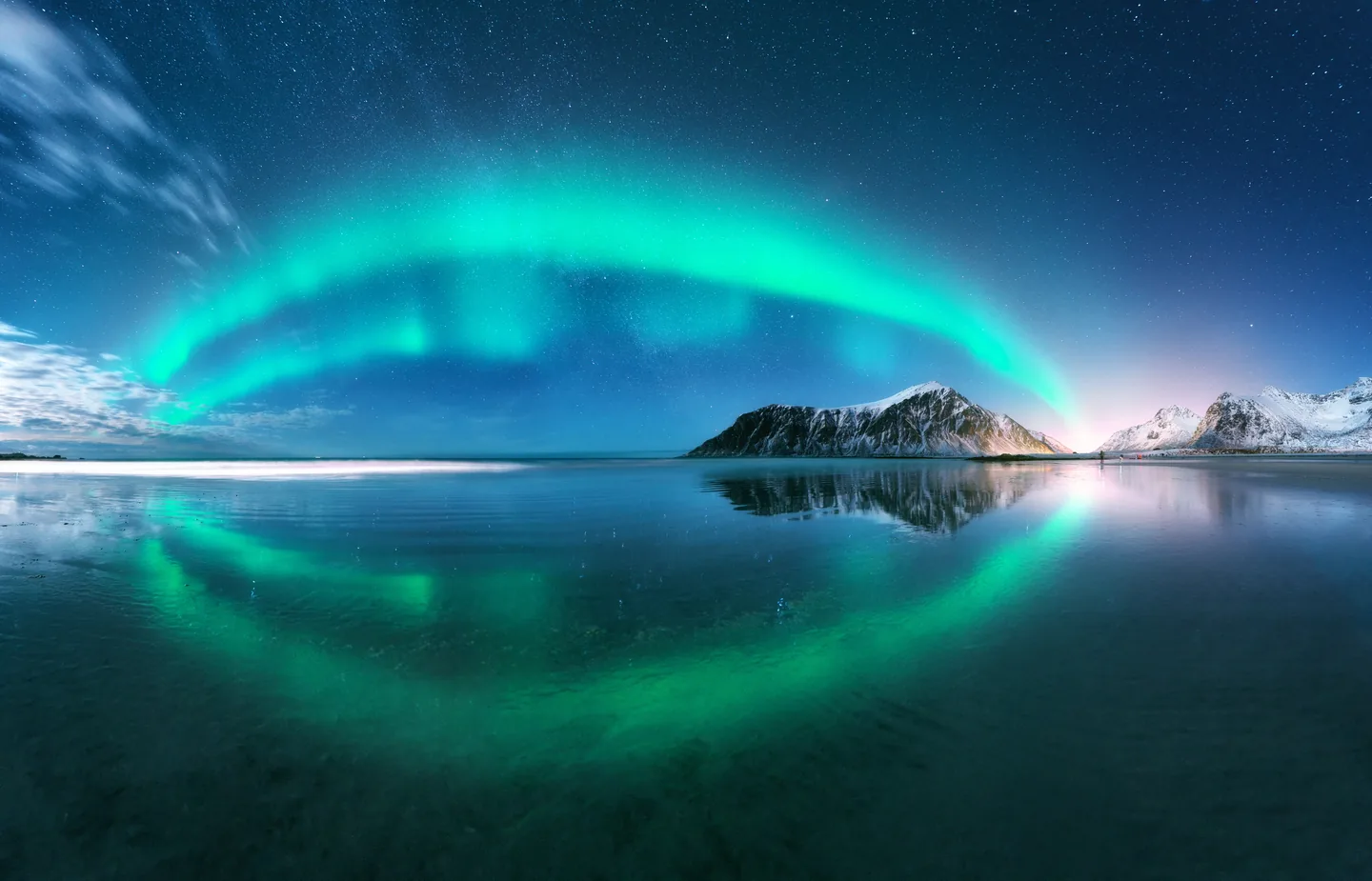
Why the atmosphere glows
Particles interacting with Earth’s magnetic environment can be accelerated toward the polar upper atmosphere. When they collide with atmospheric constituents, they transfer energy. Light is emitted as those excited atoms and molecules return to lower-energy states.
NOAA’s aurora explanation describes the role of electrons, oxygen and nitrogen. This is atmospheric emission, not sunlight reflecting from a low cloud. It occurs high above ordinary weather clouds, which can still block our view from the ground.
Why the display favors polar regions
Earth’s magnetic field organizes where many of the particles enter the atmosphere. Aurora commonly forms in oval-shaped regions around the magnetic poles. The auroral region can expand and change during disturbed geomagnetic conditions.
“Farther south” is therefore not a universal mileage rule. Geographic latitude, geomagnetic position and the changing shape of the oval all matter. A map designed for the current event gives more context than a generic list of cities.
Why Kp is useful but insufficient
Kp describes planetary geomagnetic activity over an interval. It does not report cloud cover, horizon obstructions or the brightness of a display at your exact observing spot. A high predicted Kp can coincide with daylight where you live; a real aurora can be hidden behind thick cloud.
Use the Kp guide to understand the index, then consult an official current aurora product. Check whether its time refers to a forecast, an estimate or an observed interval.
A practical observing checklist
- Find the current official aurora information and its valid time.
- Check darkness and local cloud conditions for the same interval.
- Choose a safe, accessible location with an unobstructed relevant horizon.
- Reduce nearby artificial light and give your eyes time to adjust.
- Treat photographs as photographs: exposure and processing can reveal colors or detail that look subtler to your eyes.
This is a way to improve interpretation, not a promise that a trip will produce a display. Avoid deciding on travel from a single viral screenshot.
Northern and southern lights share the same physics
The names distinguish hemispheres, not two unrelated mechanisms. Local conditions and the geometry of a particular event can produce different views. The Syowa auroral observing program provides an example of sustained observation in Antarctica.
How scientists brought the question into a laboratory
Birkeland’s terrella experiment used a magnetized sphere and low-pressure gas to explore aurora-like effects. Our historical guide explains the physical analogy and its limits.
Sources
- NOAA SWPC: auroral emission and the upper atmosphere.
- GFZ: what the planetary Kp index measures.
- NIPR: auroral observations at Syowa Station.
Keep exploring
Make room for your own observations.
Schumann Pulse brings environmental readings and your personal journal into one place. The app is coming soon for iPhone.
Explore the app