
The field guide · People & discoveries
Kristian Birkeland’s terrella: a little Earth in a glass chamber
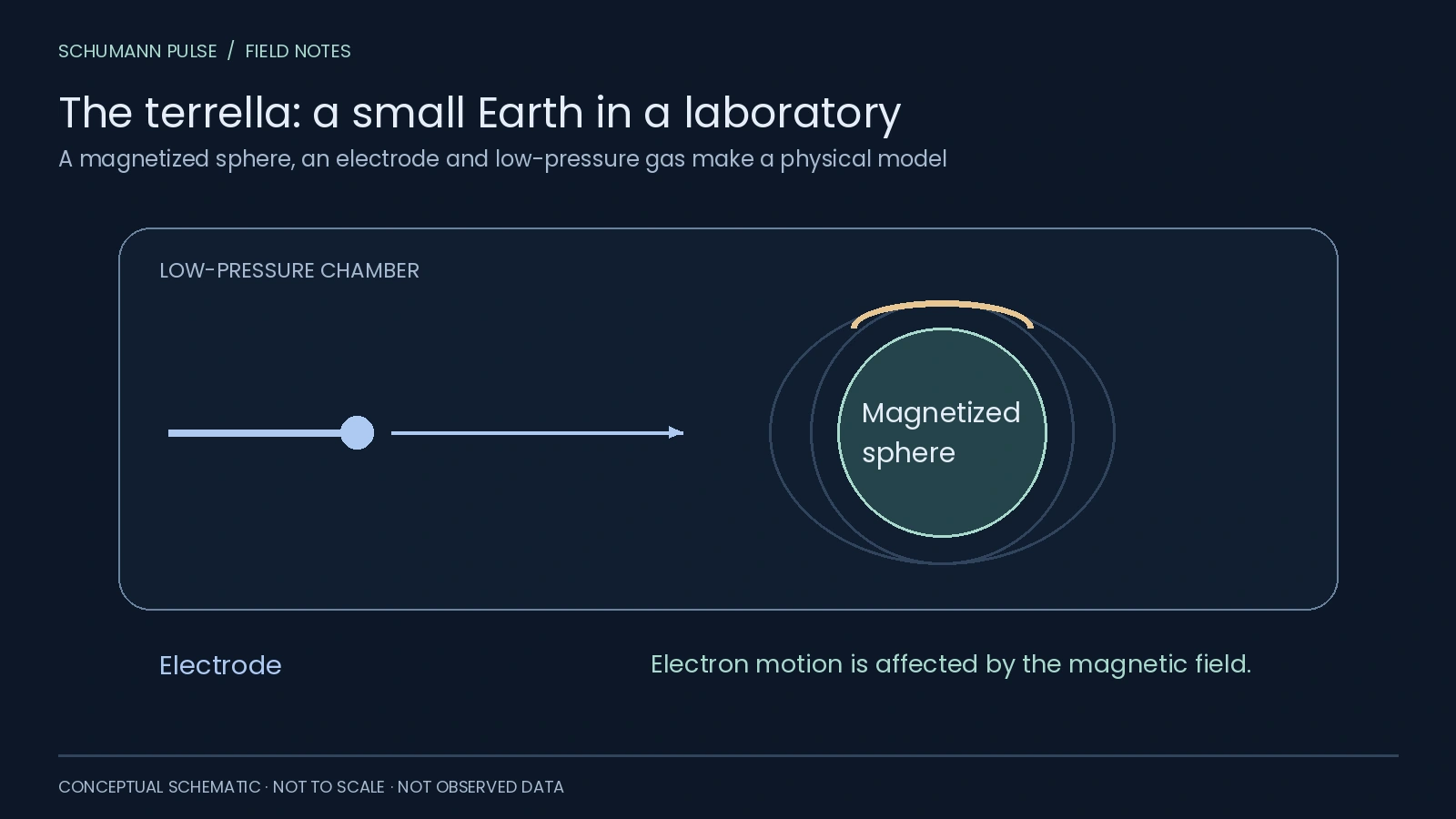
Kristian Birkeland used a magnetized sphere inside a low-pressure chamber to investigate aurora-like effects. His terrella experiments made the interaction of charged particles, magnetic fields and glowing gas visible. They were physical models, not miniature replicas of the entire Sun–Earth system.
 Open figure at full size ↗
Why put a small Earth in a chamber?
An aurora is enormous and distant. A laboratory model makes selected processes accessible: change a voltage, change a magnetic field or alter the gas pressure, then observe what changes in the glow.
In Birkeland's terrella arrangement, a magnetized sphere represented Earth. An electrode and an electrical discharge supplied particles in a chamber from which much of the air had been removed. The Norwegian Museum of Science and Technology preserves original equipment and explains these roles in its instrument collection. Museum description.
Who was Kristian Birkeland?
Birkeland was a Norwegian physicist, born in 1867 and deceased in 1917. His research combined laboratory experiments with observations of the northern lights. After an expedition to Finnmark, he developed the terrella experiments around 1900, using specially made chambers to investigate more than one luminous phenomenon. Museum history of the research.
 Open figure at full size ↗

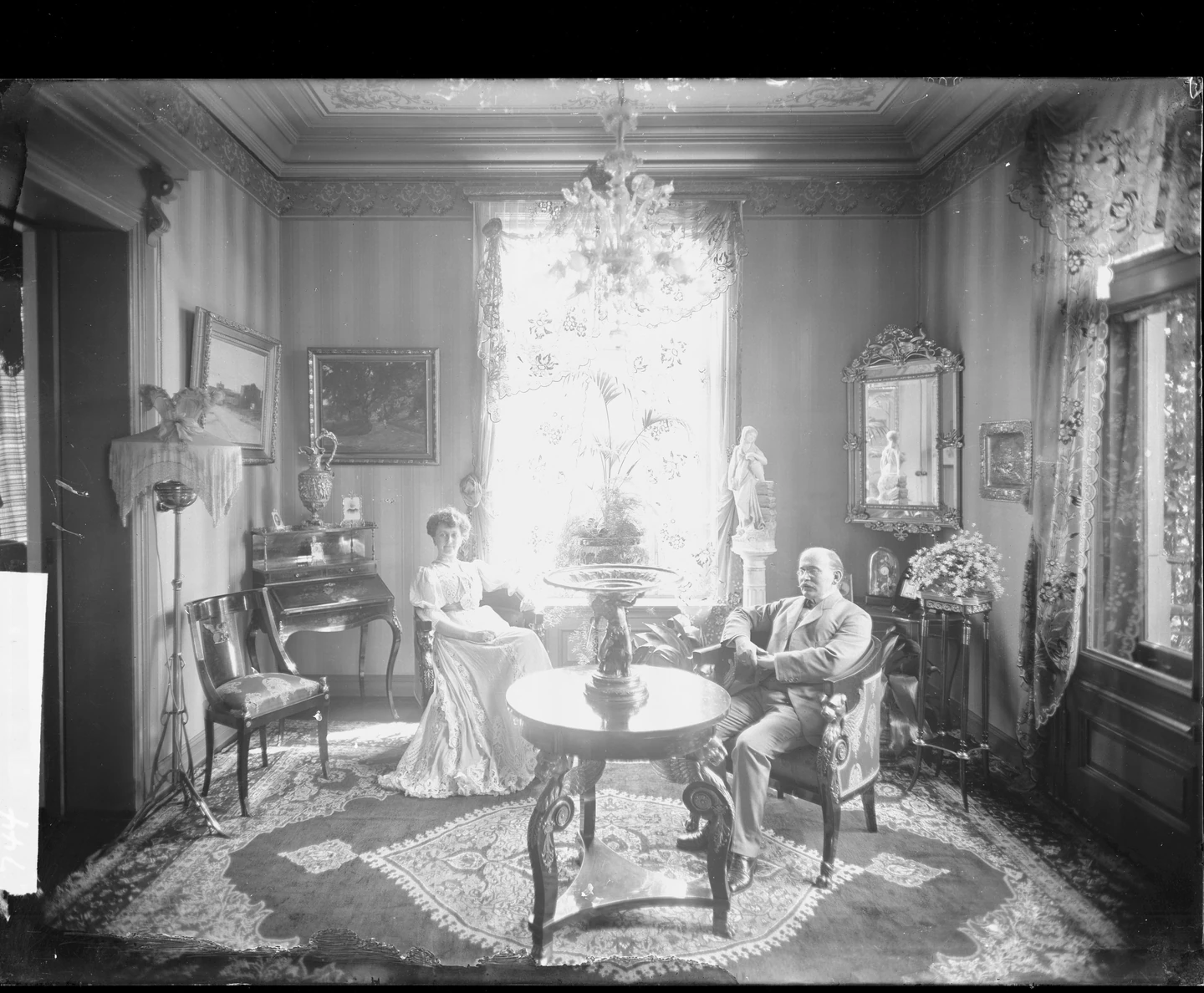
This photograph shows a different side of that history: Birkeland and his wife Ida at home in Kristiania, now Oslo. It comes from the Norwegian museum's collection, through an explicitly licensed source record. The exact exposure date is not established by that record. The picture documents people and a place; it is not evidence for a particular experiment.
What makes the gas glow?
In a laboratory discharge, energetic electrons can excite gas atoms and molecules. Light is emitted as those excited states relax. A magnetic field influences charged-particle motion, helping produce structured patterns rather than a uniformly glowing chamber.
The analogy matters because an aurora in Earth's atmosphere also involves energetic particles and atmospheric gases. But the full natural process includes the solar wind, the magnetosphere and mechanisms that accelerate particles. A visible resemblance is a starting point for investigation; it does not establish that every process scales directly from a glass chamber to a planet.
What did the modern Planeterrella add?
Jean Lilensten and colleagues developed a more flexible version of the experiment for scientific outreach. Their paper describes the Planeterrella, including configurations that demonstrate several space-plasma phenomena and a model of sharing plans with public institutions. It is a documented continuation of the experimental idea, rather than a new name for Birkeland's original equipment. The researchers' paper.
The changing geometry is part of the lesson. An experiment can be useful precisely because its limitations are clear: it isolates a relationship that is harder to see in the complete natural system.
Is this a Schumann resonance experiment?
No. A terrella investigates magnetized plasma and luminous discharge phenomena. Schumann resonances are extremely low-frequency electromagnetic modes of the Earth–ionosphere cavity, mainly excited by lightning. Both belong in a wider study of Earth's electrical environment, but one apparatus does not demonstrate the other phenomenon.
Sources
- Norwegian Museum of Science and Technology: terrella equipment.
- Museum history: Birkeland's chambers and research.
- Lilensten and colleagues (2013), the Planeterrella experiment.
- Historical photograph record and CC BY 4.0 attribution.
- NASA: how auroras form.
Keep exploring
Make room for your own observations.
Schumann Pulse brings environmental readings and your personal journal into one place. The app is coming soon for iPhone.
Explore the app