
The field guide · People & discoveries
The Carrington event: five minutes on the Sun, a lasting question on Earth
The Carrington event was an extreme episode of solar and geomagnetic activity in 1859. Richard Carrington and Richard Hodgson independently observed a brief white-light solar flare on 1 September. The subsequent great magnetic storm and auroras are distinct parts of the historical evidence.
 Open figure at full size ↗
What did Carrington see?
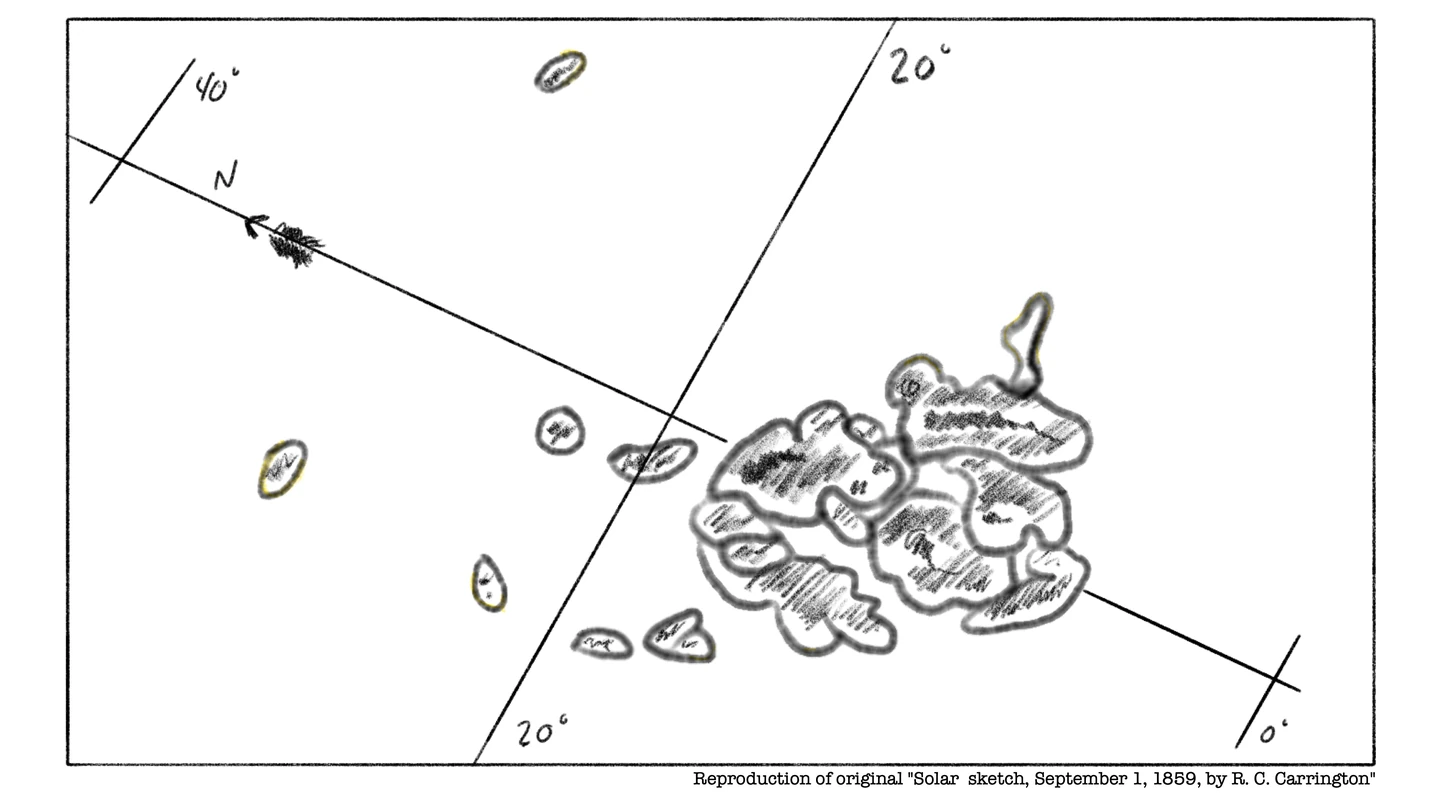
Carrington was making routine observations of sunspots when two unusually bright patches appeared within a large group. He first wondered whether stray light had entered the observing arrangement. Moving the projected solar image helped him recognise that the brightening belonged to the Sun.
He recorded the time and hurried to find another witness. When he returned, the appearance had already changed and weakened. The episode lasted only about five minutes. These details come from his own account, reproduced in NASA's historical education archive. Carrington's report.
The drawing above records the sunspot group and orientation. It is an archival reproduction, not a photograph of an eruption and not a measurement of a modern X-ray flare class.
The second observer deserves a name
Richard Hodgson observed the event independently. His report appeared alongside Carrington's in the November 1859 issue of Monthly Notices of the Royal Astronomical Society. The original publisher record preserves his contribution.
Independent observations matter because a fleeting event can be mistaken for an instrumental effect. Hodgson's account strengthened the case that something unusual had happened on the Sun, even though it did not supply the spacecraft measurements needed for a modern physical reconstruction.
Flare, ejected material and magnetic storm are different
Swipe or use the arrow keys to see all columns.
| Part of the story | What it describes | What the 1859 record can establish |
|---|---|---|
| White-light flare | A short-lived brightening on the Sun | Direct visual accounts and drawings |
| Earth-directed solar eruption | Material and magnetic field travelling through space | A physical interpretation, without an in-situ solar-wind monitor |
| Geomagnetic storm | A disturbance of Earth's magnetic environment | Historical magnetic records, auroral reports and technological effects |
The Royal Astronomical Society's discussion of the original papers connects the solar observation with later understanding of coronal mass ejections. A flare's radiation and the arrival of ejected plasma should not be collapsed into one instantaneous impact.
How strong was it?
It was an exceptionally severe historical event. Assigning an exact modern number is harder. There was no GOES satellite measuring soft X-rays in 1859, so a quoted modern flare class is a reconstruction, not a contemporary satellite reading.
Researchers continue to revisit the evidence. A 2025 study estimated an X-ray class using historical magnetic signatures and comparisons with modern events. Its existence is itself useful context: the number depends on methods and assumptions, not a hidden digital instrument record from the nineteenth century. Read the reconstruction study.
For the scales used today, see solar flare classes and geomagnetic storm categories. Neither scale is a personal health forecast.
A photograph found long after the event
The RAS has reported the recovery of a portrait identified as Carrington through archival clues, including writing on its mount. This is an engaging second discovery story: establishing a person's identity requires evidence too. Read the RAS account and view the photograph. That image is marked All Rights Reserved, so it is linked here rather than reproduced.
Sources
- Carrington's firsthand description, NASA historical archive.
- Hodgson (1859), independent observation.
- MNRAS: the original reports and their scientific context.
- 2025 X-ray reconstruction, publisher page.
- USGS: public-domain reproduction of Carrington's drawing.
- RAS: the recovered Carrington portrait.
Keep exploring
Make room for your own observations.
Schumann Pulse brings environmental readings and your personal journal into one place. The app is coming soon for iPhone.
Explore the app