
The field guide · Moon & methods
Why does the Moon change shape?
The Moon’s phases change because we see different portions of its sunlit half as it orbits Earth. The cycle from one new Moon to the next lasts about 29.5 days. Ordinary phases are a viewing geometry, not Earth’s shadow moving across the Moon.
The light is changing in our view
The Sun illuminates roughly half the Moon. From Earth, the portion of that illuminated half visible to us changes through the lunar orbit. A crescent is not a different Moon; it is a different view of the same world.
NASA’s phase guide illustrates this geometry. Earth’s shadow matters during a lunar eclipse, which is a different alignment from the ordinary monthly sequence.
Eight names, one continuous cycle
Swipe or use the arrow keys to see all columns.
| Phase | The useful reading |
|---|---|
| New Moon | The sunlit side largely faces away from us |
| Waxing crescent | A growing illuminated fraction, below half |
| First quarter | About half the visible disk is illuminated |
| Waxing gibbous | Growing illumination, above half |
| Full Moon | The visible disk is approximately fully illuminated |
| Waning gibbous | Shrinking illumination, above half |
| Third quarter | About half the visible disk is illuminated again |
| Waning crescent | Shrinking illumination, below half |
Waxing means increasing illumination; waning means decreasing illumination. “Quarter” names the position within the phase cycle, which is why a quarter Moon can look half lit.
Phase is not the same as appearance in a photograph
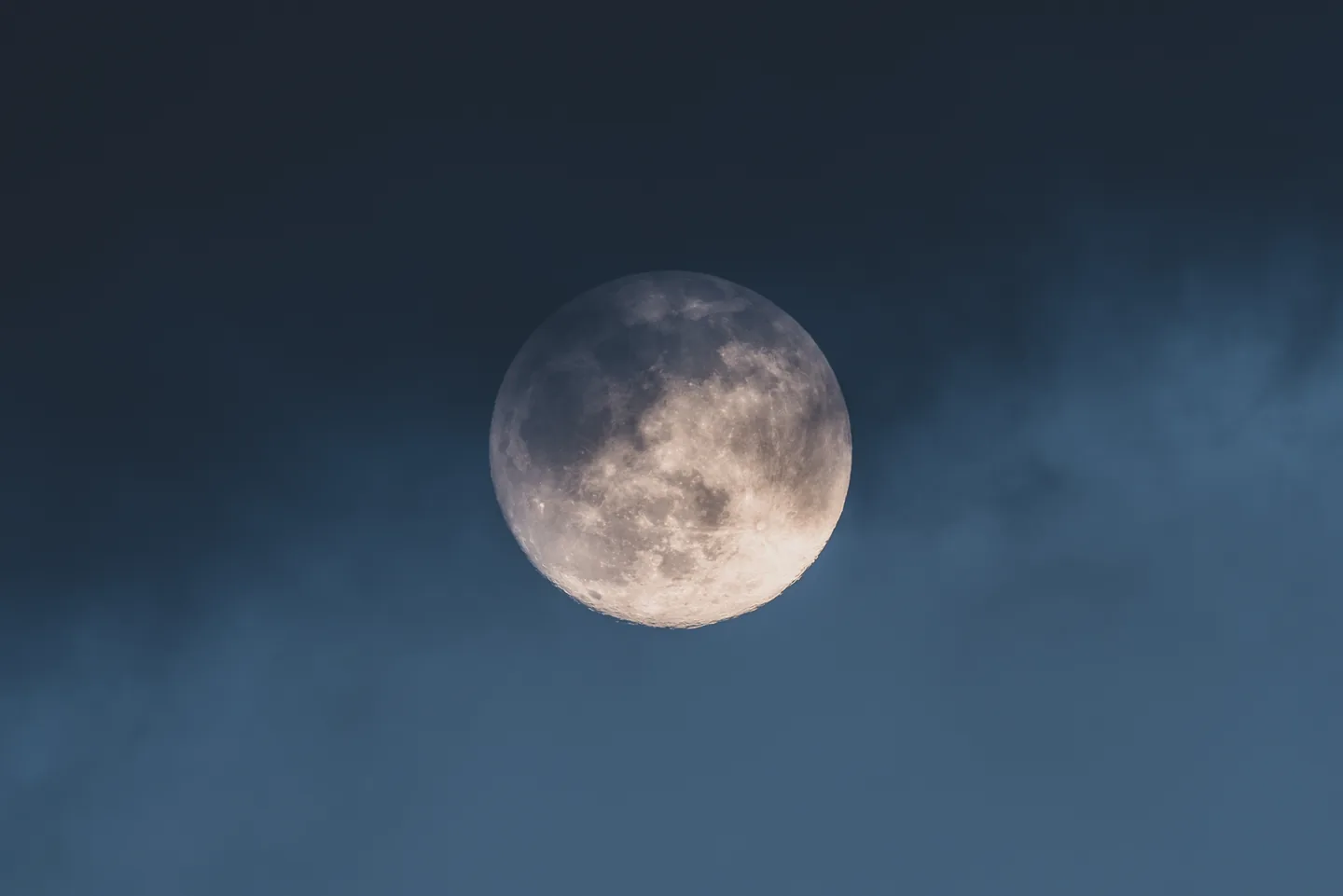
A lunar landscape, a full disk and a close-up of craters answer different visual questions. The close-up below shows a partly illuminated lunar disk and the shadow boundary across its cratered surface. It is stock footage, not today’s phase or a time-lapse of the monthly cycle.
The apparent orientation of the illuminated portion also depends on where and how you observe it. Prefer waxing/waning labels and illumination context over assuming that “bright on the right” is a universal rule for everyone on Earth.
Why 27.3 days and 29.5 days both appear
The Moon takes about 27.3 days to orbit relative to the stars. The phase cycle takes about 29.5 days because the Earth–Moon system is also moving around the Sun. The direction needed to repeat the same Sun–Earth–Moon geometry has shifted during the orbit.
For an actual phase time, use an astronomical calculation or a dated official source. Do not advance a calendar by a fixed rounded 29.5-day step and treat every result as exact.
Using lunar context in a journal
A phase can be a useful calendar reference. It is not an answer to how a person feels. Record your own experience independently and keep the date and time with it; a visual coincidence does not establish causation.
Schumann Pulse includes lunar context alongside environmental observations. The article’s photograph and film do not show today’s Moon, and its phase table is a reference rather than a live calendar.
Sources
- NASA Science: Moon phases and orbital versus phase periods.
- NASA SVS: Moon phase visualizations and dated astronomical context.
Keep exploring
Make room for your own observations.
Schumann Pulse brings environmental readings and your personal journal into one place. The app is coming soon for iPhone.
Explore the app