
The field guide · Sun
What is a coronal mass ejection?
A coronal mass ejection, or CME, is an eruption of plasma and magnetic field from the Sun’s outer atmosphere. A solar flare is a burst of radiation. They can occur together, but they travel differently and do not have identical effects at Earth.
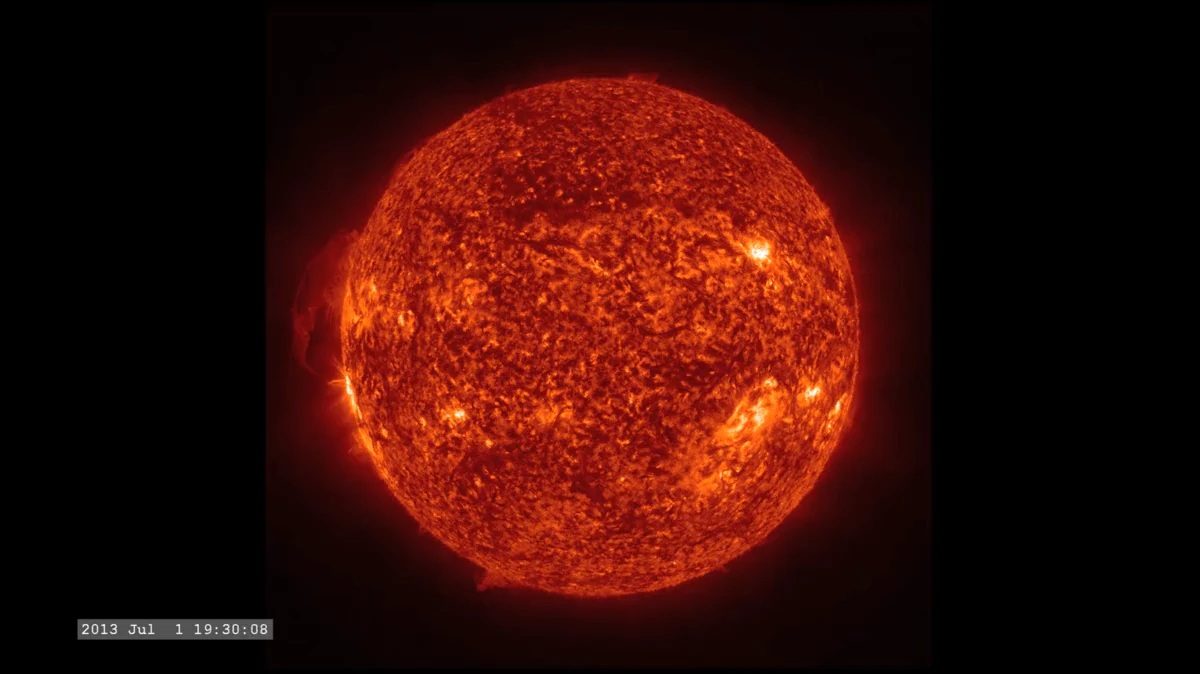
A cloud of plasma, not a flash of light
Plasma is matter containing charged particles. A CME carries this material together with a magnetic field away from the corona. A flare describes electromagnetic radiation released during solar activity. The distinction matters because the two signals travel on very different timescales.
NOAA’s CME explanation describes a wide range of speeds. Fast Earth-directed events can arrive in roughly 15–18 hours; slower ones may take several days. Those are broad physical examples, not an arrival prediction for any event discussed today.
Four questions before calling it an Earth threat
- Did an eruption occur? Use the original observation and instrument context.
- Where is it going? A visible eruption need not be directed toward Earth.
- When might it arrive? Forecasts use estimates of speed, geometry and propagation.
- How will it interact? Magnetic orientation and the encountered solar wind help determine the response at Earth.
A headline that answers only the first question cannot settle the other three. Keep the observation and forecast separate when sharing an event.
Why a “halo CME” needs context
A coronagraph blocks the bright central Sun so the surrounding corona becomes easier to see. An expanding eruption can appear around the occulting disk. That image is a projected view; interpretation needs the eruption’s location and other observations, not just its apparent ring-like shape.
The ESA space-weather sensor overview explains how solar imaging and upstream measurements complement one another. An image of the source and a measurement near Earth answer different parts of the story.
Arrival does not determine the whole storm
Even when an eruption reaches Earth’s vicinity, its speed alone does not specify a G level. The magnetic field carried by the plasma and the duration of favorable coupling matter. A forecast can therefore become more informative as an event approaches, while still retaining uncertainty.
Read updated official bulletins rather than treating an early estimated arrival as a fixed appointment. If a forecast changes, check what new observation became available and which part of the forecast changed.
Compare the terms at a glance
Swipe or use the arrow keys to see all columns.
| Term | What it describes |
|---|---|
| Solar flare | A burst of electromagnetic radiation |
| CME | Ejected plasma with an embedded magnetic field |
| Solar energetic particles | A high-energy particle population; a different observing product |
| Geomagnetic storm | A response of Earth’s magnetic environment |
Sources
- NOAA SWPC: coronal mass ejections.
- ESA: sensors across the Sun–Earth system.
- NOAA SWPC: conditions driving geomagnetic storms.
Keep exploring
Make room for your own observations.
Schumann Pulse brings environmental readings and your personal journal into one place. The app is coming soon for iPhone.
Explore the app