
The field guide · People & discoveries
How were Schumann resonances first measured?
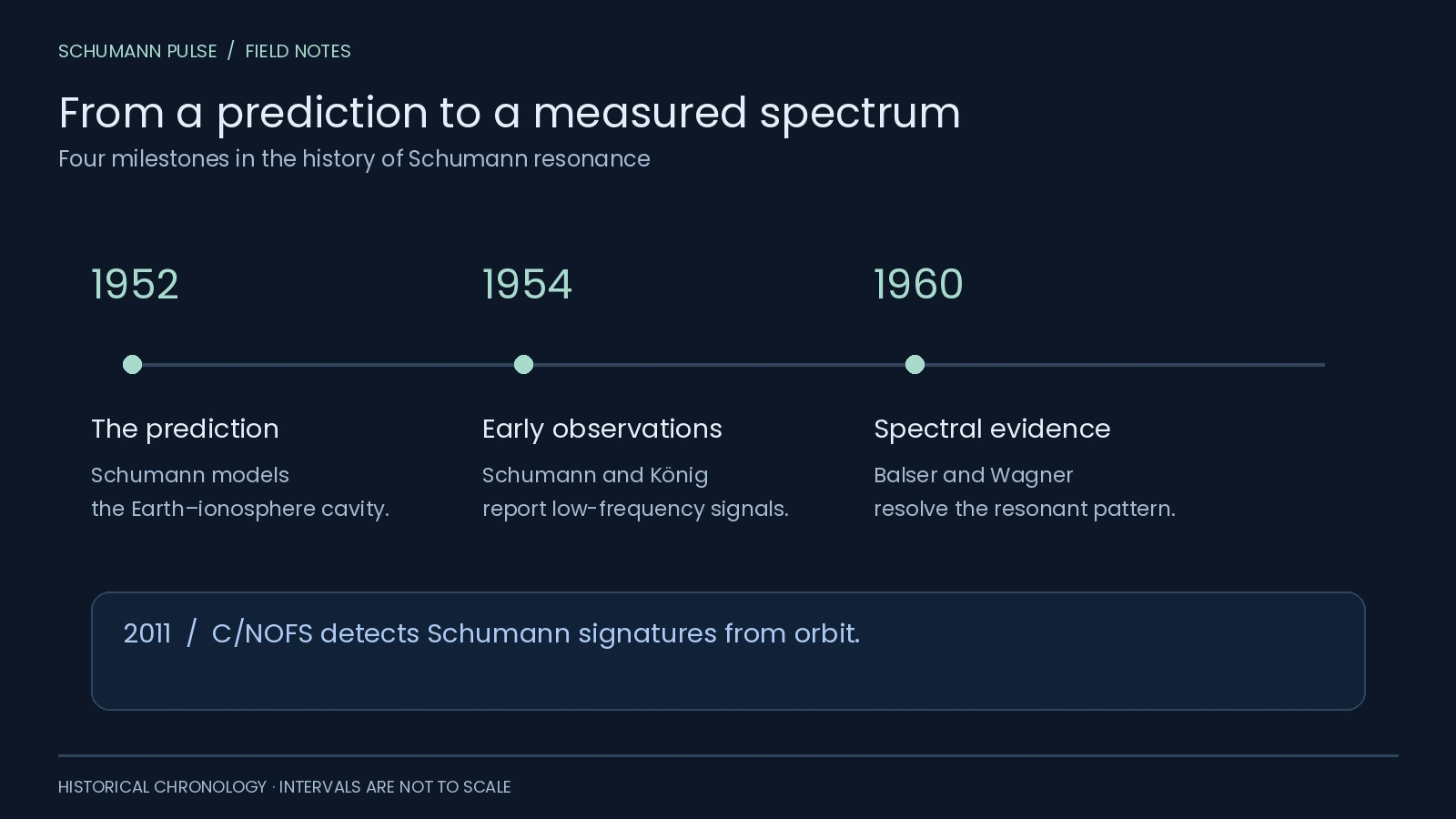
Schumann predicted Earth–ionosphere resonances in 1952. Preliminary observations followed with Herbert König in 1954; Balser and Wagner published clear spectral evidence in 1960. The discovery was a sequence of calculations, difficult measurements and better analysis, not a single reading of 7.83 Hz.
 Open figure at full size ↗
What had to be discovered?
A prediction can say that a physical system supports certain oscillations. An experiment must show that those oscillations are actually present, distinguish them from interference and describe how the instrument responds. Those are different achievements.
Schumann's 1952 paper treated an electrically conducting sphere surrounded by air and an ionospheric envelope. The geometry made a global electromagnetic resonator a calculable problem. The natural world then supplied the difficult parts: a variable ionosphere, weak signals and a noisy observing site.
Schumann and König: the early observations
Herbert L. König built the experimental arrangement used in the observations published with Schumann in 1954. Measurements in Munich and at a quieter reference site identified low-frequency waveforms, including approximately sinusoidal signals around 9 Hz. Besser's historical research documents these early results and their later refinement. They should not be retold as a perfectly resolved modern spectrum. Historical study, section 5.3.
The practical obstacle was already familiar: a nearby electrical system can be louder than the environmental signal being sought. Moving a receiver away from interference is part of making a measurement, not merely a convenient change of scenery.
The 1960 experiment that found no peaks
Before their famous Nature paper, Martin Balser and Charles A. Wagner reported a different experiment in the Journal of Research of the National Bureau of Standards. Equipment limitations led them to examine approximately 50–100 Hz, where they hoped to find higher cavity modes.
They took recordings in New Hampshire, away from power-line hum, and processed the taped signals using an IBM 709 computer. Long averaging reduced statistical uncertainty, but they found no statistically significant evidence of the expected cavity peaks in that band. Their paper explicitly described the work as preliminary and proposed looking at lower frequencies. Original 1960 report.
This result did not establish that the cavity could not resonate. It constrained what that experiment, in that frequency range and with that instrument, could detect. The distinction is still useful whenever an online chart appears blank.
A spectrum makes the case stronger
On 19 November 1960, Balser and Wagner's Observations of Earth–Ionosphere Cavity Resonances appeared in Nature. The publisher record identifies their Lincoln Laboratory affiliation and the earlier work they built upon. Later observations at Kingston, Rhode Island, provided another documented experimental setting. Original 1962 Kingston paper.
A recognisable family of broad spectral peaks is more informative than a single bright mark near one expected frequency. The test asks whether the pattern, instrument response and alternative explanations fit together. Our measurement guide explains what happens between a sensor and that plotted spectrum.
A useful fact to remember
1952 is the date of a theoretical milestone, not the beginning of Earth's resonance. Lightning and the atmosphere existed before the phenomenon had a name. Likewise, 7.83 Hz is a useful approximate reference for the lowest mode, not a number that every historical experiment measured exactly.
Sources
- Schumann (1952), original conducting-sphere and ionosphere paper.
- Besser (2007), historical development and König's measurements.
- Balser and Wagner (1960), the 50–100 Hz experiment, full text.
- Balser and Wagner (1960), Nature paper record.
- Polk and Fitchen (1962), ELF reception at Kingston, full text.
Keep exploring
Make room for your own observations.
Schumann Pulse brings environmental readings and your personal journal into one place. The app is coming soon for iPhone.
Explore the app