
The field guide · People & discoveries
Who was Winfried Otto Schumann?
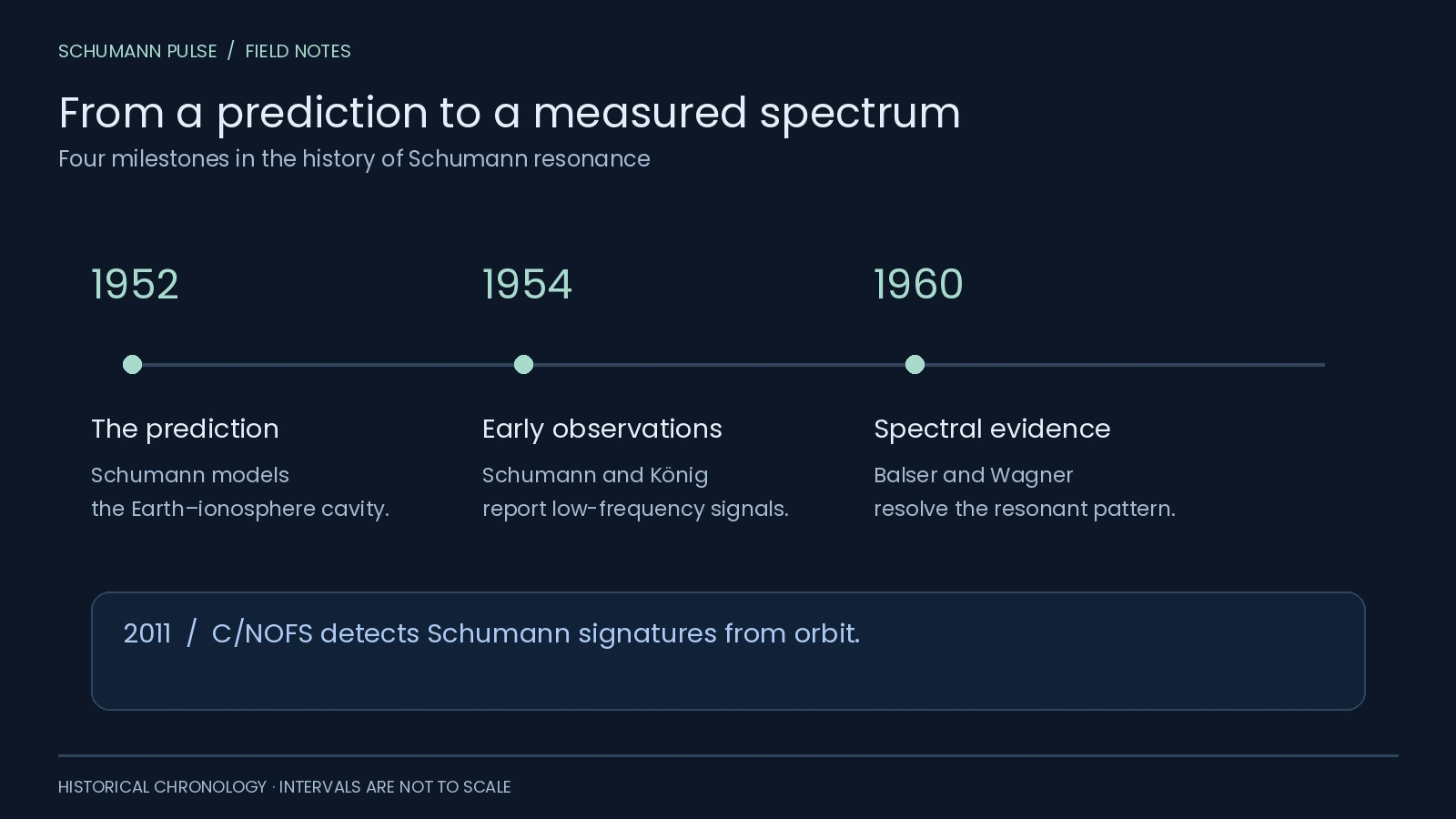
Winfried Otto Schumann (1888–1974) was a German electrical engineer and professor in Munich. The resonances named after him grew from his work on electromagnetic oscillations in the Earth–ionosphere cavity, predicted in 1952 and reliably measured in the early 1960s.
 Open figure at full size ↗
The person behind the name
Schumann is associated with a physical question: can the region between Earth and its conducting upper atmosphere support characteristic electromagnetic oscillations? His work made that question mathematically concrete and helped establish what observers should look for.
The Technical University of Munich archive records his appointment in 1924 and his leadership of the Electrophysical Laboratory until 1961. Its collection includes manuscripts, correspondence and technical publications.
Prediction and measurement are different milestones
Swipe or use the arrow keys to see all columns.
| Period | Milestone | Why the distinction matters |
|---|---|---|
| 1888–1974 | Schumann’s lifetime | Identifies the researcher behind the name |
| 1924 | Appointment in Munich | Establishes his institutional setting |
| 1952 | Prediction of the cavity resonances | A theoretical result, not a continuous monitoring network |
| 1954 | Preliminary observations with Herbert König | An early experimental contribution, distinct from later resolved spectra |
| 1960 | Balser and Wagner's Nature paper | A later milestone in establishing the resonant spectrum |
NASA’s historical summary distinguishes the 1952 prediction from reliable measurements in the following decade. Besser’s history in Radio Science gives a fuller account of the theoretical and experimental work, including other contributors.
What was the important idea?
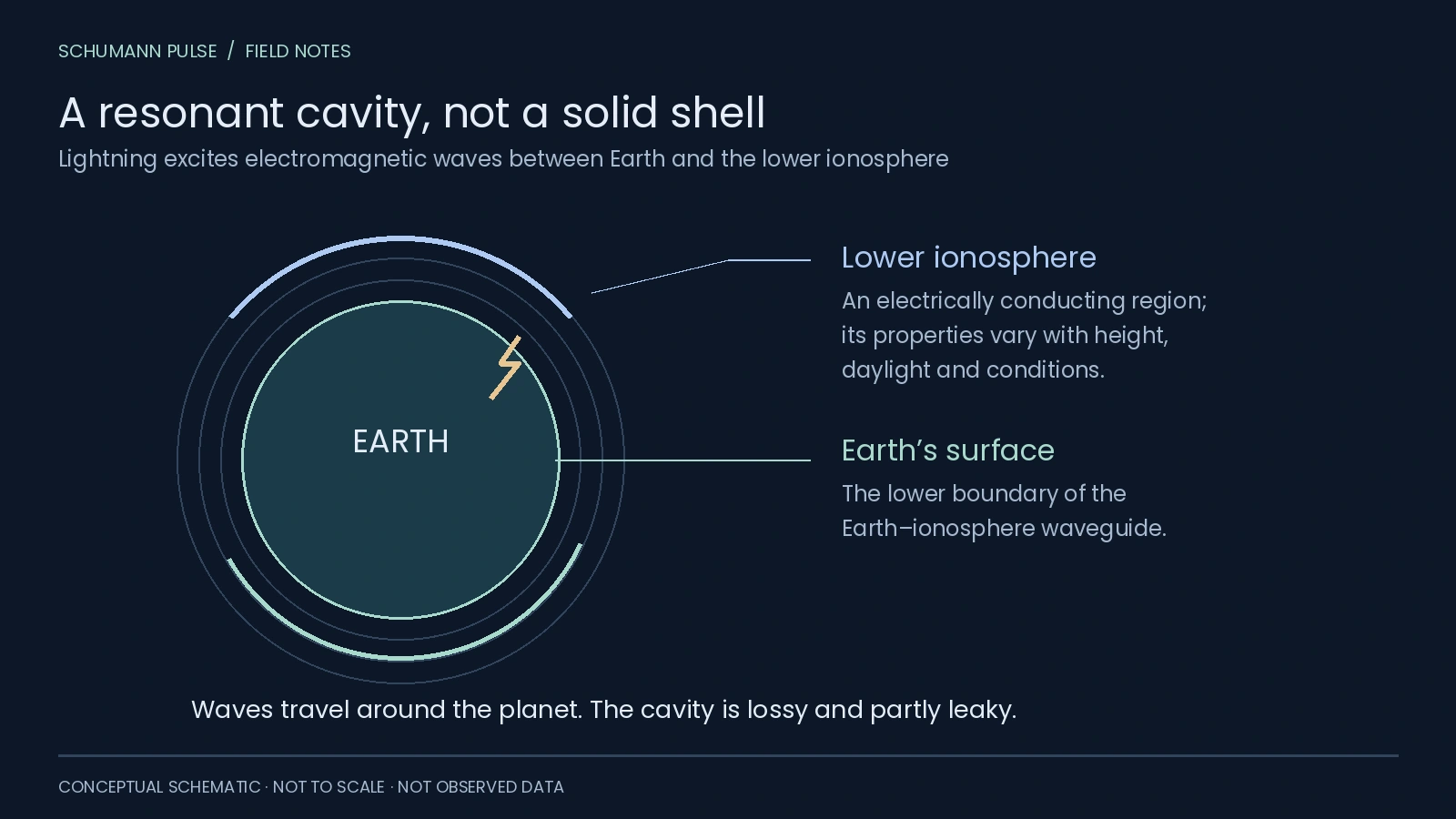
Schumann's original 1952 paper considered a conducting sphere, an intervening air layer and an ionospheric envelope. The publication's original print date is 1952; the later online date on the publisher's website is the digitization record, not the date the idea first appeared.
The important object was the entire Earth–ionosphere system. Its geometry and electrical properties permit resonant electromagnetic modes, continually excited by lightning. The phrase “Schumann resonance” names that phenomenon; it does not mean Schumann discovered one immutable number governing every process on Earth.
You can see the practical result in a spectrum: several broad peaks, each with a frequency and a strength. The frequency guide explains why the often quoted 7.83 Hz is an approximation for the lowest mode.
 Open figure at full size ↗
Who else belongs in the story?
Herbert König contributed experimental work in Munich. Martin Balser and Charles Wagner later published measurements at MIT's Lincoln Laboratory. Charles Polk and Frank Fitchen documented reception at Kingston, Rhode Island. The experimental history follows these contributions, including an early null result that is easy to miss in simplified biographies.
The phenomenon's name is a convenient label, not a complete list of everyone who helped establish it. Separating the person, the mathematical prediction and the measurements gives each contribution a clearer place.
How to check a historical claim
When a biography attaches a quotation or medical promise to a scientist’s name, look for the original work, publication date and context. A later use of a person’s name is not evidence that the person endorsed it.
The TUM archive and Besser’s historical review serve different purposes: the archive documents Schumann’s career, while the review traces the theoretical predictions and experiments. Reading them together helps distinguish a biographical fact from a later interpretation of the science.
Where the research went next
Modern resonance work includes ground observations of the global electromagnetic environment and studies of lightning-related signals. The 2011 C/NOFS result extended the observing perspective into orbit. Researchers also investigate correlated magnetic noise at gravitational-wave detectors. Our observatory directory connects these questions to documented measuring stations.
Sources
- TUM Archive: Winfried Otto Schumann’s estate and career record.
- Besser (2007): Synopsis of the historical development of Schumann resonances.
- NASA Goddard: prediction and reliable measurement milestones.
- Schumann (1952): original conducting-sphere calculation.
- Balser and Wagner (1960): Nature publication record.
- Polk and Fitchen (1962): Kingston observations.
Keep exploring
Make room for your own observations.
Schumann Pulse brings environmental readings and your personal journal into one place. The app is coming soon for iPhone.
Explore the app