
The field guide · People & discoveries
Can Schumann resonances be detected from space?
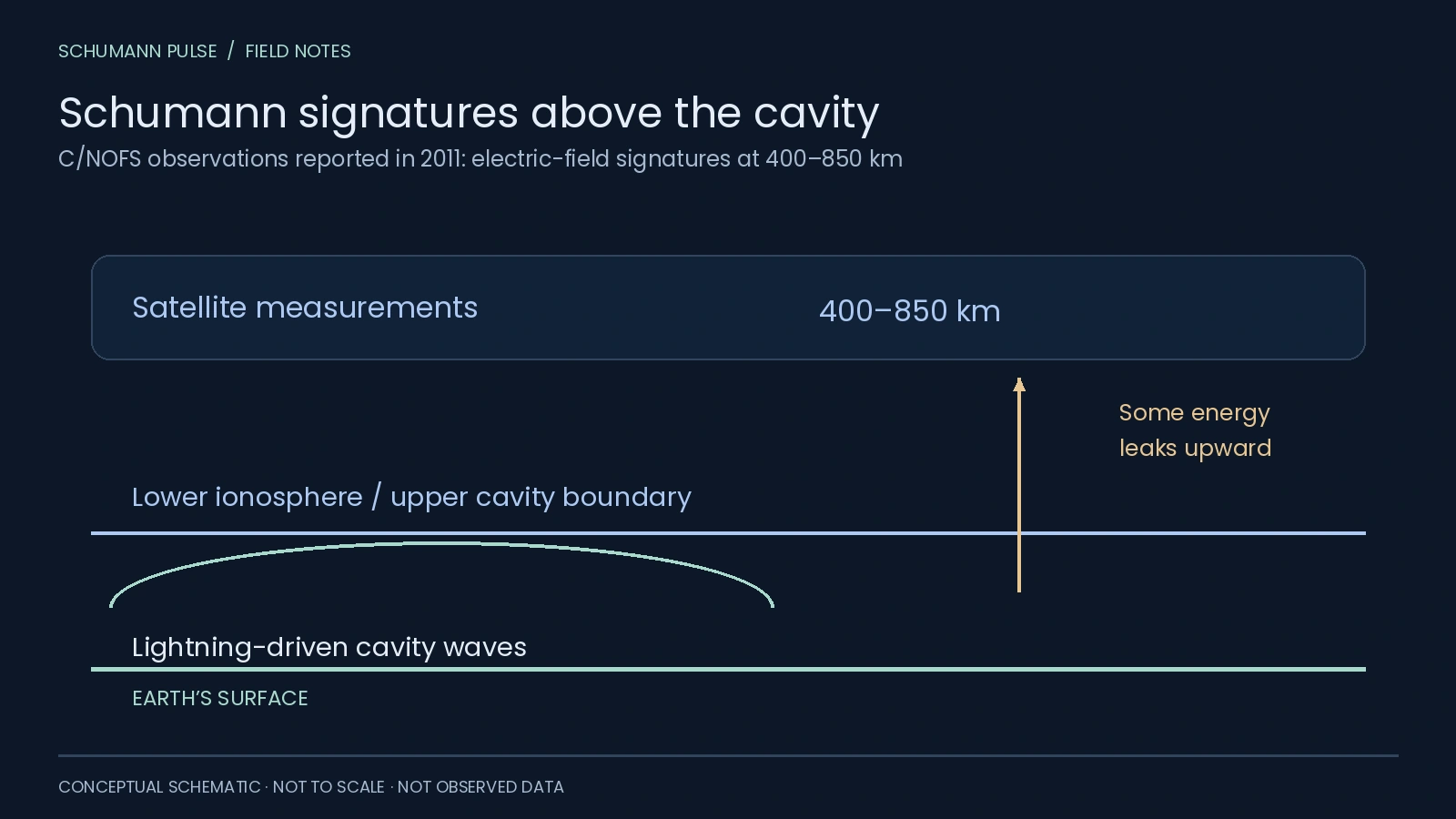
Yes. In 2011, Fernando Simões, Robert Pfaff and Henry Freudenreich reported Schumann resonance signatures in electric-field measurements from C/NOFS, at altitudes of 400–850 km. The observations showed that the Earth–ionosphere cavity is not a perfectly sealed electromagnetic enclosure.
 Open figure at full size ↗
What did the satellite detect?
The C/NOFS result came from electric-field measurements, not an optical photograph of a glowing band around Earth. Simões, Pfaff and Freudenreich identified spectral signatures associated with Schumann resonances above the lower boundary region that is normally used to describe the cavity's upper edge.
Their 2011 paper reported signatures across the spacecraft's 400–850 km altitude range, generally during nighttime, with some weaker daytime appearances. These were historical observations from a particular mission, not a statement that every satellite can continuously monitor the resonances. Original paper.
Why was this an interesting result?
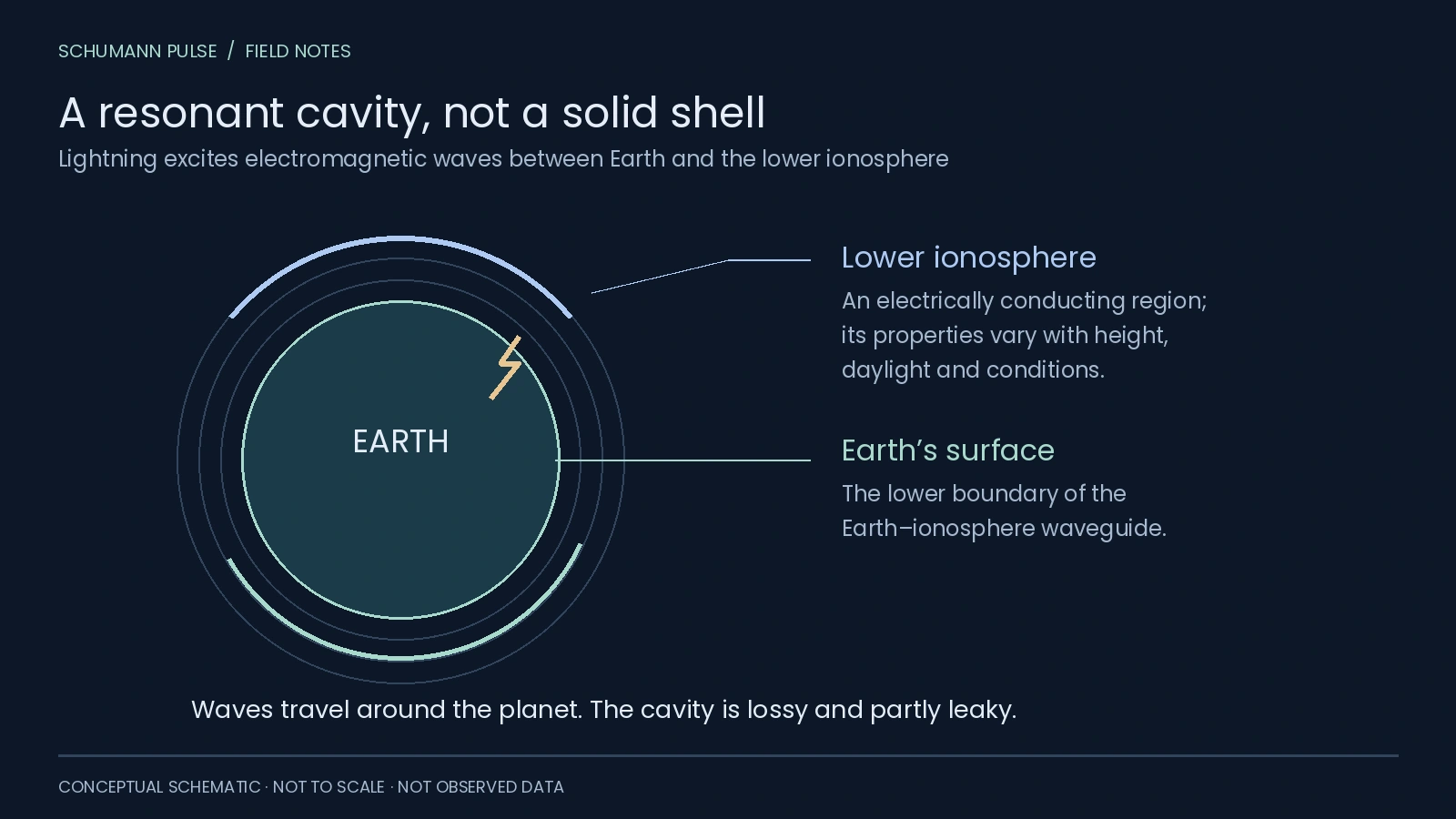
The simplest teaching picture draws Earth and the ionosphere as two boundaries around a resonant space. That picture is useful, but it can suggest an enclosure with perfectly reflecting walls.
The ionosphere is a changing plasma, not a metal ceiling. Its properties vary with altitude, location and time. Detecting a signature above the cavity raises questions about propagation and leakage that a rigid-shell drawing leaves out. The original authors discuss a leaky-cavity interpretation, particularly under nighttime conditions.
 Open figure at full size ↗
The two diagrams describe complementary viewpoints. One introduces the global cavity near Earth. The other shows where the satellite observations were made. Neither draws the relative heights to scale or reconstructs a measured wave path.
Who carried out the work?
The paper lists Fernando Simões, Robert Pfaff and Henry Freudenreich, affiliated with NASA Goddard Space Flight Center. A Goddard seminar presented the orbital observations in July 2011 and discussed their potential for studying atmospheric electricity and the connection between the lower atmosphere and ionosphere. NASA seminar record.
The historical sequence matters. The spacecraft did not discover the existence of Schumann resonance from scratch. It extended the observing perspective decades after the ground-based experiments.
Is a satellite reading interchangeable with a ground chart?
No. A measurement depends on the instrument, field component, observing position and processing. A receiver moving through the ionosphere samples a different environment from a stationary magnetic coil on the ground.
Comparing the two is a scientific problem, not a matter of lining up colours in screenshots. A useful comparison needs instrument response, timing, geometry and a physical model of how the signals propagate. The broader NASA-hosted review places such measurements among several mechanisms coupling the troposphere and ionosphere. Research review.
What should a reader remember?
A boundary in a scientific diagram is not necessarily an impenetrable wall. Models simplify a system so that it can be understood and tested. A new observation can reveal where that simplification needs more detail while leaving the central phenomenon intact.
For the wider observing system, explore the space-weather observatory guide. Solar imaging, upstream solar-wind sampling and electric-field measurements in the ionosphere are distinct capabilities.
Sources
- Simões, Pfaff and Freudenreich (2011), satellite observations.
- NASA Goddard: July 2011 research seminar.
- NASA NTRS: low-frequency electromagnetic coupling review.
Keep exploring
Make room for your own observations.
Schumann Pulse brings environmental readings and your personal journal into one place. The app is coming soon for iPhone.
Explore the app