
The field guide · People & discoveries
Why LIGO researchers study Schumann resonance
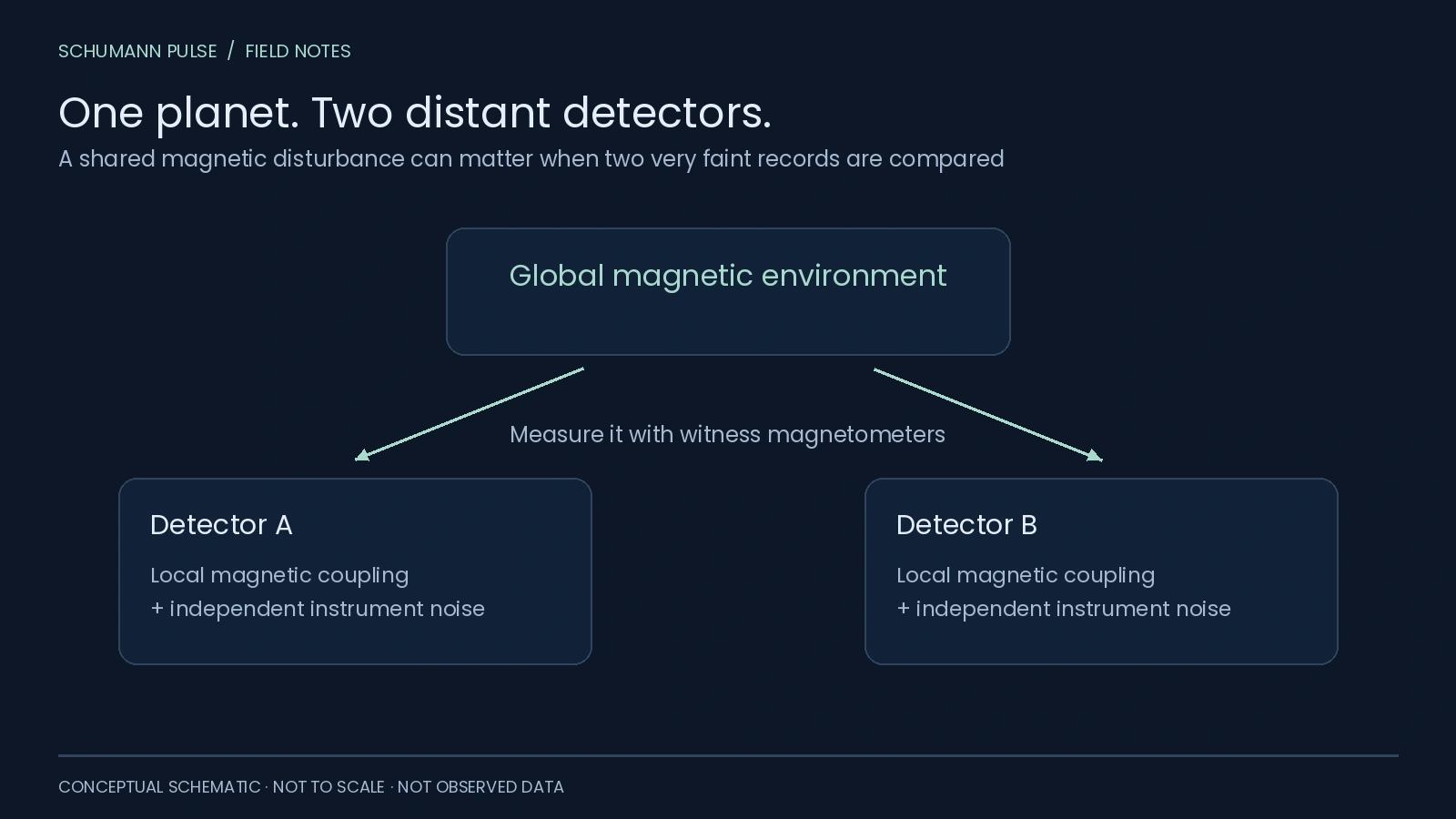
Schumann resonances can produce correlated magnetic fields across large distances. Researchers studying a faint stochastic gravitational-wave background monitor that environment because shared magnetic noise can affect comparisons between detectors. An electromagnetic disturbance is not itself a gravitational wave.
 Open figure at full size ↗
Why compare two distant instruments?
When searching for an extremely faint background, comparing independent detectors can help distinguish a shared signal from noise unique to each instrument. But the independence assumption has a condition: the instruments must not also respond to an unaccounted common environmental disturbance.
Earth's magnetic environment provides a concrete example. Lightning-driven Schumann resonances are global enough that measurements far apart can contain related magnetic features. If magnetic fields couple into detector hardware, an environmental correlation can enter a comparison intended to search for something astronomical. Coughlin and colleagues' subtraction study.
What is correlated noise?
Imagine two microphones recording the same distant ventilation system. Moving the microphones into separate rooms might reduce local noise without making the ventilation completely independent. The analogy concerns a shared disturbance, not the type of wave: Schumann resonances are electromagnetic, not sound.
The diagram separates a common magnetic environment from each detector's local coupling and independent noise. It deliberately does not draw an invented gravitational-wave signal or imply that a known event has been explained away.
The witness magnetometer
A witness sensor measures a possible noise source alongside the main instrument. In this case, magnetometers record the magnetic environment. Researchers can investigate how strongly those records are related, how they couple into the main measurement and whether a statistical filter reduces the unwanted contribution.
A 2018 paper by Michael Coughlin and colleagues reported dedicated measurements at Virgo and KAGRA, compared with a wider magnetometer network including LIGO sites. It tested Wiener-filter subtraction of correlated magnetic noise. The same work examined an easily overlooked experimental issue: magnetometers placed too close together can influence one another. Published study and author manuscript.
This is a good example of measurement discipline. A sensor intended to diagnose noise must not quietly become an additional source of it.
What did the gravitational-wave search conclude?
The LIGO and Virgo collaboration's analysis of the second observing run did not report a detection of an isotropic stochastic background; it placed upper limits. The paper also assessed correlated broadband magnetic noise using measurements at the Hanford and Livingston observatories. The O2 stochastic-background search.
An upper limit is a scientific result: it describes what the observations and analysis allow. It is not the same as proving that a background does not exist, or claiming that an unrelated transient detection was magnetic interference.
What this research does not mean
It does not mean Schumann resonance is a gravitational wave. It does not show that every detector signal comes from lightning. And it does not turn an environmental spectrum into evidence of a personal health effect.
The useful connection is narrower and more interesting: the same natural phenomenon studied by ELF observatories becomes part of the noise budget in a very different precision experiment. What one researcher wants to measure, another may need to monitor and subtract.
Sources
- Coughlin and colleagues (2016), intercontinental correlated-noise subtraction.
- Coughlin and colleagues (2018), measurements at gravitational-wave sites, journal DOI.
- LIGO and Virgo collaborations (2019), O2 stochastic-background search.
Keep exploring
Make room for your own observations.
Schumann Pulse brings environmental readings and your personal journal into one place. The app is coming soon for iPhone.
Explore the app