
The field guide · People & discoveries
How Heinrich Hertz demonstrated radio waves
Heinrich Hertz demonstrated electromagnetic waves in laboratory experiments in Karlsruhe during 1886–1888. A spark at a transmitter could produce a tiny spark in a separate receiver. The frequency unit hertz honours him; he did not discover Schumann resonance.
 Open figure at full size ↗
What did Hertz actually do?
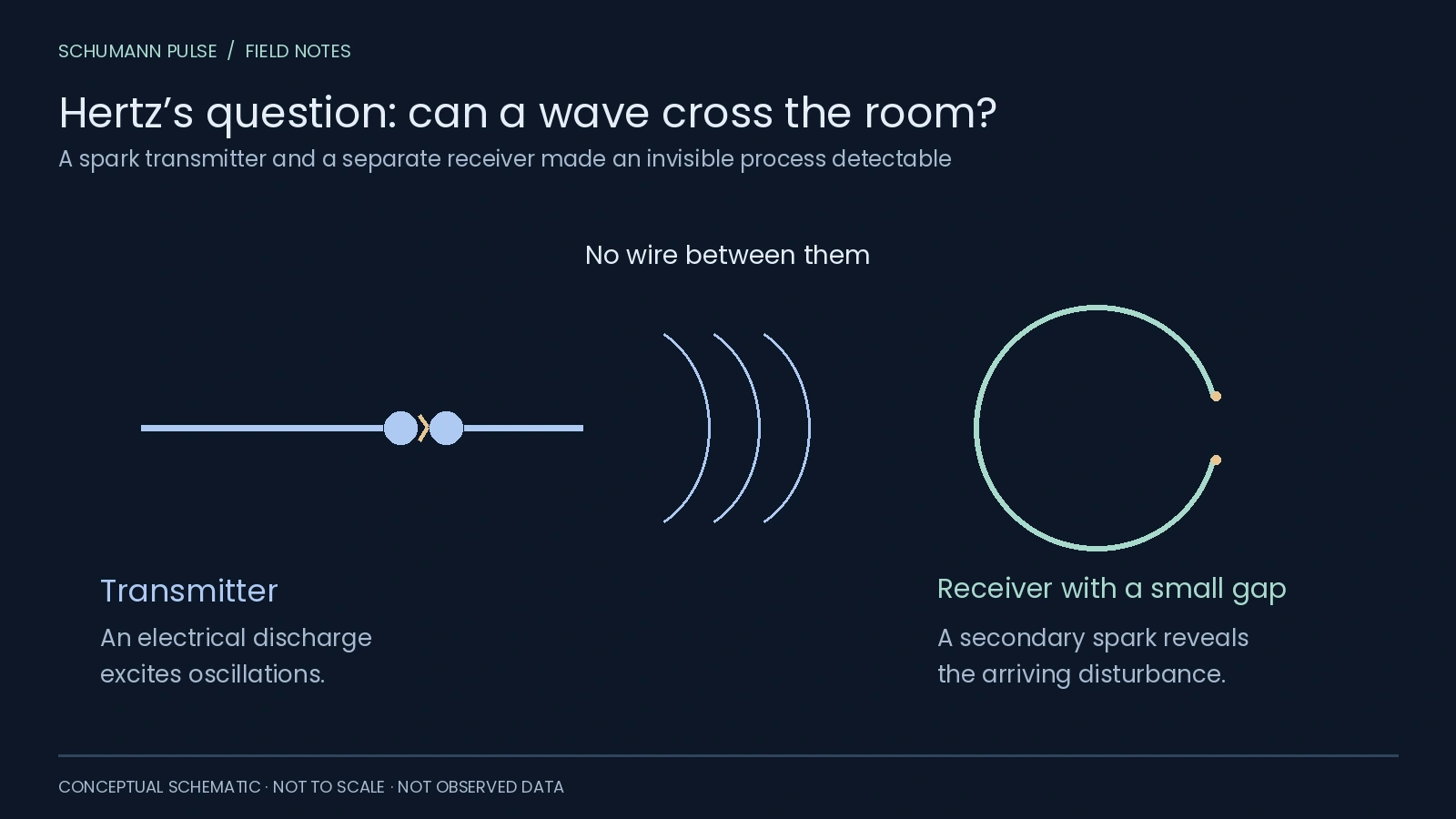
Hertz used an oscillating electrical discharge as a transmitter and a separate conductor with a small gap as a receiver. When the transmitter sparked, a much smaller spark could appear at the receiving gap. There was no wire carrying the signal between the two.
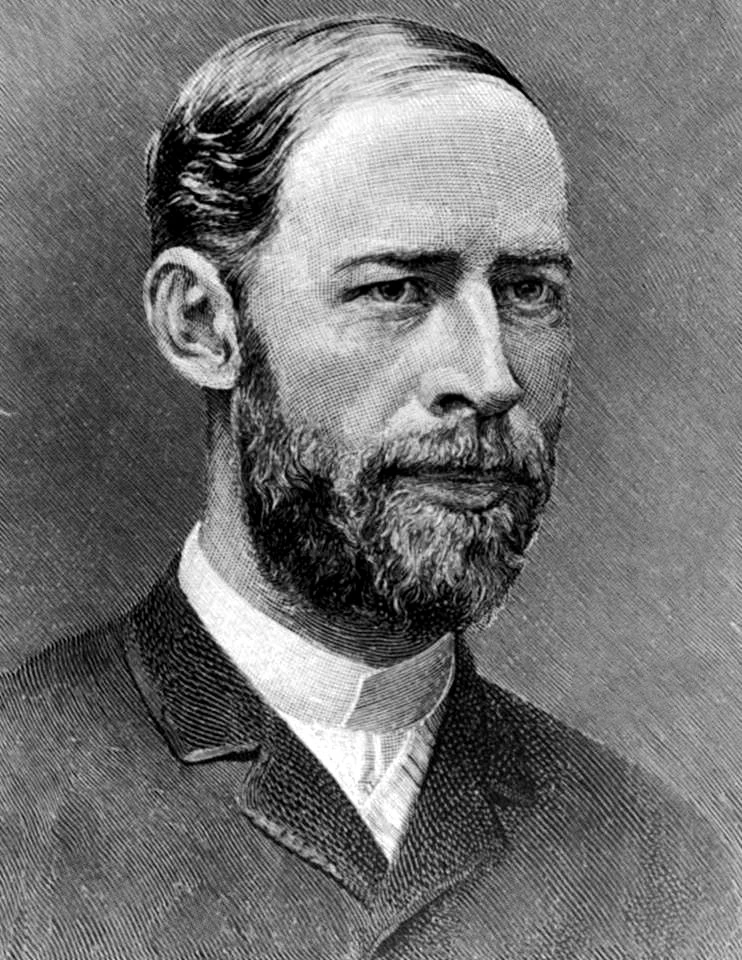
Karlsruhe Institute of Technology dates a key early experiment to 11 November 1886. Subsequent investigations of reflection, polarization and standing waves helped establish the connection between these electrical waves and the behaviour predicted by Maxwell's theory. KIT's account of the experiments.
 Open figure at full size ↗

The room mattered as much as the apparatus
The experiments were conducted in a lecture hall at the former Technische Hochschule Karlsruhe. The university's archive identifies the spark-induction equipment, transmitting gap and wireless receiving apparatus in a historical equipment photograph. A familiar teaching space became a place to test whether a mathematical description corresponded to something observable. KIT archival object 22.
The receiver was not a radio loudspeaker. It did not turn a broadcast into words or music. Its small gap acted as an indicator: enough electrical disturbance across the gap could make a spark visible. Changing the arrangement let Hertz investigate properties of the waves, rather than simply announce that a spark had happened.
What does one hertz mean?
One hertz means one cycle per second. A process repeating 10 times in one second has a frequency of 10 Hz. Frequency describes repetition; it does not, by itself, describe how strong a signal is.
That distinction becomes useful on a Schumann resonance chart. A spectral peak near 7.8 Hz locates a mode along the frequency axis. The peak's height expresses a different quantity, such as a field amplitude or a power spectral density. Changing height does not automatically mean changing frequency.
The SI definition is independent of the apparatus: a mechanical vibration, an electrical oscillation and a repeating digital signal can all be described in hertz. Sharing a unit does not make them the same physical phenomenon. BIPM SI Brochure.
Did Hertz discover Earth's resonance?
No. Hertz's laboratory work established experimental properties of electromagnetic waves decades before Schumann's 1952 cavity calculations. The connection is a foundation of wave physics and a unit of measurement, not a claim that the two scientists measured the same thing.
For the later story, follow the first Schumann experiments. Both histories show the value of a clear question, a detector and a way to distinguish the proposed signal from something else.
Read the historical work
The Library of Congress makes Hertz's 1892 Untersuchungen ueber die Ausbreitung der elektrischen Kraft available as a digitized volume. Its apparatus drawings are a useful reminder that the familiar results emerged through a series of experimental arrangements. Read the original volume.
Sources
- KIT: 125 years since Hertz's first experiments.
- KIT archive: apparatus and the Karlsruhe lecture hall.
- BIPM: the International System of Units.
- Hertz (1892), digitized original at the Library of Congress.
Keep exploring
Make room for your own observations.
Schumann Pulse brings environmental readings and your personal journal into one place. The app is coming soon for iPhone.
Explore the app