
The field guide · People & discoveries
C. T. R. Wilson: from clouds to a global electric circuit
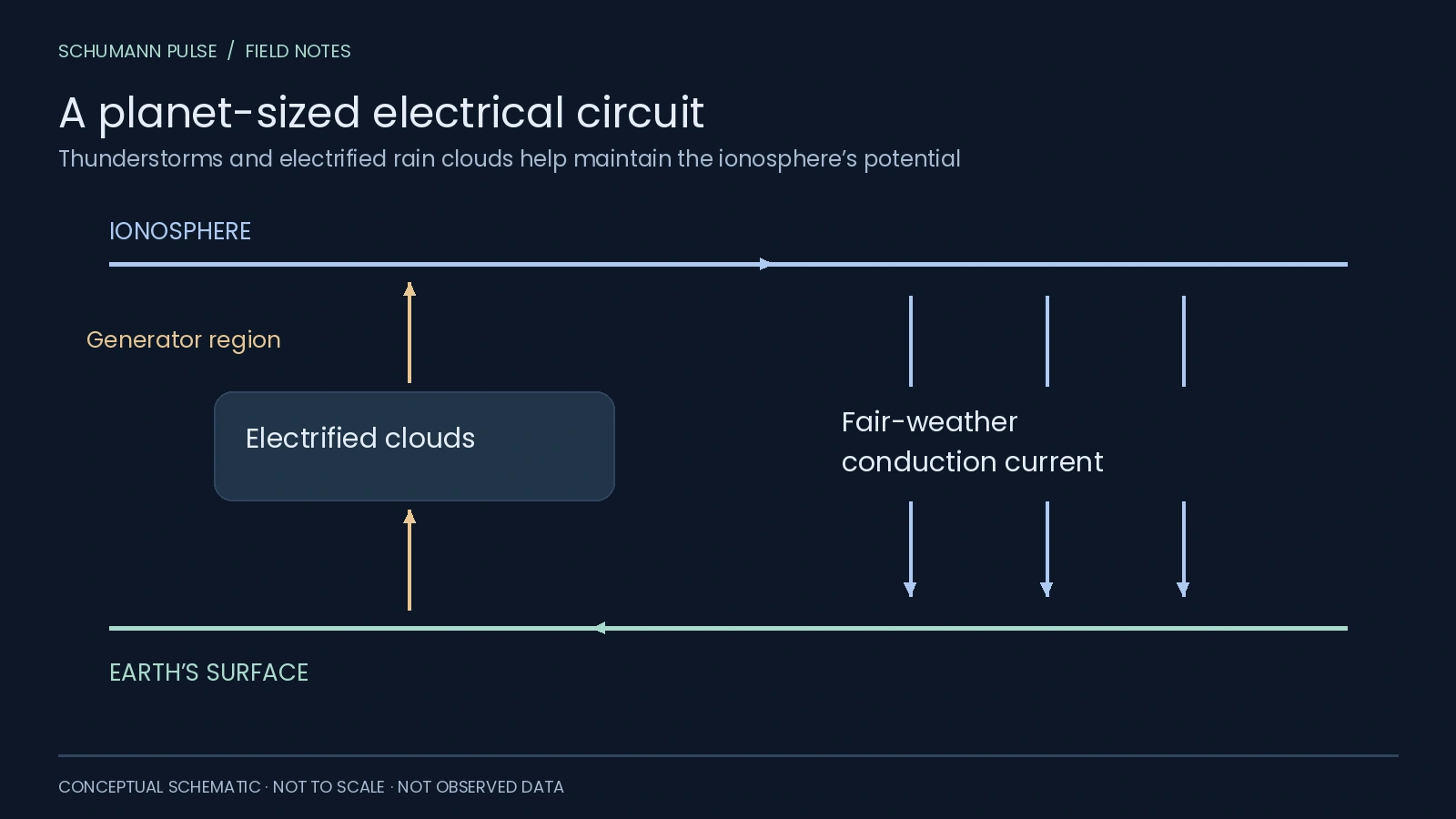
C. T. R. Wilson helped develop the idea that thunderstorms and fair-weather regions form a global electrical circuit. This slowly varying current system is related to atmospheric electricity but is distinct from the oscillating Schumann resonance modes excited by lightning.
 Open figure at full size ↗
Who was C. T. R. Wilson?
Charles Thomson Rees Wilson is widely remembered for the cloud chamber, which made the tracks of ionizing particles visible through condensation. His interest began with atmospheric phenomena, including the clouds and optical effects he encountered at Ben Nevis in 1894. His later work connected laboratory instruments with questions about electricity in the atmosphere. Historical study from the University of Reading.
In his 1927 Nobel lecture, Wilson described how condensation could make paths of ionizing particles visible and photographable. The connection to atmospheric science is easy to miss when the cloud chamber is presented only as a particle-physics instrument.
The fair-weather puzzle
Electricity is easy to notice during a lightning storm. A more subtle question is what happens under apparently quiet skies. Fair-weather air is not a perfect insulator: ions allow a small conduction current to flow.
The global-circuit model connects generator regions, including thunderstorms and electrified rain clouds, with a return path through fair-weather regions. The ionosphere is generally at a positive electrical potential relative to the ground. In the simplified picture above, conventional current rises through generator regions and returns downward through fair-weather air. NASA-hosted review of atmospheric electrical coupling.
The arrows describe a large-scale electrical balance. They are not a map of every electron, and they do not say that each lightning stroke travels upward through the entire circuit.
What can scientists measure?
Measurements can include the atmospheric electric field, air conductivity and current above electrified clouds. A NASA research report describes 850 aircraft overflights of electrified clouds, combined with satellite lightning information, to estimate contributions to the circuit's daily variation. This is a useful example of bringing several instruments together to investigate a global process. Aircraft-current study.
The method also explains why counting local lightning alone is not a complete measurement of the circuit. Different clouds and regions can contribute differently, and electrical measurements add information that a photograph of a storm cannot supply.
Is the global electric circuit the same as Schumann resonance?
No. The two are related through atmospheric electricity, but they answer different questions.
Swipe or use the arrow keys to see all columns.
| Concept | What it describes | A useful distinction |
|---|---|---|
| Global electric circuit | The large-scale balance of generators, atmospheric conduction and return current | Often discussed through a quasi-steady or DC framework |
| Schumann resonances | Oscillating electromagnetic modes in the Earth–ionosphere cavity | Identified through broad spectral peaks at extremely low frequencies |
“DC” here is an organising approximation, not a claim that the atmosphere never changes. Equally, the presence of oscillations does not turn a whole planet into a simple laboratory component. The Schumann resonance introduction explains the cavity picture separately.
A useful way to read an electrical diagram
Ask what the arrows represent. Current, particle motion, wave propagation and the direction of an electric field are different things. A diagram becomes more informative when it names the quantity it is showing, rather than using the same glowing line for all four.
Sources
- Harrison (2011), Wilson's meteorological interests and cloud chamber.
- Wilson (1927), Nobel lecture.
- Simões and colleagues, NASA-hosted atmospheric-coupling review.
- NASA research record: total current over electrified clouds.
Keep exploring
Make room for your own observations.
Schumann Pulse brings environmental readings and your personal journal into one place. The app is coming soon for iPhone.
Explore the app