
The field guide · Wellbeing & evidence
What is CBT-I for insomnia?
Cognitive behavioral therapy for insomnia is a structured treatment that works on sleep-related habits, thoughts and routines. It is recommended for chronic insomnia in adults. It involves more than relaxation or a list of sleep tips, and it should be adapted to your circumstances.
 Open figure at full size ↗
Why is CBT-I recommended?
The AASM's 2021 guideline [1] gives multicomponent CBT-I a strong recommendation for adult chronic insomnia. This means the treatment combines several approaches; it is not a claim that one breathing exercise or a generic wellness app is equivalent.
The “cognitive” part concerns thoughts about sleep. The “behavioral” part concerns what you do around sleep. Addressing these factors does not mean symptoms are imaginary. It means the treatment has practical targets beyond simply trying harder to become sleepy.
If you first need help deciding what kind of problem to discuss, start with insomnia: what helps, and when to seek care.
What does treatment involve?
The NHLBI treatment overview [2] describes several components:
Swipe or use the arrow keys to see all columns.
| Component | Plain-language purpose |
|---|---|
| Work on sleep-related thoughts | Reduce the worry surrounding wakefulness and expectations about sleep. |
| Stimulus control | Rebuild a connection between bed and sleep rather than prolonged wakefulness. |
| Adjusting time in bed | Use an individually planned sleep window, reviewed and changed as treatment progresses. |
| Relaxation | Learn ways to settle rather than escalating the effort to fall asleep. |
| Sleep education | Understand routines and conditions that support the wider treatment. |
The overview describes a typical course of six to eight weeks, with in-person, telephone or online delivery. The timetable is not a promised deadline for recovery. Ask a provider what the sessions, between-session practice and follow-up actually include.
How is it different from sleep hygiene?
Sleep hygiene covers general habits: the room, substances and routine around bedtime. CBT-I is a structured treatment rather than a bedroom checklist. The AASM guideline does not recommend sleep hygiene as the only treatment for chronic insomnia.
For example, “make the bedroom quieter” changes a condition. Reviewing a diary with a provider to understand a recurring sleep pattern is a different activity. A person can already have a comfortable bedroom and still need insomnia care.
Is sleep restriction something to try on my own?
Do not interpret “sleep restriction” as a challenge to sleep as little as possible. The term refers to a planned treatment component, not an arbitrary short night or a schedule calculated from a single bad night.
The AASM provider factsheet on brief behavioral treatment [3] highlights risks for conditions including bipolar disorder and seizures. Discuss medical history, daytime sleepiness, driving and safety-sensitive work before changing your time in bed. This guide does not prescribe a sleep window.
Can CBT-I be combined with medication?
Sometimes. A 2026 AASM guideline [4] examined starting CBT-I and insomnia medication together. It conditionally favors the combination over medication alone, but does not favor routinely adding medication over CBT-I alone. Both recommendations have low certainty of evidence.
The guideline also allows for individual priorities: a person who values increased sleep time early in treatment may reasonably choose a combination after discussion. This is a decision with a clinician, not a universal rule to avoid all medicine or to add a sleeping pill automatically.
If you already take medication, bring the details to the appointment. This article is not an instruction to taper, stop or replace it.
What can I prepare before an appointment?
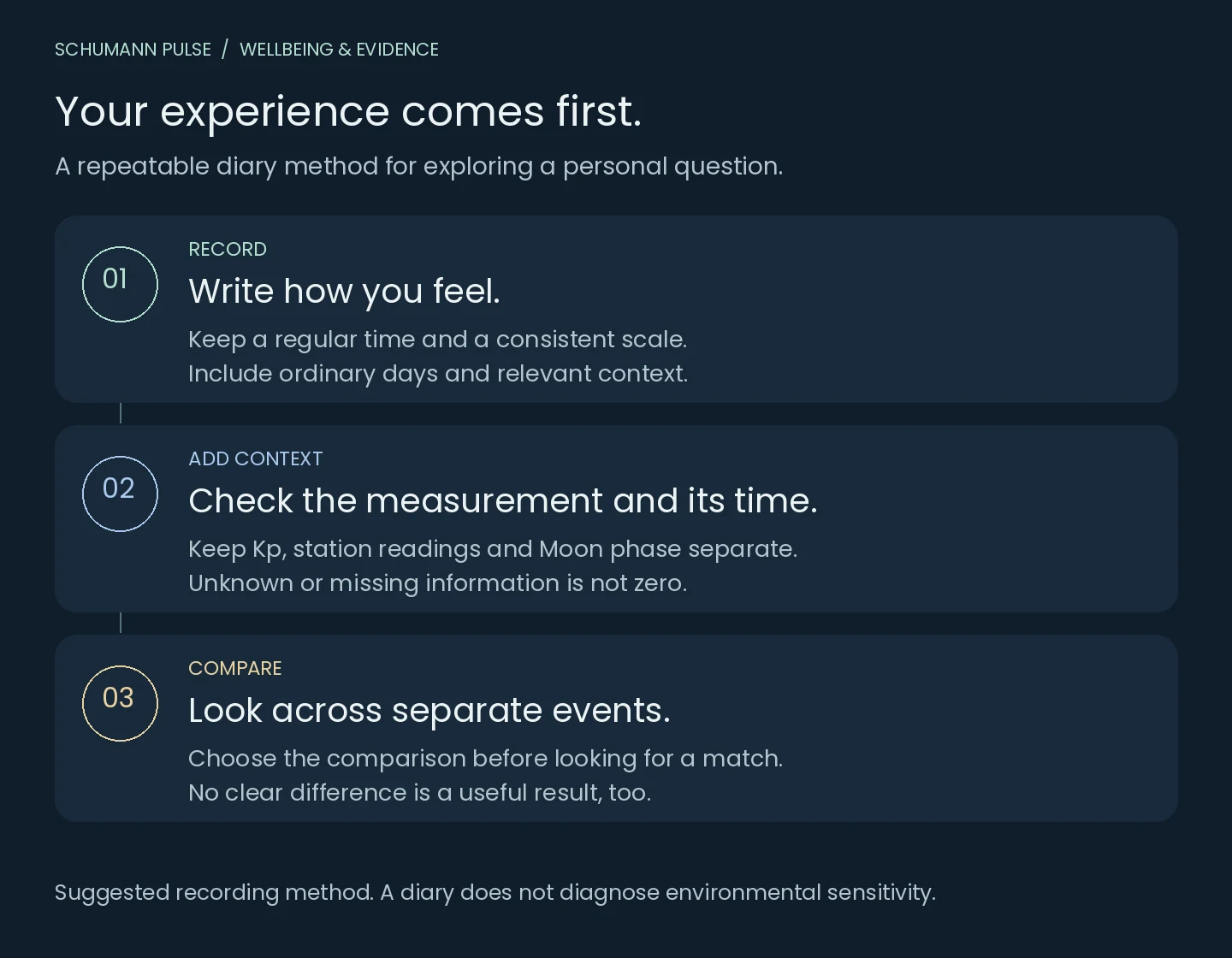
Write down your main difficulty and how it affects the next day. List current medicines and supplements, work hours, recent schedule changes and previous attempts to improve sleep. A simple sleep diary can make the conversation more concrete; an incomplete record is still preferable to invented precision.
Useful questions include: Is this insomnia or another sleep problem? Who will review my progress? Is the proposed program specifically CBT-I? How will it account for my health history and work schedule? What happens if it does not help enough?
These are suggested appointment questions, not a clinical eligibility checklist. Treatment availability and referral routes depend on where you live.
Does Schumann Pulse provide CBT-I?
No. Schumann Pulse is an environmental-observation and personal-journal app, not an insomnia treatment program. Its journal can preserve observations for personal exploration; environmental comparisons do not diagnose a disorder or deliver CBT-I.
The Moon, Kp index and Schumann station values cannot decide whether CBT-I or medication is right for someone. You can read our lunar sleep research guide without using a phase calendar as a care plan.
Sources
References in the text lead here. Original publications open in a new tab; this guide stays open.
- Edinger et al. (2021), [1] AASM behavioral and psychological treatment guideline (opens in a new tab) Back to text ↑, recommendation strength and sleep-hygiene distinction.
- [2] NHLBI: insomnia treatment (opens in a new tab) Back to text ↑, components and delivery formats.
- [3] AASM: brief behavioral treatment provider factsheet (opens in a new tab) Back to text ↑, 2025; cautions about sleep restriction.
- [4] AASM combination-treatment guideline (opens in a new tab) Back to text ↑, 2026; conditional recommendations with low-certainty evidence.
An editorial explanation of selected guidance for adults, not an individual treatment plan or clinical review. Our health evidence standards.
Keep exploring
Make room for your own observations.
Schumann Pulse brings environmental readings and your personal journal into one place. The app is coming soon for iPhone.
Explore the app