
The field guide · Wellbeing & evidence
How to track mood and environmental patterns
Record how you feel on ordinary days as well as difficult ones, before checking environmental charts. Choose one comparison in advance, keep the timestamps clear and look for repetition across separate events. A diary can reveal an association worth investigating; it cannot prove that the Moon, a storm or Schumann resonance caused it.
Start with a question you can actually compare
“Am I sensitive to everything in the sky?” combines too many questions. Try one descriptive comparison instead: “Are my recorded feelings different on geomagnetically active days?” or “Does my sleep timing differ around a predefined lunar phase window?”
These are our suggested recording practices for personal exploration, not a validated diagnostic protocol. A useful result might be a repeatable difference, an inconsistent pattern or no clear difference. Set up the diary so all three answers are possible.
Record your experience first
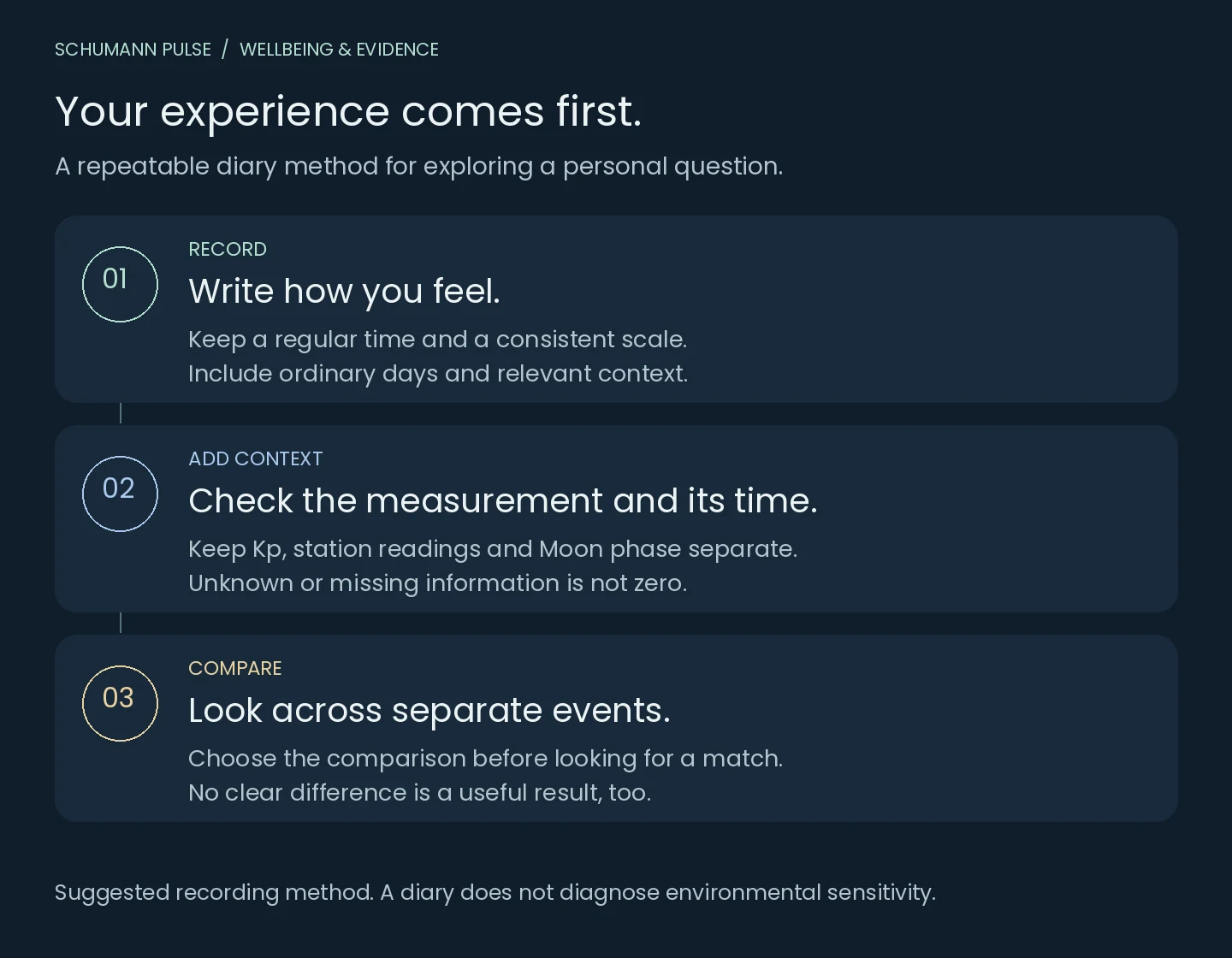
Choose a regular time that fits your routine. Write your feeling before opening a storm alert or a lunar calendar when practical. Keep the scale consistent and record optional details separately rather than forcing everything into one score.
Swipe or use the arrow keys to see all columns.
| Record | Why it matters |
|---|---|
| Date, local time and time zone | Allows a fair comparison with environmental records that may use UTC |
| Overall feeling and optional mood | Keeps the person's report separate from an environmental index |
| Energy, focus or specific symptoms | Different outcomes can change in different ways |
| A short context note | Helps preserve sleep, travel, illness or routine changes that a chart cannot explain |
| An ordinary day with no symptom | Provides the comparison that a symptom-only diary lacks |
Do not fill a missed day with “fine” or zero. Missing information is unknown. If you enter something later from memory, note that it is retrospective.
 Open figure at full size ↗
For sleep specifically, use the sleep diary guide and blank template, which separates a night’s timing from the date on an environmental chart.
Keep environmental measurements separate
Use the Kp index for a defined geomagnetic question, a named station's measurement for a Schumann resonance question, and calculated Moon phase for a lunar question. These quantities are not interchangeable.
Check the timestamp and quality. A delayed reading is not the current environment; a gap is not zero; a local station amplitude is not a personal exposure measurement. Several measurements on one day do not automatically provide several independent comparisons with a single diary entry.
Decide the comparison before searching for a match
Write down the time window you intend to use. If you later explore a one-day delay or a different threshold, label it as a new exploratory question. Test that question against future observations rather than presenting the same data that suggested it as confirmation.
Why be this careful? In a 2020 HRV study [1], most apparent geomagnetic relationships disappeared after researchers accounted for dependence between neighboring observations. That statistical issue can also arise when a personal diary contains many entries from the same prolonged event.
Comparing many symptoms, several environmental signals and numerous time delays creates many chances to find a coincidental match. Keep the first question small and resist selecting only the graph that looks persuasive.
How much history is enough?
There is no universal diary duration that proves environmental sensitivity. You need observations on both sides of a comparison and repeated, separate events. A week around one full Moon is not seven independent full Moons. Three days within one storm are not three separate storms.
More entries help only if they answer the same question consistently. If every active day also coincides with night shifts, your diary may not distinguish the two. Report that limitation instead of manufacturing certainty from a larger entry count.
How Schumann Pulse handles the idea
The app's check-in starts with a feeling and offers optional energy, mood, focus, symptoms and a note. Environmental context accompanies the journal; it does not choose your answer. Personal comparisons require enough suitable history, and some deeper history and comparisons depend on Pro access.
Entries prompted by a Schumann spike alert remain in the journal but are excluded from the app's ordinary comparison analysis. This reduces one source of selective sampling: answering specifically because an event drew attention. It does not remove all bias or turn the remaining results into proof of cause.
The app may show that there is no clear difference so far. That is useful information. See app availability; the journal is not a clinical sensitivity test, and the website does not ask you to submit health records.
What to do with an apparent pattern
Keep the dates and context, describe the result as an association, and see whether it persists in later observations. Do not change treatment or delay care based on a calendar or chart. A clinician can use a well-kept symptom history even when the environmental explanation remains uncertain.
For the underlying research, explore space weather and health, full Moon and sleep and Schumann resonance and health.
A relationship is not an explanation
A correlation can help frame a question, but does not identify its cause. Keep the original observations, the comparison rule and alternative explanations together.
Sources
References in the text lead here. Original publications open in a new tab; this guide stays open.
- Mattoni et al. (2020), [1] Exploring the relationship between geomagnetic activity and human heart rate variability (opens in a new tab) Back to text ↑, European Journal of Applied Physiology; time-series dependence and multiple-comparison limitations.
- [2] NHS: Headaches (opens in a new tab), use of a symptom diary.
- Schumann Pulse's product descriptions here reflect the implemented check-in fields and comparison rules reviewed on 21 October 2026. These are product features, not externally validated clinical outcomes.
See our health evidence standards for the scope of editorial review.
A little context
Correlation
A statistical relationship between variables. A pattern alone does not show that one caused the other; timing, chance and other factors need consideration.
Keep exploring
Make room for your own observations.
Schumann Pulse brings environmental readings and your personal journal into one place. The app is coming soon for iPhone.
Explore the app