
The field guide · Moon
Lunar days and Moon age: which clock are you reading?
Moon age usually means elapsed days since the preceding astronomical new Moon. A numbered lunar calendar day depends on that calendar’s rules. A tithi uses an angular Sun–Moon interval. These are different ways of measuring time, not interchangeable daily health forecasts.
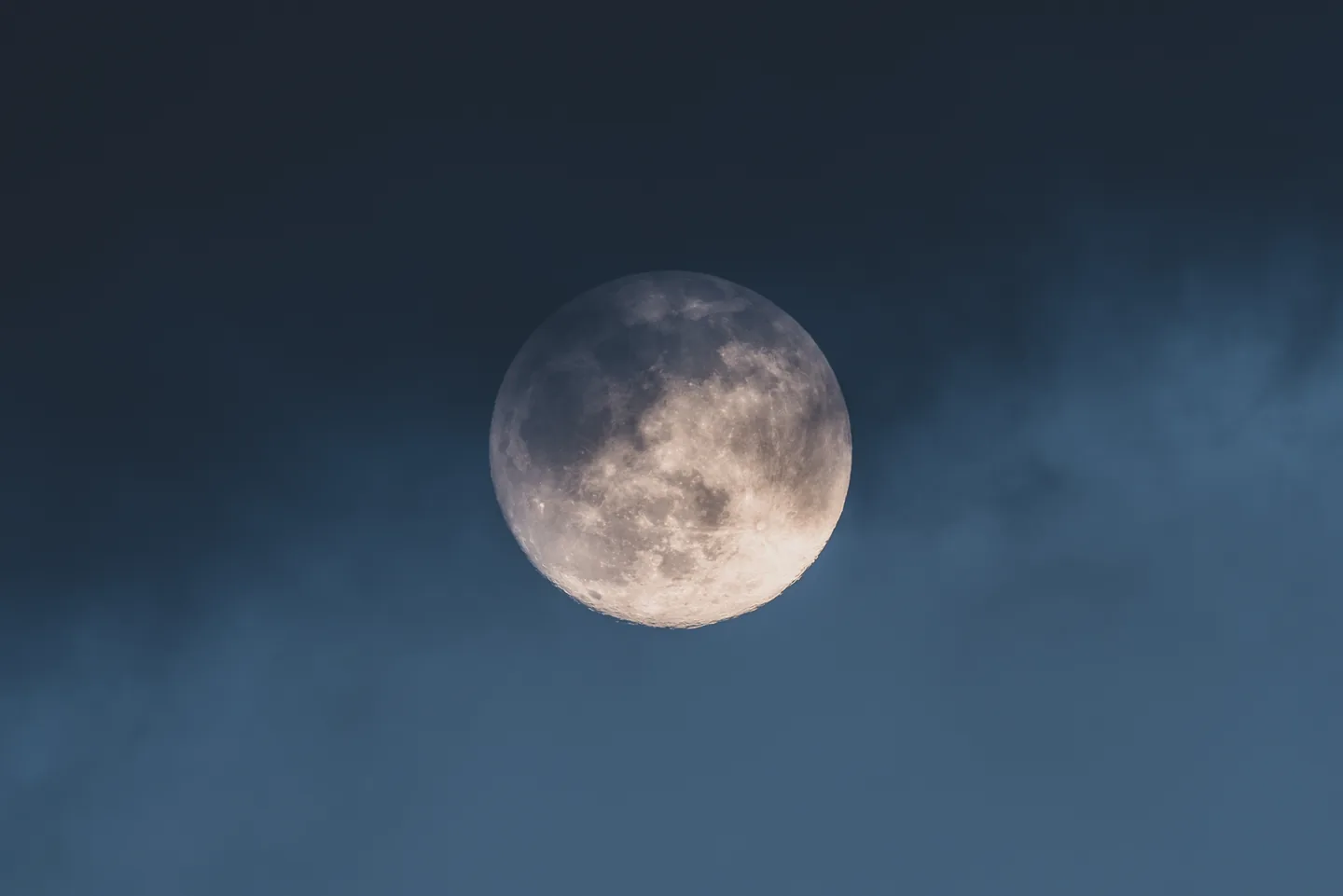
See today’s Moon phase and the monthly calendar, with local event times and a hemisphere view.
What is the Moon’s age today?
Lunar age counts elapsed time from new Moon. At that reference instant, age is zero; one day later it is one day. The US Naval Observatory [1] distinguishes age from the named phases. To calculate an actual value, you need the current timestamp and the preceding new-Moon time in a consistent time system.
This page explains the method; it does not display a live calculation. A rounded diagram should not be presented as today’s precise lunar age.
A phase cycle is not exactly thirty days
The synodic month averages about 29.53 days. A simplified evenly advancing cycle puts first quarter near age 7.4, full Moon near 14.8 and third quarter near 22.1 days. These are teaching landmarks, not fixed dates in every lunation. NASA’s phase guide [2].
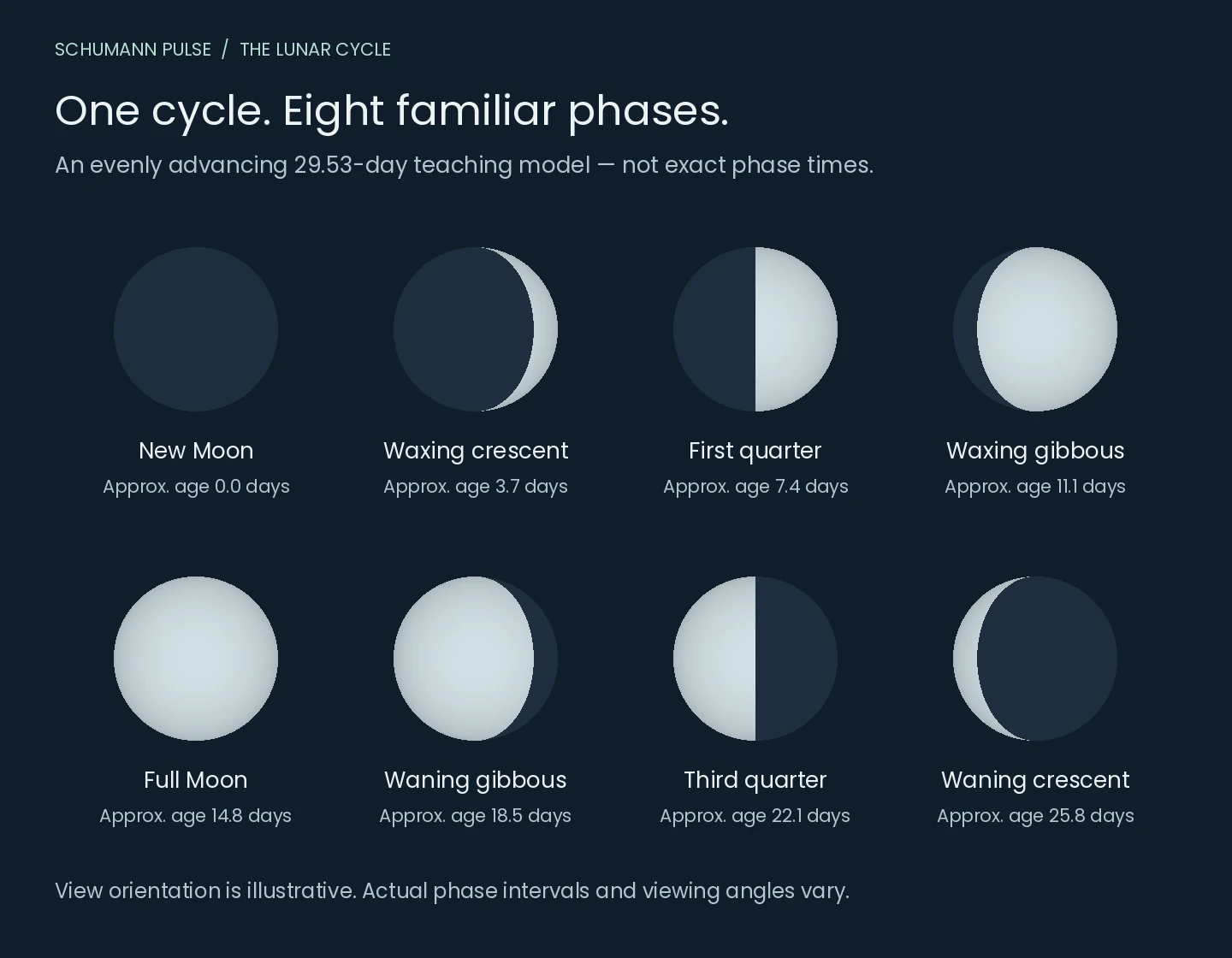 Open figure at full size ↗
Swipe or use the arrow keys to see all columns.
| Label you see | What you need to know |
|---|---|
| Age 0.0 days | The chosen astronomical new-Moon reference |
| Lunar day 1 | Which calendar defines the start of its first day |
| Day 15 | Whether this means a numbered date, elapsed age or a tithi |
| Day 30 | Whether that calendar’s month contains a thirtieth day |
| Full Moon | The calculated phase time, not merely a day number |
What is a tithi?
India’s Positional Astronomy Centre defines a tithi by successive 12-degree steps in the Moon’s longitude relative to the Sun. Thirty such intervals span a complete 360-degree cycle. Because the relative angular speed varies, a tithi is not a fixed midnight-to-midnight, 24-hour unit. The official Rashtriya Panchang specifies how its entries are reported. Positional Astronomy Centre explanation [3].
This is why taking an elapsed age, rounding it to a whole day and labelling it “tithi” is not an adequate calculation. Use the calendar’s stated convention and the location/time references it requires.
Do individual lunar nights have names?
Some calendars do. Māori maramataka offers an example in which named nights connect timekeeping with observations of the local environment. Names and practices vary by iwi and hapū. Explore our source-specific examples, rather than assuming a worldwide list of thirty names.
Monthly names such as Wolf Moon or Strawberry Moon answer another question: which full Moon in the year? Our monthly name guide keeps those separate.
How should I record a lunar day in a journal?
Keep the ordinary local date and time first. Then add the field exactly as supplied: “age 6.2 days”, “waxing crescent”, or a calendar name with its tradition and source. Do not silently translate one into another.
For example, a useful note might read “21:00 local; waxing crescent; evening walk; felt restless”. The restlessness is your observation, not a property assigned to that lunar day. An automatically generated “day 8 means anxiety” label would replace observation with an untested prediction.
If your aim is to explore patterns, our personal tracking guide explains how to record ordinary days as carefully as memorable ones.
Sources
References in the text lead here. Original publications open in a new tab; this guide stays open.
- [1] US Naval Observatory: Moon age and phase definitions (opens in a new tab) Back to text ↑.
- [2] NASA Science: the lunar phase cycle (opens in a new tab) Back to text ↑.
- [3] India Meteorological Department, Positional Astronomy Centre: Rashtriya Panchang explanation (opens in a new tab) Back to text ↑.
- [4] Te Papa: named nights in maramataka (opens in a new tab).
A little context
Lunar age
Elapsed time since the preceding astronomical new Moon, usually expressed in days. Age zero and a calendar’s “day one” are different conventions.
A little context
Synodic month
The cycle from one new Moon to the next: about 29.53 days on average. Individual cycles vary, so a fixed interval is not an exact phase forecast.
A little context
Maramataka
Māori systems for organizing time through the Moon and environmental observations. Names and practices vary by iwi, hapū and place; one published sequence is not a universal calendar.
Read the full explanationKeep exploring
Make room for your own observations.
Schumann Pulse brings environmental readings and your personal journal into one place. The app is coming soon for iPhone.
Explore the app