
The field guide · Moon
What makes a supermoon “super”?
A supermoon is a popular name for a full Moon occurring near its closest approach to Earth. It can look somewhat larger and brighter than a more distant full Moon. The term has no single official astronomical threshold.
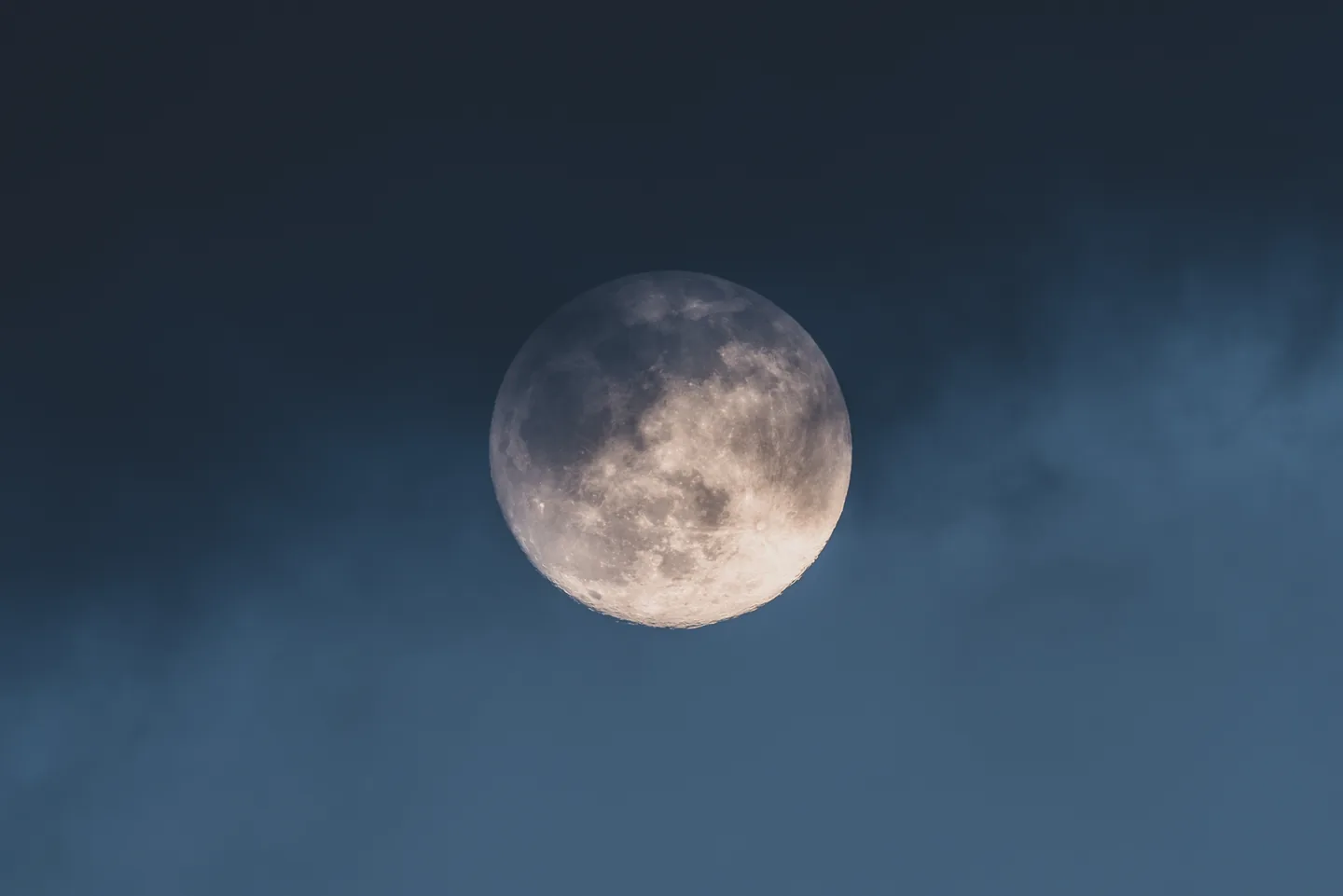
The distance changes, not the Moon itself
The Moon’s orbit is not a perfect circle. Its nearest point is perigee; its farthest is apogee. A full Moon near the closer part of the orbit is commonly called a supermoon. The distances of those orbital extremes also vary. NASA’s supermoon guide [1].
The Moon has not physically expanded. It occupies a somewhat larger angle in our view because it is closer. “Supermoon” is useful popular shorthand, but a precise comparison needs the event time and distance rather than the label alone.
What does “14% bigger” compare?
NASA describes an upper comparison of about 14% greater apparent diameter and 30% greater brightness against a full Moon near its farthest distance. Those figures are not a guarantee that every advertised supermoon will be 14% larger than the full Moon you saw last month.
Always ask for the baseline. “Larger than a particularly distant full Moon” and “larger than an average full Moon” are different claims. A cropped photograph without a fixed scale cannot settle the comparison.
Why does it look enormous near the horizon?
That is a separate effect: the Moon illusion. The Moon can seem surprisingly large beside buildings or a landscape even when its measured angular size is not unusually large. NASA’s Moon illusion explanation [2] discusses why the experience and the camera measurement differ.
An original observation exercise: photograph the Moon near the horizon and again later using the same camera, lens and zoom. Keep the original files and avoid cropping either image. Compare the disk’s pixel diameter, then compare how large it felt to you in each setting. This explores perception; it is not a precision orbital measurement.
How to read a supermoon announcement
Swipe or use the arrow keys to see all columns.
| Check | Why it helps |
|---|---|
| Full Moon time and time zone | Identifies the event behind “tonight” |
| Definition or distance criterion | Explains why a source uses the label |
| Comparison baseline | Makes size or brightness percentages meaningful |
| Local viewing conditions | Separates an astronomical event from a chance to see it |
| Photograph caption | Distinguishes a documentary image from illustrative artwork |
Is a supermoon also a Blue Moon?
Only if it independently meets a Blue Moon calendar definition. If a total eclipse occurs as well, headlines may add Blood Moon. These are overlapping descriptions, not a scale of personal “lunar energy”.
A name is not evidence of a health effect. If you are trying to understand an unsettled night, our sleep evidence guide and practical insomnia article address that question directly.
Sources
References in the text lead here. Original publications open in a new tab; this guide stays open.
- [1] NASA Science: supermoons, perigee, apogee and the size comparison (opens in a new tab) Back to text ↑.
- [2] NASA Science: why the Moon can look large near the horizon (opens in a new tab) Back to text ↑.
- [3] NASA: overlapping supermoon and Blue Moon labels (opens in a new tab).
A little context
Perigee
The closest point to Earth in the Moon’s orbit. A full Moon near perigee is often called a supermoon; the distance varies between orbits.
A little context
Apogee
The farthest point from Earth in the Moon’s orbit. It describes distance, not the Moon’s phase.
Keep exploring
Make room for your own observations.
Schumann Pulse brings environmental readings and your personal journal into one place. The app is coming soon for iPhone.
Explore the app