
The field guide · Moon
The Moon across hemispheres: same phase, different view.
People across Earth share essentially the same lunar phase at the same instant, but see it from different orientations. The Moon may appear rotated, the local date may differ, and the seasons are opposite between the Northern and Southern Hemispheres.
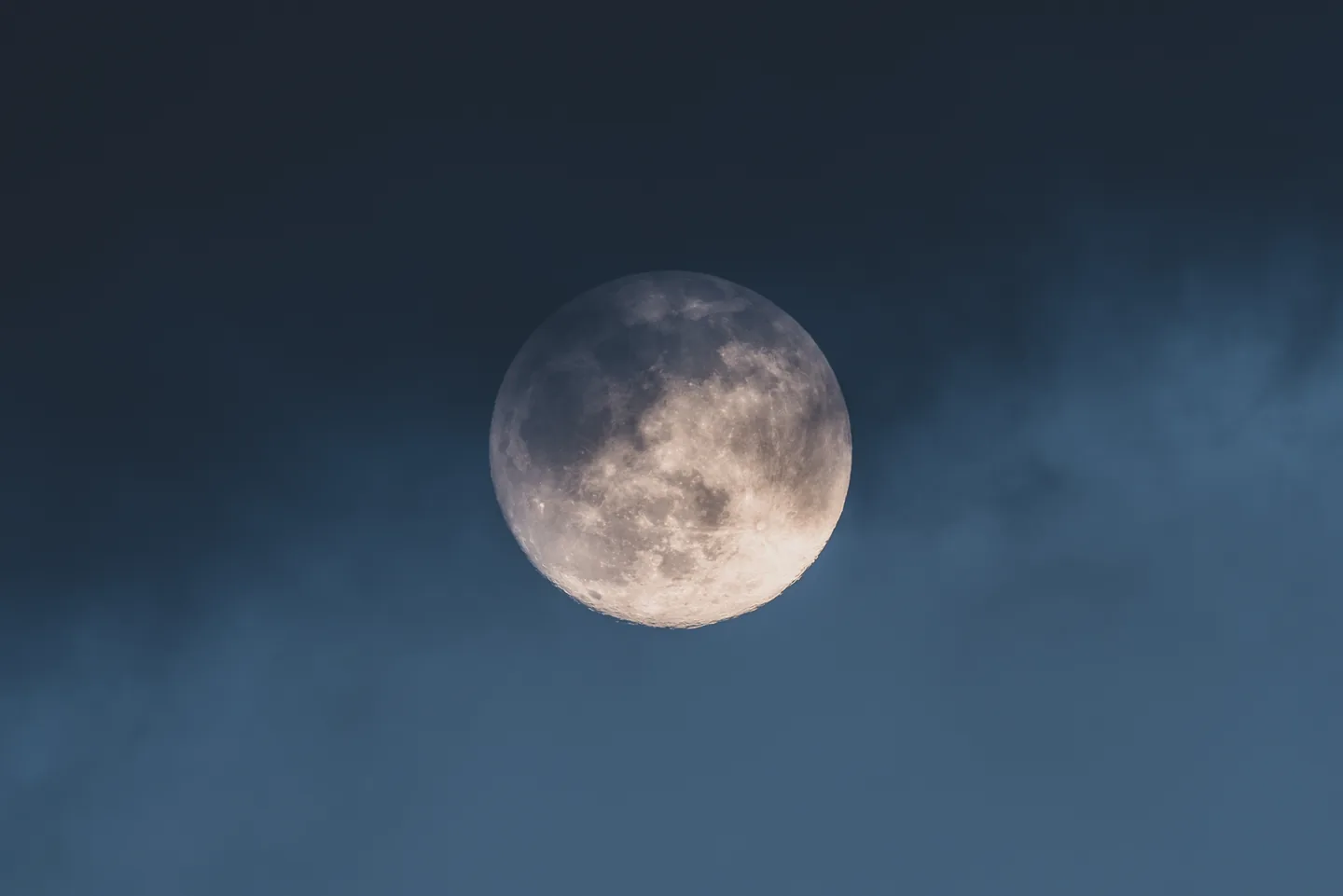
See today’s Moon phase and the monthly calendar, with local event times and a hemisphere view.
Does Australia see a different Moon phase?
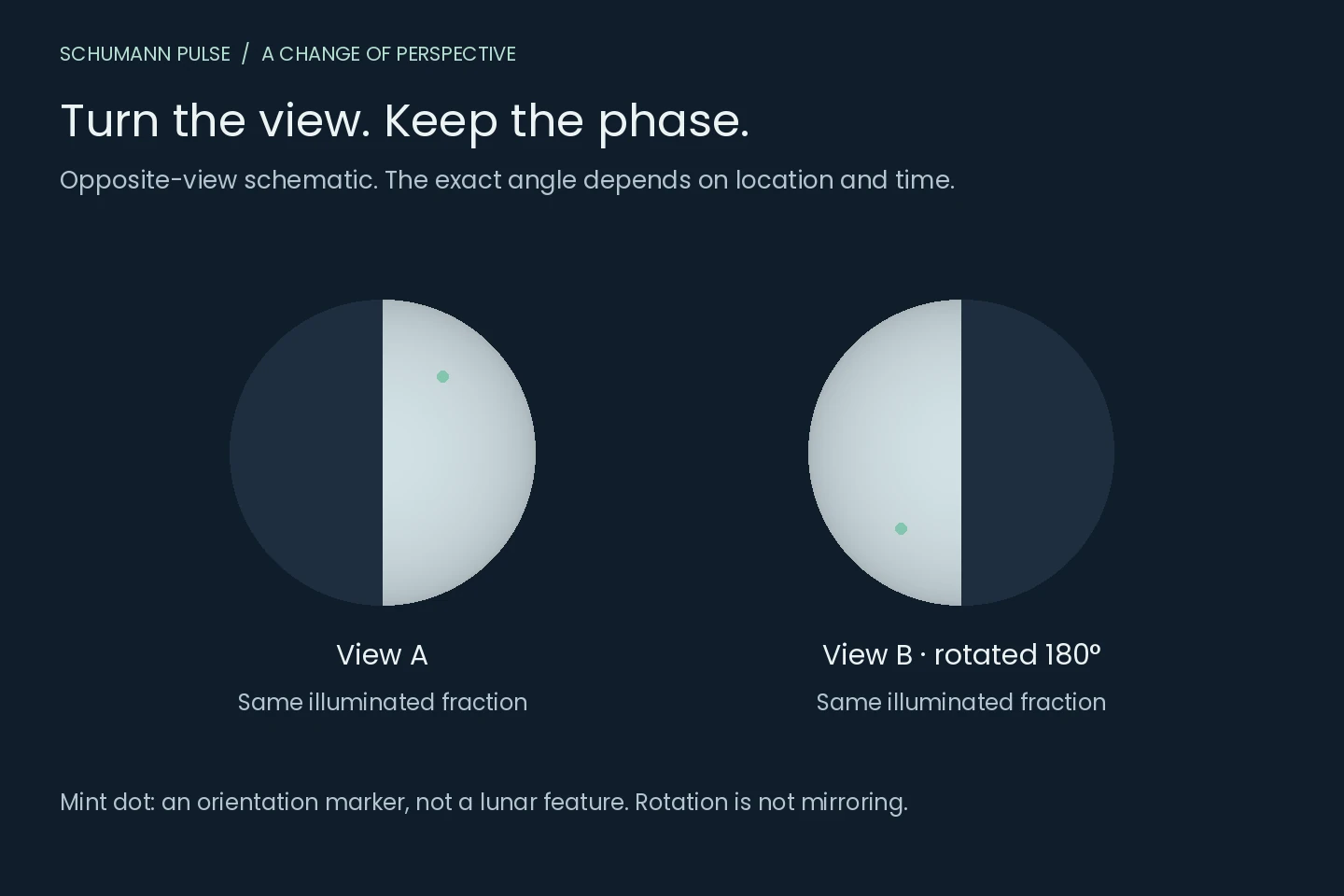
No. Changing your latitude does not turn a waxing Moon into a waning one. NASA’s Moon questions [1] explains that observers share the phase but look from different directions. Views from opposite hemispheres can appear upside down relative to each other.
This is a rotation of the view, not a different lunar hemisphere suddenly coming into sight. The exact angle depends on the observing location and time; “always rotate every photograph by 180 degrees” would be too rigid a rule.
 Open figure at full size ↗
Which side of the Moon should be illuminated?
“Right side bright means waxing” is a useful shortcut only for a particular viewing orientation. A photograph may also have been rotated after capture. Use the phase label and whether the illuminated fraction is growing or shrinking instead of assigning a universal left/right rule.
Try this with the diagram: turn the same image upside down. Its bright area moves across your page, but the amount of illumination is unchanged. The drawing demonstrates rotation only; it does not calculate tonight’s sky for a location.
Why June means different seasons
Earth’s axial tilt produces opposite seasonal timing across the hemispheres. Around June, northern summer coincides with southern winter; around December, the relationship reverses. The cause is Earth’s orientation toward the Sun, not a special seasonal Moon. NASA’s explanation of seasons [2].
Swipe or use the arrow keys to see all columns.
| Part of the year | Northern Hemisphere | Southern Hemisphere |
|---|---|---|
| Around March equinox | Spring begins astronomically | Autumn begins astronomically |
| Around June solstice | Summer begins astronomically | Winter begins astronomically |
| Around September equinox | Autumn begins astronomically | Spring begins astronomically |
| Around December solstice | Winter begins astronomically | Summer begins astronomically |
These are astronomical season boundaries, not a promise about local rainfall or temperature. Tropical and local seasonal descriptions may follow different patterns.
Do full Moon names change when you travel?
The familiar monthly names often refer to northern seasonal cues. You may still encounter “Cold Moon” in a December headline while experiencing summer. The name has travelled; the season has not.
When choosing a calendar, ask whether it uses imported English names or a specifically documented local tradition. For one example of named nights grounded in place, explore Māori maramataka.
Why do two calendars show different full Moon dates?
An astronomical event can fall before midnight in one time zone and after midnight in another. A useful comparison therefore records the exact phase time, its time zone and your location. Seeing different civil dates does not automatically mean either calendar has calculated a different phase.
For a viewing plan, add local moonrise, moonset and weather. For a journal, keep your own local date and time consistently. A seasonal name alone cannot align a diary entry with an astronomical event.
Sources
References in the text lead here. Original publications open in a new tab; this guide stays open.
- [1] NASA: Moon phase and appearance from different places on Earth (opens in a new tab) Back to text ↑.
- [2] NASA Space Place: Earth’s tilt and the seasons (opens in a new tab) Back to text ↑.
- [3] US Naval Observatory: day and night at the equinoxes (opens in a new tab).
- [4] US Naval Observatory: astronomical definitions of Moon phases (opens in a new tab).
A little context
Waxing
The visible illuminated fraction of the Moon is increasing toward full Moon. Which side looks bright depends on the viewing orientation.
Read the full explanationA little context
Waning
The visible illuminated fraction of the Moon is decreasing after full Moon, toward the next new Moon.
Read the full explanationKeep exploring
Make room for your own observations.
Schumann Pulse brings environmental readings and your personal journal into one place. The app is coming soon for iPhone.
Explore the app