
The field guide · Wellbeing & evidence
How to keep a useful sleep diary
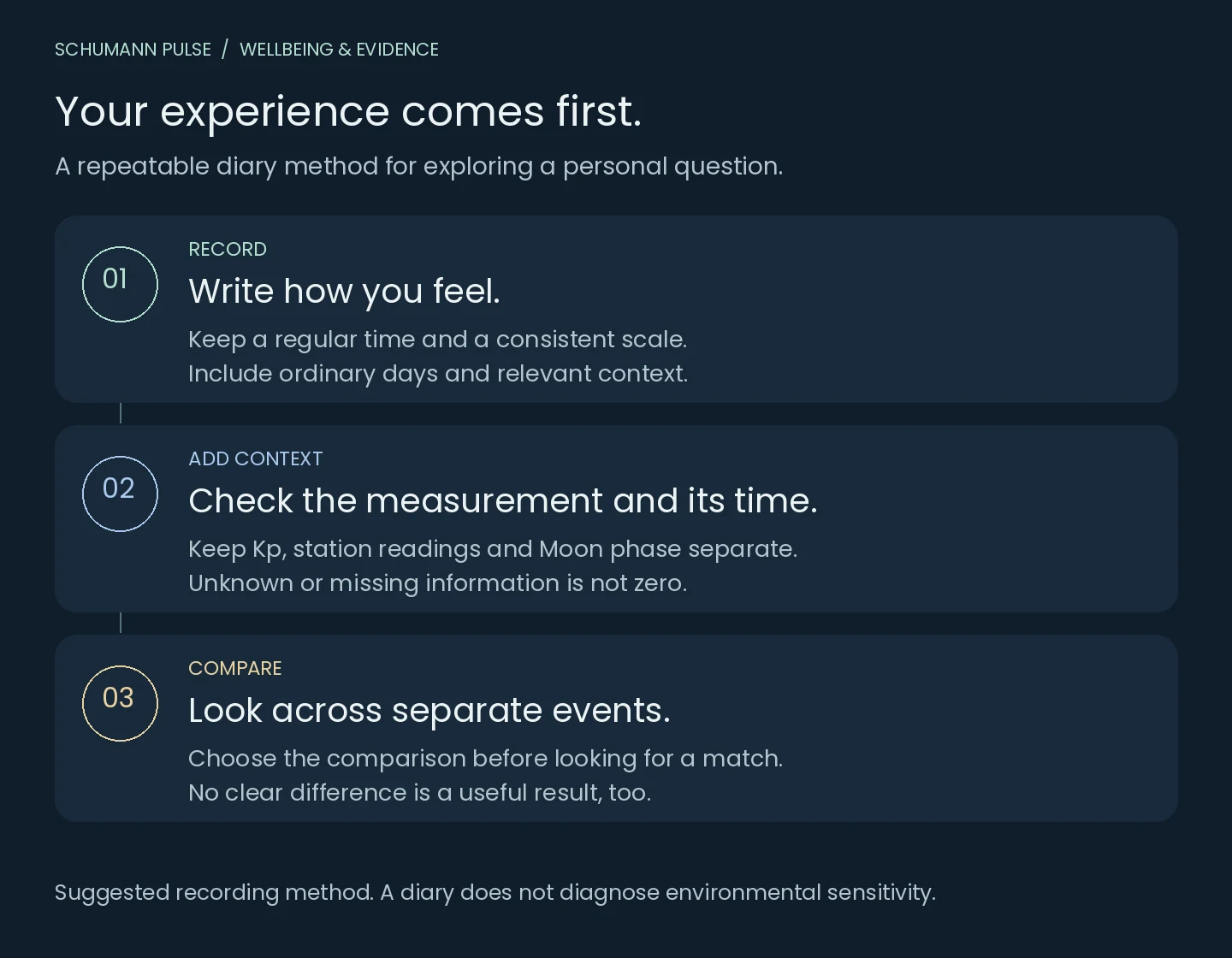
Write a brief record after waking: when you tried to sleep, your approximate sleep and waking times, and how you feel. Keep estimates honest and include ordinary nights. A diary can support a clinical conversation or personal exploration; it cannot prove that a lunar phase or magnetic storm caused insomnia.
 Open figure at full size ↗
What is a sleep diary for?
A sleep diary is a record of experience over time. It can help you explain a recurring problem without relying on whichever night was most memorable. The NHLBI sleep-diary resource [1] highlights sleep amount and quality, daytime sleepiness and habits such as caffeine, alcohol and medicines.
For an appointment, NHLBI suggests one to two weeks of records [2]. That is preparation for a conversation, not a diagnostic minimum or a reason to postpone help. Studying a possible lunar pattern is a different task: one or two weeks do not cover several lunar cycles.
A simple morning record
The layout below is our own lightweight recording aid. It is not a reproduction of a clinical questionnaire, a validated score or a treatment program. Use your provider's form if they have given you one.
Swipe or use the arrow keys to see all columns.
| Field | What to write |
|---|---|
| Wake date and time zone | The date you woke after the main sleep period; keep the time zone explicit. |
| Tried to sleep | Approximate local time you settled down to sleep. |
| Time to fall asleep | Your best estimate in minutes, or “unknown.” |
| Awake during the night | Approximate total awake time after first falling asleep. |
| Final wake and out-of-bed times | Record separately when different. |
| How you feel | A short description of restfulness and daytime sleepiness. |
| Context | Naps, caffeine/alcohol timing, medicines as taken, work changes, pain or illness if relevant. |
Record what you know. If you remember being awake but cannot estimate how long, write “unknown.” Do not turn a blank into zero minutes of wakefulness. Avoid watching the clock repeatedly just to make a record look exact; this template does not need minute-perfect measurements.
Get the blank two-week template
A small morning ritual
Fourteen rows. Your own observations.
Download an original blank CSV to open in a spreadsheet, or copy the fields above into a notebook. It has no scores, formulas or sample personal results.
Download the blank sleep diary ↓No account required. The website does not receive entries you add to the downloaded file. Keep or share the file under your own control.
If you fill it in using a cloud spreadsheet, that service's storage and sharing settings apply. The file is independent of the Schumann Pulse app and does not automatically import into its journal.
Which date belongs to a night?
Choose a convention and write it down. Our template uses the wake date. A sleep period beginning on Monday evening and ending on Tuesday morning belongs to Tuesday's row. This is an organizing choice, not a scientific rule.
For night shifts or split sleep, describe the actual period rather than forcing it into a conventional nighttime schedule. Add a row for an extra sleep period if needed. For travel, retain the local date, time and time zone; an environmental chart may use UTC instead.
This avoids a simple comparison error: matching a Tuesday morning sleep report to Tuesday evening's magnetic activity, which had not happened when you slept.
How do I compare sleep with the Moon or storms?
First record sleep without choosing the answer from a chart. Then add environmental context separately. Decide in advance which sleep outcome and time window you want to compare. For example, sleep timing and how rested you feel are different questions.
Keep ordinary nights as well as difficult ones. Keep missing entries visible. Do not change the definition of “around full Moon” until the graph looks persuasive. If you explore a different definition later, label it as a new exploratory comparison.
These are our suggested practices for reducing selective recording, not a validated test of environmental sensitivity. Several dates within one storm are not independent storms. Several nights near one full Moon are not independent lunar cycles. See how to track mood and environmental patterns for the limits of personal comparisons.
What should I look for in the record?
Start with descriptions: changing bedtimes, repeated waking, work-night differences or missing entries. “These three nights followed late shifts” describes the record. “A storm caused my insomnia” goes beyond what the record alone can establish.
A diary does not need to find a cosmic pattern to be useful. It may show inconsistency, no apparent relationship or a practical topic to discuss with a clinician. For care options, read what helps with insomnia and what CBT-I involves.
If tracking itself becomes a burden, simplify the record and discuss that with your clinician. Do not delay care until you have assembled a perfect dataset.
Sources
References in the text lead here. Original publications open in a new tab; this guide stays open.
- [1] NHLBI: sleep diary (opens in a new tab) Back to text ↑, the purpose of recording sleep and daytime context. Our downloadable file is an original, non-validated layout.
- [2] NHLBI: insomnia diagnosis (opens in a new tab) Back to text ↑, diary use before assessment.
Date conventions, the blank file and the environmental-comparison suggestions are Schumann Pulse's editorial tools, not clinically validated instructions. Our health evidence standards.
Keep exploring
Make room for your own observations.
Schumann Pulse brings environmental readings and your personal journal into one place. The app is coming soon for iPhone.
Explore the app