
The field guide · Wellbeing & evidence
Can space weather affect your health?
Space weather has established effects on technology and can create radiation risks in space or at high altitude. For everyday symptoms at ground level, research does not provide a validated way to diagnose “solar storm sensitivity.” A magnetic index can describe the environment; it cannot explain your health on its own.

Solar flares, magnetic storms and radiation are not the same
“Solar storm” is often used for several events. A solar flare is a burst of radiation from the Sun. Energetic particles are another space-weather hazard. A geomagnetic storm is a disturbance of Earth's magnetic environment. Their measurements and effects are different; our space weather guide explains the sequence.
The US Geological Survey [1] states that Earth's magnetic field does not directly affect human health. It distinguishes radiation risks for high-altitude pilots and astronauts from the magnetic field itself. Disruption of power or communications can also affect people indirectly.
That official guidance is different from a claim that all biological questions have been settled. Researchers continue to investigate possible associations. The question is whether those studies justify a symptom explanation or a personal prediction; the evidence below does not supply such a rule.
What research on the body can tell us
Heart rate variability, or HRV, describes variation in the intervals between heartbeats. It is one outcome used in this literature, not a measurement of “magnetic sensitivity.”
A 2018 observational study [3] followed 16 participants with repeated HRV recordings over five months and reported relationships with solar and geomagnetic variables. It did not randomly assign storms or test whether a forecast could diagnose symptoms.
A 2020 study by Mattoni and colleagues [4] highlights a statistical problem: after accounting for dependence between neighboring observations, most apparent relationships disappeared and the remaining correlations were very small. Its authors also cautioned about testing many possible comparisons.
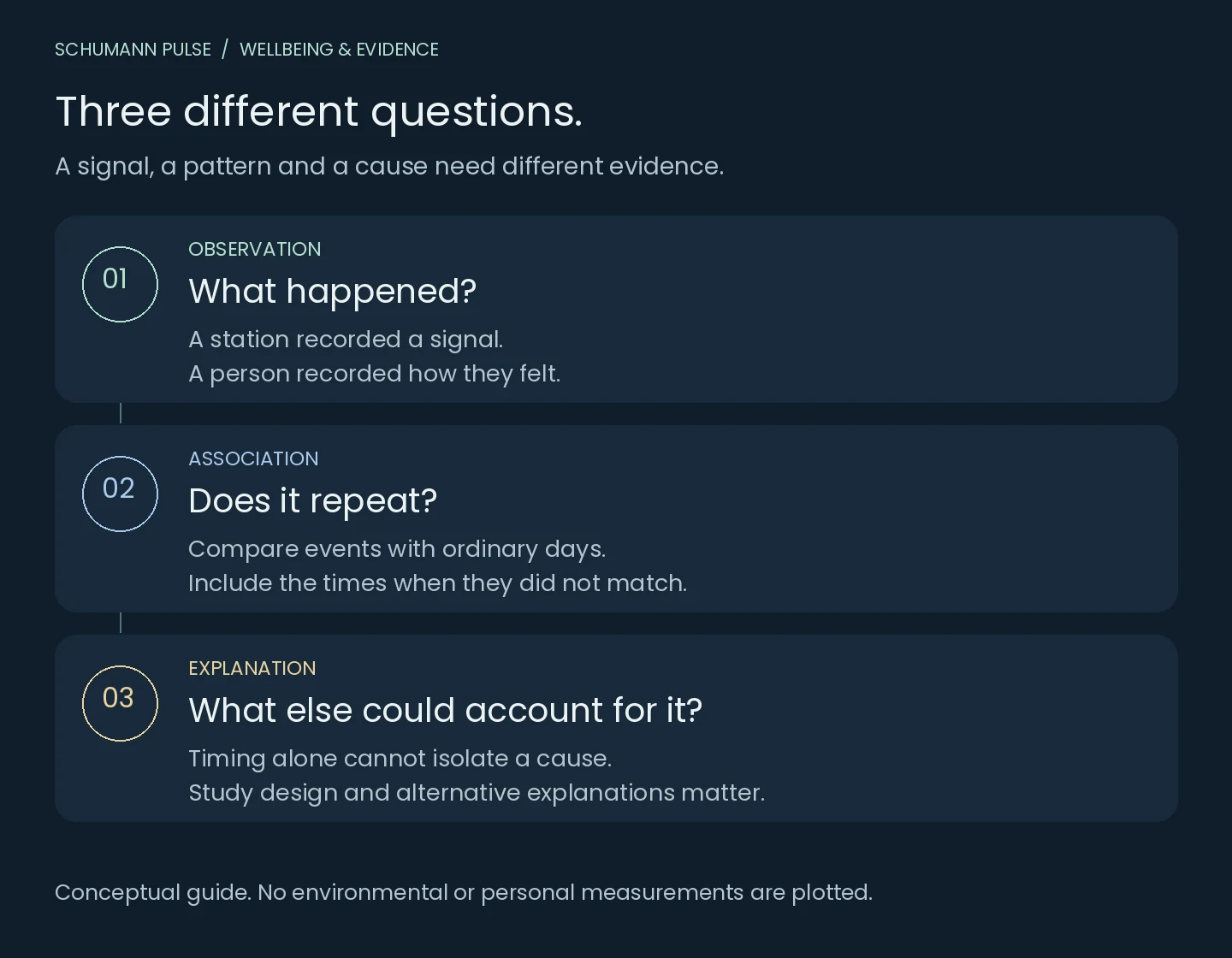
These papers illustrate why the size and design of a study matter. An association with a physiological measurement does not establish that a storm caused fatigue, anxiety or illness in a particular person.
 Open figure at full size ↗
Can a magnetic storm cause fatigue or anxiety?
There is no validated symptom checklist in the evidence discussed here that identifies a geomagnetic storm as the cause of tiredness, anxiety or “brain fog.” A symptom and a storm occurring together establish timing, not mechanism.
If you feel unwell, record what happened without needing to assign a cause. Include sleep and changes in routine rather than checking only the space-weather chart. Persistent or disruptive symptoms deserve appropriate health advice regardless of whether Kp is high or low.
For a focused review of pain research, read geomagnetic storms and headaches. For lunar questions, start with full Moon and sleep; lunar phase is a separate variable, not another level of magnetic storm.
Does a higher Kp mean greater personal health risk?
No validated conversion from Kp to an individual's symptom risk is provided by these studies. Kp is a planetary magnetic index; the NOAA storm scales [2] describe space-weather severity and its recognized impacts. A G-level is not a medical warning category.
Likewise, a Schumann station's amplitude is not a body measurement. It has its own instrument, location, units and processing. Do not combine a Kp value, a resonance amplitude and a Moon phase into a health score merely because all three appear on the same date.
What a personal diary can usefully do
A diary gives you a record that is less dependent on remembering only striking days. Our suggested method is to write how you feel first, keep ordinary days, then compare environmental context later. Include enough repeated events and comparison days, and accept “no clear difference” as a legitimate result.
In Schumann Pulse, a feeling entry can include optional mood, energy, focus, symptoms and a note. Comparisons depend on suitable history and remain observational. The app does not determine a medical cause, certify susceptibility or replace clinical assessment. See how to track mood and environmental context.
You can also check today's space weather without making a health inference. Read each source's timestamp and distinguish observed conditions from forecasts.
Sources
References in the text lead here. Original publications open in a new tab; this guide stays open.
- [1] USGS: Does Earth's magnetic field affect human health? (opens in a new tab) Back to text ↑
- [2] NOAA Space Weather Scales (opens in a new tab) Back to text ↑
- Alabdulgader et al. (2018), [3] Long-Term Study of Heart Rate Variability Responses to Changes in the Solar and Geomagnetic Environment (opens in a new tab) Back to text ↑, Scientific Reports. DOI: 10.1038/s41598-018-20932-x.
- Mattoni et al. (2020), [4] Exploring the relationship between geomagnetic activity and human heart rate variability (opens in a new tab) Back to text ↑, European Journal of Applied Physiology.
This is an editorial review of selected evidence, not a systematic review or a clinical assessment. See our health evidence standards.
Keep exploring
Make room for your own observations.
Schumann Pulse brings environmental readings and your personal journal into one place. The app is coming soon for iPhone.
Explore the app