
The field guide · Wellbeing & evidence
Does the Moon affect your mood?
Research does not establish a reliable Moon phase that predicts everyone's mood. Large hospital-record studies and small studies of particular clinical conditions ask different questions and have produced different findings. Your feelings are worth recording, but a lunar calendar cannot explain them on its own.
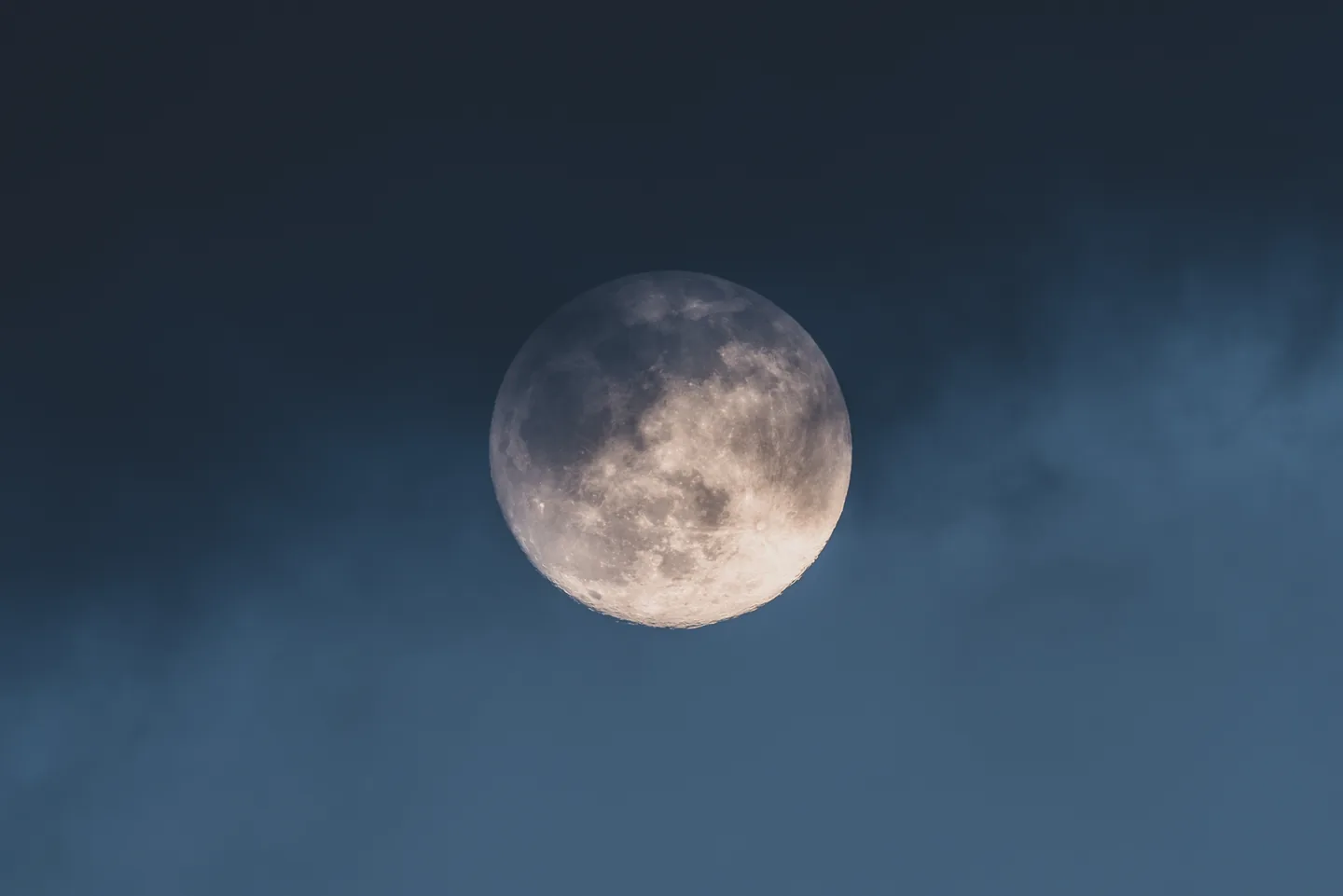
What does “the Moon affects people” mean?
A change in mood, a hospital admission, a difficult night and a change in behavior are different outcomes. Evidence about one does not automatically answer the others. The most useful question is specific: which people, which outcome, and which part of the lunar cycle?
That distinction helps avoid two equally unhelpful responses to a personal experience: immediately attributing it to the Moon, or dismissing the experience because its cause is uncertain. Feeling anxious or unusually energetic is a real observation. Its explanation is a separate question.
A large hospital study found no lunar pattern
A 2019 Swiss study [1] examined 17,966 psychiatric inpatient cases. It found no significant association between lunar phases and admissions, discharges or length of stay. The result challenges the idea that full Moon reliably produces a hospital-wide surge.
Hospital records are not a daily mood diary for the general population. This study cannot tell us that no individual ever experiences a recurring pattern; equally, an individual story cannot overturn a population result about admissions.
Why some bipolar disorder studies attract attention
In a 2017 study [2], Thomas Wehr examined long-term records from 17 people with rapidly cycling bipolar disorder and reported relationships between mood cycles and lunar tidal cycles. These were selected clinical records, not a representative sample of ordinary mood fluctuations.
A 2026 follow-up by Wehr and David Avery [3] analyzed longitudinal sleep records from three patients to explore a proposed sleep-related mechanism. It is a proof-of-concept hypothesis study. It does not establish a general effect on everyone's emotions, and it is not a calendar-based treatment guide.
These papers are interesting because they pose a testable question in a narrowly defined group. Their interpretation depends on who was studied and how the time series were analyzed. “Scientists studied a possible lunar relationship” is a much more accurate takeaway than “full Moon causes mood swings.”
Could sleep explain part of the story?
Sleep is one proposed pathway in that clinical research. However, the broader literature on Moon phases and sleep is itself mixed. A reported sleep association does not establish a direct effect on emotions, and an average group result does not say what will happen to a particular person tonight.
Keep sleep and mood as separate entries. If you combine them into one “lunar sensitivity” score at the outset, you lose the ability to see whether one changed while the other stayed the same.
How to record a pattern without assuming the answer
Our suggested approach is to choose a regular recording time and describe your state before consulting the lunar calendar. Use the same scale consistently: a mood of 3 should mean roughly the same thing next week as it does today. Add a short note when circumstances changed, such as travel, illness or an unusually demanding day.
Include calm days and ordinary weeks. If you only record after noticing a full Moon, the diary cannot show what happened at other phases. Several observations from one difficult week also do not constitute several independent lunar events.
Look for repetition across cycles, then ask whether the same pattern appears when major changes in routine are taken into account. “No consistent difference” is a useful result. A personal diary can organize questions for a clinician; it cannot establish a psychiatric diagnosis or determine treatment.
Where Schumann Pulse fits
The app's journal supports a feeling entry with optional mood, energy, focus, symptoms and a note. Lunar context sits alongside those records. History-based comparisons need enough suitable observations; they are not an instant test of whether you are “Moon sensitive.”
Start with the guide to tracking mood and environmental context. If your question is about the Sun instead, space weather and health separates geomagnetic activity from lunar phases and personal symptoms.
Sources
References in the text lead here. Original publications open in a new tab; this guide stays open.
- Gupta et al. (2019), [1] Is it the moon? Effects of the lunar cycle on psychiatric admissions, discharges and length of stay (opens in a new tab) Back to text ↑, Swiss Medical Weekly. DOI: 10.4414/smw.2019.20070.
- Wehr (2017), [2] Bipolar mood cycles and lunar tidal cycles (opens in a new tab) Back to text ↑, Molecular Psychiatry.
- Wehr and Avery (2026), [3] Proof of concept for a hypothesis linking a form of rapid cycling with lunar cycles in sleep (opens in a new tab) Back to text ↑, Molecular Psychiatry. DOI: 10.1038/s41380-026-03799-7.
This is an editorial review of selected evidence, not a systematic review or a clinical assessment. See our health evidence standards.
Keep exploring
Make room for your own observations.
Schumann Pulse brings environmental readings and your personal journal into one place. The app is coming soon for iPhone.
Explore the app