One Moon. Your local time.
A moment with the Moon.
A saved calculation. The same Moon, the same moment, whenever you return.
Wednesday, 21 October 2026
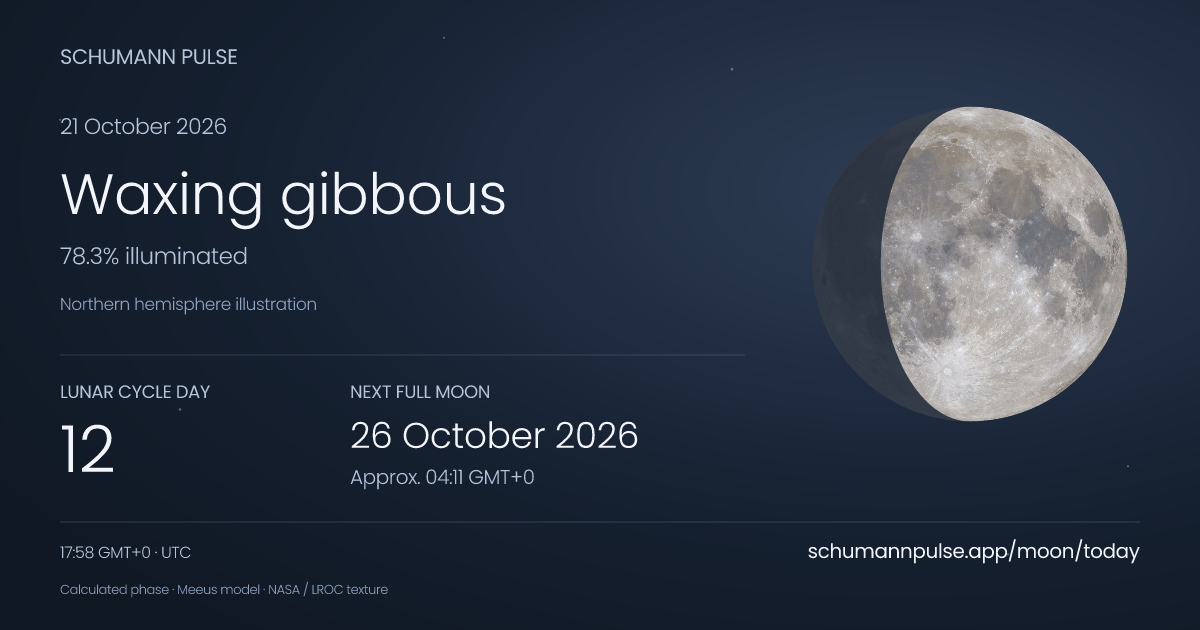
Waxing gibbous
The illuminated side is growing toward full.
- Illuminated
- 78.3%
- Lunar cycle day ⓘ
- 12
Moon age · 11d 2h 7m since new Moon
Calculated for
UTC · Saved calculation
About this view
Next full Moon
Approx. 04:11 GMT+0
A calculated moment, beautifully kept.
PNG · No watermark · Northern hemisphere illustration
 Schumann Pulse for iPhone
The Moon. Your day.
A little more perspective.
Follow Moon phases beside Schumann readings and space weather. Keep a journal of how you feel and explore your own history over time.
Get to know the Moon.
Why the Moon changes shape ↗
Eight familiar phases, one continuous cycle. Understand what waxing and waning actually mean.
02 / Counting the cycleWhat is a lunar day? ↗
Moon age, days since new Moon and traditional calendar systems explained.
03 / Names & seasonsFrom Wolf to Harvest Moon ↗
Explore monthly full-Moon names, their origins and the places where they make sense.
A clear view of the numbers
How this Moon calendar works.
Moon phase describes how much of the sunlit half we can see from Earth. The phase happens at essentially the same moment worldwide; your time zone changes its date and clock time.
Why the Moon looks different across hemispheres ↗How are lunar day and Moon age counted?
Lunar cycle day 1 starts at the calculated new Moon. Day 2 starts 24 hours later, and the number resets at the next new Moon. Moon age gives the elapsed time in days, hours and minutes. The displayed minute reflects the calculation, not minute-level certainty in the model. This convention is not a count of local moonrises, a Hindu tithi or a named night in a traditional calendar. Compare the different definitions.
Why do dates change with my time zone?
A full Moon at 04:12 UTC can still be on the previous evening in the Americas. We convert event times with your selected IANA time zone, including daylight saving time. The initial interactive view uses your device time zone; without JavaScript it starts in UTC. Change it above whenever you travel.
What changes in the Southern hemisphere view?
The Moon illustration rotates by 180°. The phase, illumination and event time stay the same. This is a simplified hemisphere view: the Moon's actual angle in your sky also depends on latitude, time and direction of observation. Near the equator it may appear tilted or horizontal. We do not request your coordinates or calculate moonrise, visibility or cloud cover here.
How precise are the calculations?
We use the same Meeus-based phase calculation as the app. Principal phase times are approximate to a few minutes; the illuminated fraction is approximate to about one percentage point. Phase names are shown within 12 hours on either side of the exact quarter, new or full phase. The calendar images and selected-day percentages sample 12:00 local time, while event labels use the calculated event instant. Supported calendar years: 2020–2035.
Does a Moon phase predict how I will feel?
This calendar describes astronomy. It cannot predict an individual's mood, sleep or health. You can record your own experience without assuming a lunar cause. Read what sleep research has found or explore the evidence on mood.
Sources and image credits
Calculation method: Jean Meeus, Astronomical Algorithms, second edition, chapters 48 and 49 (simplified phase angle and principal phase series). Phase times were checked against US Naval Observatory tables (opens in a new tab). NASA's phase guide (opens in a new tab) explains the geometry.
The surface illustration uses the NASA SVS CGI Moon Kit (opens in a new tab): Ernie Wright / NASA Scientific Visualization Studio, LRO / LROC WAC camera-team data assembled by Arizona State University. We projected the texture onto a disk and added calculated illumination. It is an illustration, not a live photograph; exact libration and local sky angle are not shown. No NASA endorsement is implied.