Home / Moon / Today One Moon. Your local time.
Moon today. Today's phase, lunar cycle day and a month of changing light.
Time zoneUTC Africa/Abidjan Africa/Accra Africa/Addis Ababa Africa/Algiers Africa/Asmera Africa/Bamako Africa/Bangui Africa/Banjul Africa/Bissau Africa/Blantyre Africa/Brazzaville Africa/Bujumbura Africa/Cairo Africa/Casablanca Africa/Ceuta Africa/Conakry Africa/Dakar Africa/Dar es Salaam Africa/Djibouti Africa/Douala Africa/El Aaiun Africa/Freetown Africa/Gaborone Africa/Harare Africa/Johannesburg Africa/Juba Africa/Kampala Africa/Khartoum Africa/Kigali Africa/Kinshasa Africa/Lagos Africa/Libreville Africa/Lome Africa/Luanda Africa/Lubumbashi Africa/Lusaka Africa/Malabo Africa/Maputo Africa/Maseru Africa/Mbabane Africa/Mogadishu Africa/Monrovia Africa/Nairobi Africa/Ndjamena Africa/Niamey Africa/Nouakchott Africa/Ouagadougou Africa/Porto-Novo Africa/Sao Tome Africa/Tripoli Africa/Tunis Africa/Windhoek America/Adak America/Anchorage America/Anguilla America/Antigua America/Araguaina America/Argentina/La Rioja America/Argentina/Rio Gallegos America/Argentina/Salta America/Argentina/San Juan America/Argentina/San Luis America/Argentina/Tucuman America/Argentina/Ushuaia America/Aruba America/Asuncion America/Bahia America/Bahia Banderas America/Barbados America/Belem America/Belize America/Blanc-Sablon America/Boa Vista America/Bogota America/Boise America/Buenos Aires America/Cambridge Bay America/Campo Grande America/Cancun America/Caracas America/Catamarca America/Cayenne America/Cayman America/Chicago America/Chihuahua America/Ciudad Juarez America/Coral Harbour America/Cordoba America/Costa Rica America/Coyhaique America/Creston America/Cuiaba America/Curacao America/Danmarkshavn America/Dawson America/Dawson Creek America/Denver America/Detroit America/Dominica America/Edmonton America/Eirunepe America/El Salvador America/Fort Nelson America/Fortaleza America/Glace Bay America/Godthab America/Goose Bay America/Grand Turk America/Grenada America/Guadeloupe America/Guatemala America/Guayaquil America/Guyana America/Halifax America/Havana America/Hermosillo America/Indiana/Knox America/Indiana/Marengo America/Indiana/Petersburg America/Indiana/Tell City America/Indiana/Vevay America/Indiana/Vincennes America/Indiana/Winamac America/Indianapolis America/Inuvik America/Iqaluit America/Jamaica America/Jujuy America/Juneau America/Kentucky/Monticello America/Kralendijk America/La Paz America/Lima America/Los Angeles America/Louisville America/Lower Princes America/Maceio America/Managua America/Manaus America/Marigot America/Martinique America/Matamoros America/Mazatlan America/Mendoza America/Menominee America/Merida America/Metlakatla America/Mexico City America/Miquelon America/Moncton America/Monterrey America/Montevideo America/Montserrat America/Nassau America/New York America/Nome America/Noronha America/North Dakota/Beulah America/North Dakota/Center America/North Dakota/New Salem America/Ojinaga America/Panama America/Paramaribo America/Phoenix America/Port-au-Prince America/Port of Spain America/Porto Velho America/Puerto Rico America/Punta Arenas America/Rankin Inlet America/Recife America/Regina America/Resolute America/Rio Branco America/Santarem America/Santiago America/Santo Domingo America/Sao Paulo America/Scoresbysund America/Sitka America/St Barthelemy America/St Johns America/St Kitts America/St Lucia America/St Thomas America/St Vincent America/Swift Current America/Tegucigalpa America/Thule America/Tijuana America/Toronto America/Tortola America/Vancouver America/Whitehorse America/Winnipeg America/Yakutat Antarctica/Casey Antarctica/Davis Antarctica/DumontDUrville Antarctica/Macquarie Antarctica/Mawson Antarctica/McMurdo Antarctica/Palmer Antarctica/Rothera Antarctica/Syowa Antarctica/Troll Antarctica/Vostok Arctic/Longyearbyen Asia/Aden Asia/Almaty Asia/Amman Asia/Anadyr Asia/Aqtau Asia/Aqtobe Asia/Ashgabat Asia/Atyrau Asia/Baghdad Asia/Bahrain Asia/Baku Asia/Bangkok Asia/Barnaul Asia/Beirut Asia/Bishkek Asia/Brunei Asia/Calcutta Asia/Chita Asia/Colombo Asia/Damascus Asia/Dhaka Asia/Dili Asia/Dubai Asia/Dushanbe Asia/Famagusta Asia/Gaza Asia/Hebron Asia/Hong Kong Asia/Hovd Asia/Irkutsk Asia/Jakarta Asia/Jayapura Asia/Jerusalem Asia/Kabul Asia/Kamchatka Asia/Karachi Asia/Katmandu Asia/Khandyga Asia/Krasnoyarsk Asia/Kuala Lumpur Asia/Kuching Asia/Kuwait Asia/Macau Asia/Magadan Asia/Makassar Asia/Manila Asia/Muscat Asia/Nicosia Asia/Novokuznetsk Asia/Novosibirsk Asia/Omsk Asia/Oral Asia/Phnom Penh Asia/Pontianak Asia/Pyongyang Asia/Qatar Asia/Qostanay Asia/Qyzylorda Asia/Rangoon Asia/Riyadh Asia/Saigon Asia/Sakhalin Asia/Samarkand Asia/Seoul Asia/Shanghai Asia/Singapore Asia/Srednekolymsk Asia/Taipei Asia/Tashkent Asia/Tbilisi Asia/Tehran Asia/Thimphu Asia/Tokyo Asia/Tomsk Asia/Ulaanbaatar Asia/Urumqi Asia/Ust-Nera Asia/Vientiane Asia/Vladivostok Asia/Yakutsk Asia/Yekaterinburg Asia/Yerevan Atlantic/Azores Atlantic/Bermuda Atlantic/Canary Atlantic/Cape Verde Atlantic/Faeroe Atlantic/Madeira Atlantic/Reykjavik Atlantic/South Georgia Atlantic/St Helena Atlantic/Stanley Australia/Adelaide Australia/Brisbane Australia/Broken Hill Australia/Darwin Australia/Eucla Australia/Hobart Australia/Lindeman Australia/Lord Howe Australia/Melbourne Australia/Perth Australia/Sydney Europe/Amsterdam Europe/Andorra Europe/Astrakhan Europe/Athens Europe/Belgrade Europe/Berlin Europe/Bratislava Europe/Brussels Europe/Bucharest Europe/Budapest Europe/Busingen Europe/Chisinau Europe/Copenhagen Europe/Dublin Europe/Gibraltar Europe/Guernsey Europe/Helsinki Europe/Isle of Man Europe/Istanbul Europe/Jersey Europe/Kaliningrad Europe/Kiev Europe/Kirov Europe/Lisbon Europe/Ljubljana Europe/London Europe/Luxembourg Europe/Madrid Europe/Malta Europe/Mariehamn Europe/Minsk Europe/Monaco Europe/Moscow Europe/Oslo Europe/Paris Europe/Podgorica Europe/Prague Europe/Riga Europe/Rome Europe/Samara Europe/San Marino Europe/Sarajevo Europe/Saratov Europe/Simferopol Europe/Skopje Europe/Sofia Europe/Stockholm Europe/Tallinn Europe/Tirane Europe/Ulyanovsk Europe/Vaduz Europe/Vatican Europe/Vienna Europe/Vilnius Europe/Volgograd Europe/Warsaw Europe/Zagreb Europe/Zurich Indian/Antananarivo Indian/Chagos Indian/Christmas Indian/Cocos Indian/Comoro Indian/Kerguelen Indian/Mahe Indian/Maldives Indian/Mauritius Indian/Mayotte Indian/Reunion Pacific/Apia Pacific/Auckland Pacific/Bougainville Pacific/Chatham Pacific/Easter Pacific/Efate Pacific/Enderbury Pacific/Fakaofo Pacific/Fiji Pacific/Funafuti Pacific/Galapagos Pacific/Gambier Pacific/Guadalcanal Pacific/Guam Pacific/Honolulu Pacific/Kiritimati Pacific/Kosrae Pacific/Kwajalein Pacific/Majuro Pacific/Marquesas Pacific/Midway Pacific/Nauru Pacific/Niue Pacific/Norfolk Pacific/Noumea Pacific/Pago Pago Pacific/Palau Pacific/Pitcairn Pacific/Ponape Pacific/Port Moresby Pacific/Rarotonga Pacific/Saipan Pacific/Tahiti Pacific/Tarawa Pacific/Tongatapu Pacific/Truk Pacific/Wake Pacific/Wallis Use device time zone ↗ Choose your hemisphere. Time zone sets dates and times; it does not identify your location.
Wednesday, 21 October 2026
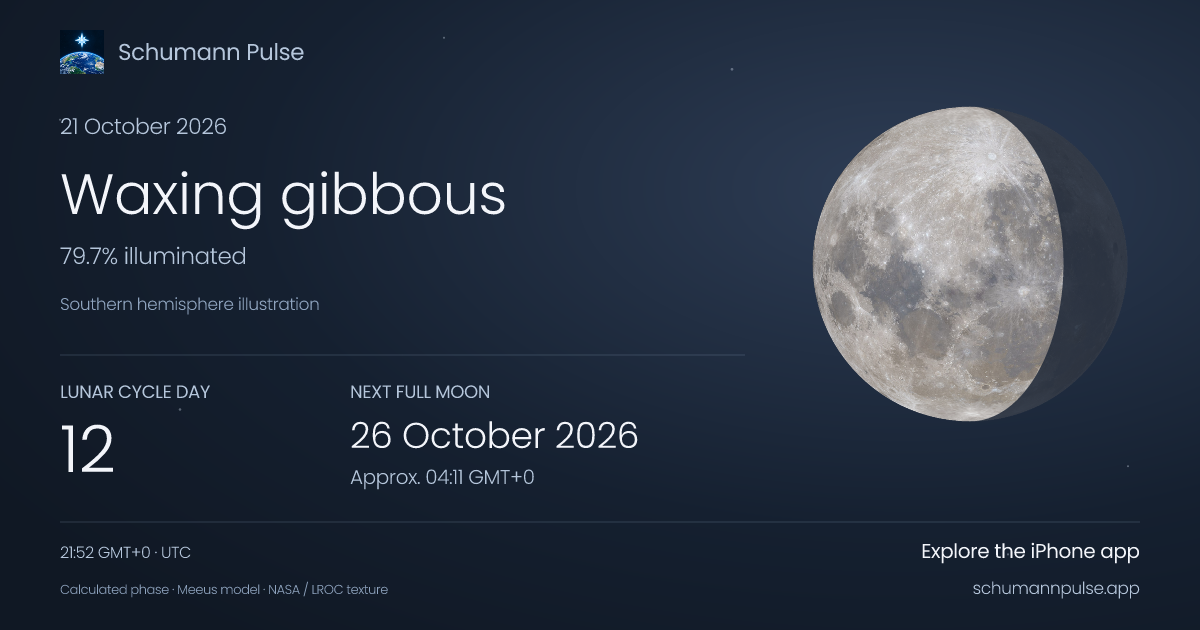
Waxing gibbous The illuminated side is growing toward full.
Illuminated 79.7% Moon age · 11d 6h 2m since new Moon
Calculated for 21:52 GMT+0 UTC · Updates every minute
Southern hemisphere illustrationAbout this view Next full Moon
26 October
Approx. 04:11 GMT+0 A little Moon, to pass on
Keep this moment. A lunar postcard with the phase, cycle day and next full Moon. Made for your messages, your Stories, or just for you.
21 October 2026 · 21:52 GMT+0
This card keeps the time shown above, even as today's readings update. It uses the current Moon, not the calendar’s noon sample.
Open this saved view ↗ Use the latest moment ↻ Card 1200 × 630 Story 1080 × 1920
A calculated moment, beautifully kept.
Download Story PNG . Copy the saved-view link to share.
The month at a glance
October 2026 ← Today → Select a day to explore. Phase illustrations show local noon; labelled events show the day of the primary phase.
Wednesday 21 October
Waxing gibbous 76.2% illuminated
At 12:00 local time No primary phase event on this date.
This view uses the time zone shown above. Month, date and hemisphere links work without JavaScript. Enable JavaScript to use the time-zone selector and automatic updates; reload for a fresh calculation.
Schumann Pulse for iPhone The Moon. Your day. Follow Moon phases beside Schumann readings and space weather. Keep a journal of how you feel and explore your own history over time.
A clear view of the numbers
How this Moon calendar works. Moon phase describes how much of the sunlit half we can see from Earth. The phase happens at essentially the same moment worldwide; your time zone changes its date and clock time.
Why the Moon looks different across hemispheres ↗
How are lunar day and Moon age counted? Lunar cycle day 1 starts at the calculated new Moon. Day 2 starts 24 hours later, and the number resets at the next new Moon. Moon age gives the elapsed time in days, hours and minutes. The displayed minute reflects the calculation, not minute-level certainty in the model. This convention is not a count of local moonrises, a Hindu tithi or a named night in a traditional calendar. Compare the different definitions.
Why do dates change with my time zone? A full Moon at 04:12 UTC can still be on the previous evening in the Americas. We convert event times with your selected IANA time zone, including daylight saving time. The initial interactive view uses your device time zone; without JavaScript it starts in UTC. Change it above whenever you travel.
What changes in the Southern hemisphere view? The Moon illustration rotates by 180°. The phase, illumination and event time stay the same. This is a simplified hemisphere view: the Moon's actual angle in your sky also depends on latitude, time and direction of observation. Near the equator it may appear tilted or horizontal. We do not request your coordinates or calculate moonrise, visibility or cloud cover here.
How precise are the calculations? We use the same Meeus-based phase calculation as the app. Principal phase times are approximate to a few minutes; the illuminated fraction is approximate to about one percentage point. Phase names are shown within 12 hours on either side of the exact quarter, new or full phase. The calendar images and selected-day percentages sample 12:00 local time, while event labels use the calculated event instant. Supported calendar years: 2020–2035.
Does a Moon phase predict how I will feel? This calendar describes astronomy. It cannot predict an individual's mood, sleep or health. You can record your own experience without assuming a lunar cause. Read what sleep research has found or explore the evidence on mood .
Sources and image credits Calculation method: Jean Meeus, Astronomical Algorithms , second edition, chapters 48 and 49 (simplified phase angle and principal phase series). Phase times were checked against US Naval Observatory tables (opens in a new tab) . NASA's phase guide (opens in a new tab) explains the geometry.
The surface illustration uses the NASA SVS CGI Moon Kit (opens in a new tab) : Ernie Wright / NASA Scientific Visualization Studio, LRO / LROC WAC camera-team data assembled by Arizona State University. We projected the texture onto a disk and added calculated illumination. It is an illustration, not a live photograph; exact libration and local sky angle are not shown. No NASA endorsement is implied.


 Schumann Pulse for iPhone