
The field guide · Sun
Why can’t I see the aurora when Kp is high?
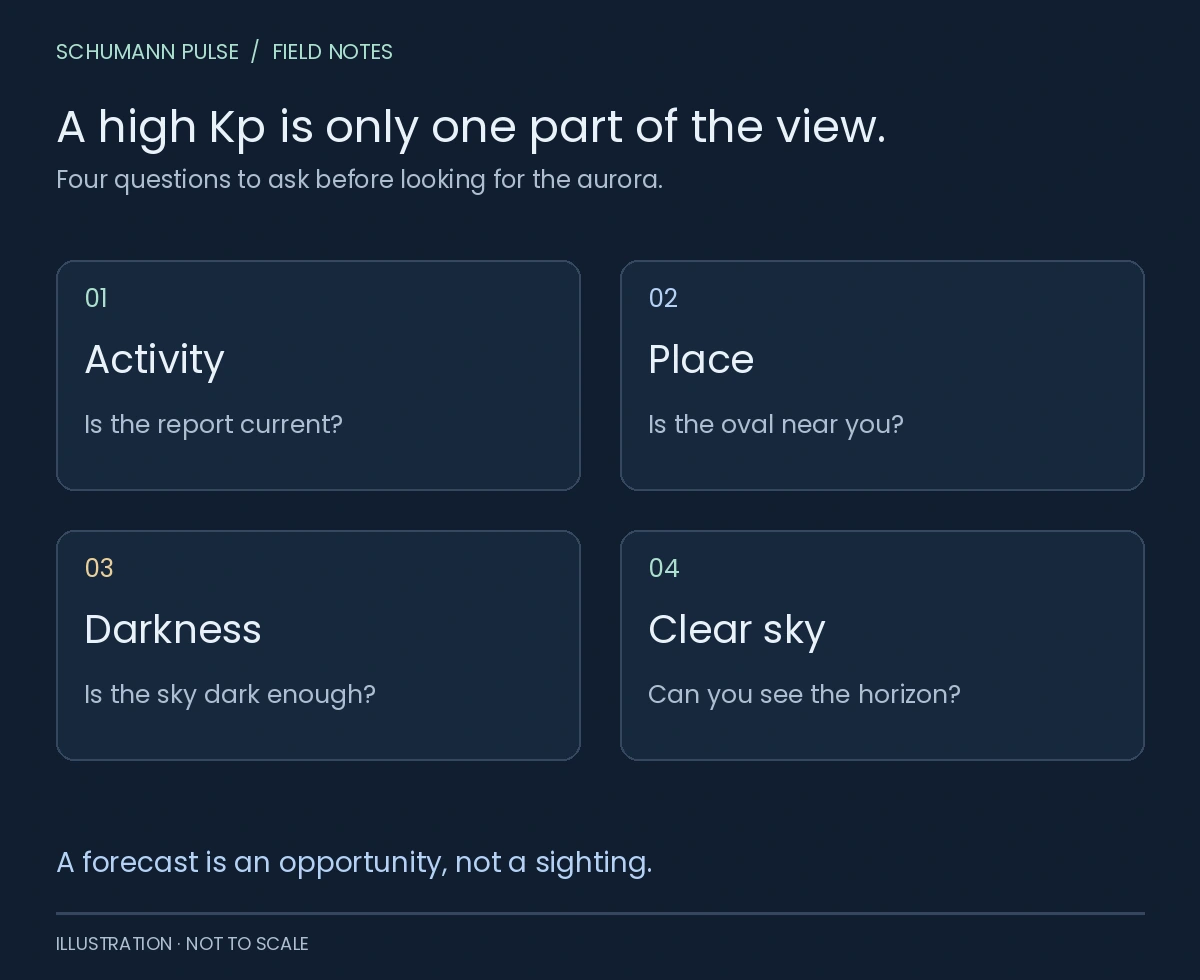
A high Kp indicates disturbed geomagnetic conditions across a planetary network. It does not guarantee an aurora at your location. The activity must coincide with a suitable auroral position, a dark enough sky and a clear view.
Start with the time on the number
Is the Kp value observed, estimated, or forecast? And which interval does it describe? Kp is a three-hour planetary index; a peak from an earlier interval is not a live report of light above your house. A forecast is an expectation, not an observed sighting. GFZ: how Kp is defined [1].
Open space weather today and read the measurement time before the colour or headline. Our current readings help put the activity in context; they are not a location-specific aurora forecast.
Four things need to line up
Schumann Pulse · field notes
High Kp is only part of the view.
Four checks before looking for aurora.
Activity
Is the report current?
Place
Is the auroral oval near you?
Darkness
Is the sky dark enough?
Clear sky
Can you see an unobstructed sky and horizon?
A forecast is an opportunity, not a sighting.
An observing checklist, not a current forecast. Kp alone cannot confirm a sighting.
Activity + location
Look at a current auroral map for your hemisphere. A planetary number cannot tell you where every part of the display will be.
Darkness + a clear view
Check local twilight, cloud cover, nearby lights and obstructions for the same observing window.
The relationship between Kp and how far the auroral oval extends is approximate. Magnetic latitude is also different from ordinary map latitude. A high-latitude observer can see a display at relatively low Kp, while someone far away can miss one during a much stronger event. NOAA: viewing factors [2].
Clear sky is not enough if it is still bright outside. At polar latitudes, summer daylight can hide an aurora that is physically present. Moonlight and artificial light can reduce contrast. Conversely, cloud can block the view even when all the space-weather indicators look promising.
What an aurora map can and cannot tell you
NOAA’s short-range aurora product uses the OVATION model to estimate the location and intensity of the aurora. Its lead time depends on the solar wind’s travel time from the upstream measurement point. Use the map’s valid time and the correct hemisphere. NOAA product documentation [3].
The model is not a webcam, and the coloured area is not a promise that a particular observer will see colour. It also does not remove the need to check ground-level weather. Save the map’s timestamp with any observing note; otherwise a screenshot can lose the context that makes it useful.
Why does my phone see more colour than I do?
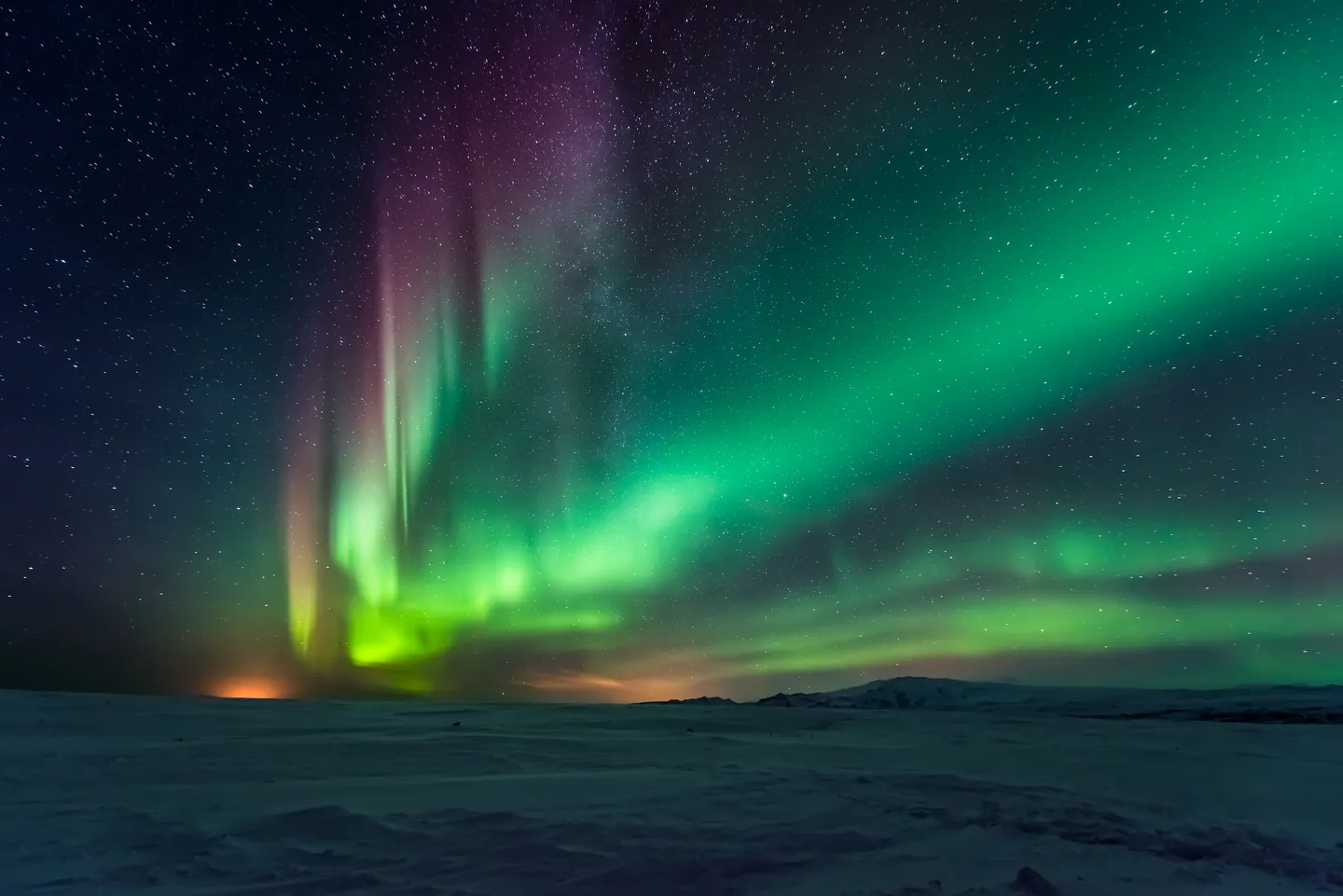
An exposure gathers light over time, and camera processing changes the displayed result. A dim visual display can therefore look more vivid in a photograph. That does not make it a fake photograph, but it changes what the image can demonstrate. For the underlying emission process, see why auroras have different colours.
This licensed Alta timelapse illustrates the changing appearance of an aurora. It is not a forecast, a real-time view or a record of the May 2024 storm.
A useful note after an unsuccessful attempt
Instead of writing only “Kp was high, no lights,” record the local time, observation duration, approximate place, cloud, visible horizon and which dated activity report you checked. Keep naked-eye and camera observations separate.
For example, “cloud covered the relevant horizon” and “clear, dark sky but no visible display during a ten-minute watch” answer different questions. Both are useful records. Neither, on its own, proves that the planetary index was wrong.
Sources
References in the text lead here. Original publications open in a new tab; this guide stays open.
- [1] GFZ: the planetary Kp index (opens in a new tab) Back to text ↑.
- [2] NOAA: aurora viewing factors (opens in a new tab) Back to text ↑.
- [3] NOAA: OVATION short-range aurora forecast documentation (opens in a new tab) Back to text ↑.
- [4] NASA: what causes auroras and their colours (opens in a new tab).
Your next observation
Stay curious when conditions change.
Choose activity alerts and keep your own feelings, sleep quality and everyday context in a journal. Explore suitable personal comparisons over time; a storm index is not a health score.
iPhone app coming soon · history and personal comparisons live in the app.