
The field guide · Moon
Why does the Moon look so big near the horizon?
The Moon often seems much larger near the horizon even though its angular width changes very little over the same evening. This is called the Moon illusion. A supermoon involves a real distance difference; the horizon illusion is a different effect.
Schumann Pulse · field notes
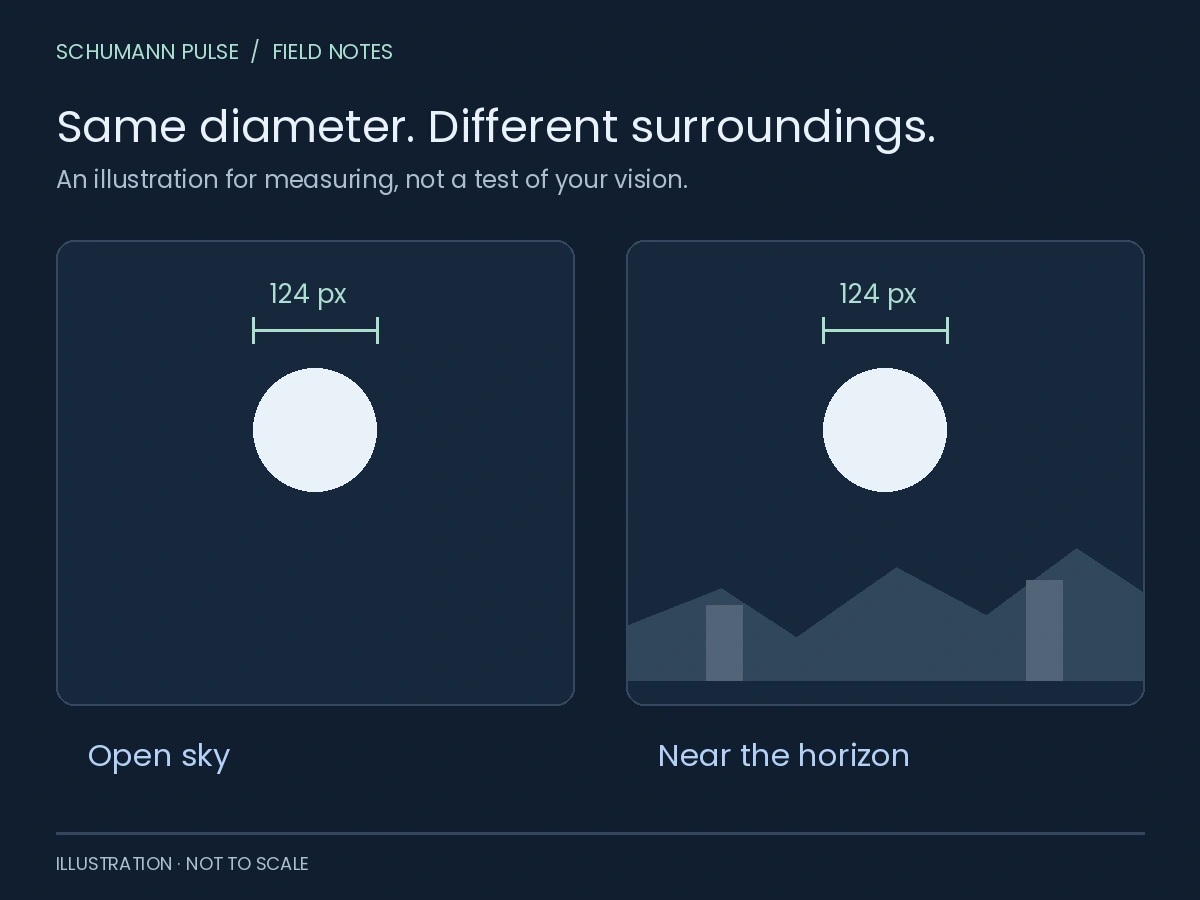
Same size. Different surroundings.
Compare the matching rulers above the discs.
Open sky
Near the horizon
Both drawn discs have exactly the same diameter.
Original illustration, not measured photographs or a test of your vision. It does not fully explain the Moon illusion.
What the illustration can show
The two drawn discs above are exactly 124 pixels wide in the original image. One floats in an open field; the other has a horizon beneath it. Their surroundings differ, but the rulers do not.
This is a measurement exercise, not a promise that everyone will experience an illusion on a small screen. Cover the lower scenery with a piece of paper, then uncover it. Whether the impression changes or stays the same, the two drawn diameters remain equal.
Why does the real Moon look bigger when it rises?
The enlargement is perceptual; atmospheric refraction can flatten the low Moon rather than magnify it. NASA notes that a complete explanation remains unsettled. NASA’s Moon illusion overview [2].
In a 2000 experiment, Lloyd Kaufman and James H. Kaufman used artificial moons to investigate perceived distance. Their results supported an account in which the horizon Moon is treated as farther away and therefore looks larger. They manipulated binocular viewing information, not the size of the real Moon. Kaufman and Kaufman, PNAS [1].
Our two-disc drawing is not a replication of that apparatus. It simply gives you an unchanged diameter to compare against changing visual context. Keeping that distinction makes a small classroom-style demonstration useful without pretending it settles the research question.
A fair two-photo comparison
Try this on one clear evening when the Moon rises into view:
- Photograph the Moon near the horizon. Record the camera or phone lens and zoom setting.
- Photograph it again when it is higher. Use the same lens and zoom, keeping the original resolution.
- Open both original images at the same scale. Compare the horizontal diameter in pixels, not the size of differently cropped previews.
- Record any change in phone lens, digital zoom, image processing or focus. Those changes can spoil the comparison.
This procedure is adapted from NASA’s same-zoom test. You should find broadly similar widths, rather than the dramatic growth your first impression suggested. It is not an exact astronomical distance measurement. NASA: how to check the illusion [2].
A phone’s bright white blob is also a poor measuring target. Focus and exposure matter; use our daytime photography notes to keep the edge and surface detail visible.
How is this different from a supermoon?
Swipe or use the arrow keys to see all columns.
| Question | Moon illusion | Supermoon |
|---|---|---|
| What changes? | The impression of size, often near the horizon | Earth–Moon distance near full Moon |
| What comparison helps? | Same evening, same lens and image scale | Comparable full-Moon images near different orbital distances |
| Can both occur together? | Yes | Yes |
NASA describes a full Moon near perigee as a supermoon. Compared with a full Moon near apogee, its apparent diameter can be about 14% greater. That comparison uses the two orbital extremes, not an ordinary Moon from the night before. NASA: supermoons [3].
Why is it sometimes orange too?
Colour and perceived size have different explanations. Low in the sky, moonlight crosses more atmosphere, where scattering changes the light reaching you. That can give it a warmer appearance. An orange horizon Moon is not automatically a Blood Moon eclipse.
Explore why the Moon looks orange or red for the two different light paths and an observed moonset sequence.
Check Moon today for the actual phase before attaching a special name to the view.
Sources
References in the text lead here. Original publications open in a new tab; this guide stays open.
-
[1] Kaufman and Kaufman (2000): artificial-moon experiments on perceived distance (opens in a new tab) Back to text ↑.
-
[2] NASA: Moon illusion, same-zoom comparison and atmospheric effects (opens in a new tab) First mention ↑.
- [3] NASA: supermoon distances and the comparison between orbital extremes (opens in a new tab) Back to text ↑.
- [4] NASA: camera exposure and lunar photography (opens in a new tab).
Your next observation
Make the Moon part of your daily perspective.
Follow the lunar cycle and keep separate energy, mood and sleep-quality records. Explore available full-Moon comparisons in You when enough suitable history exists; no clear difference is a valid result.
iPhone app coming soon · history and personal comparisons live in the app.