
The field guide · Moon
Why can you see the Moon during the day?
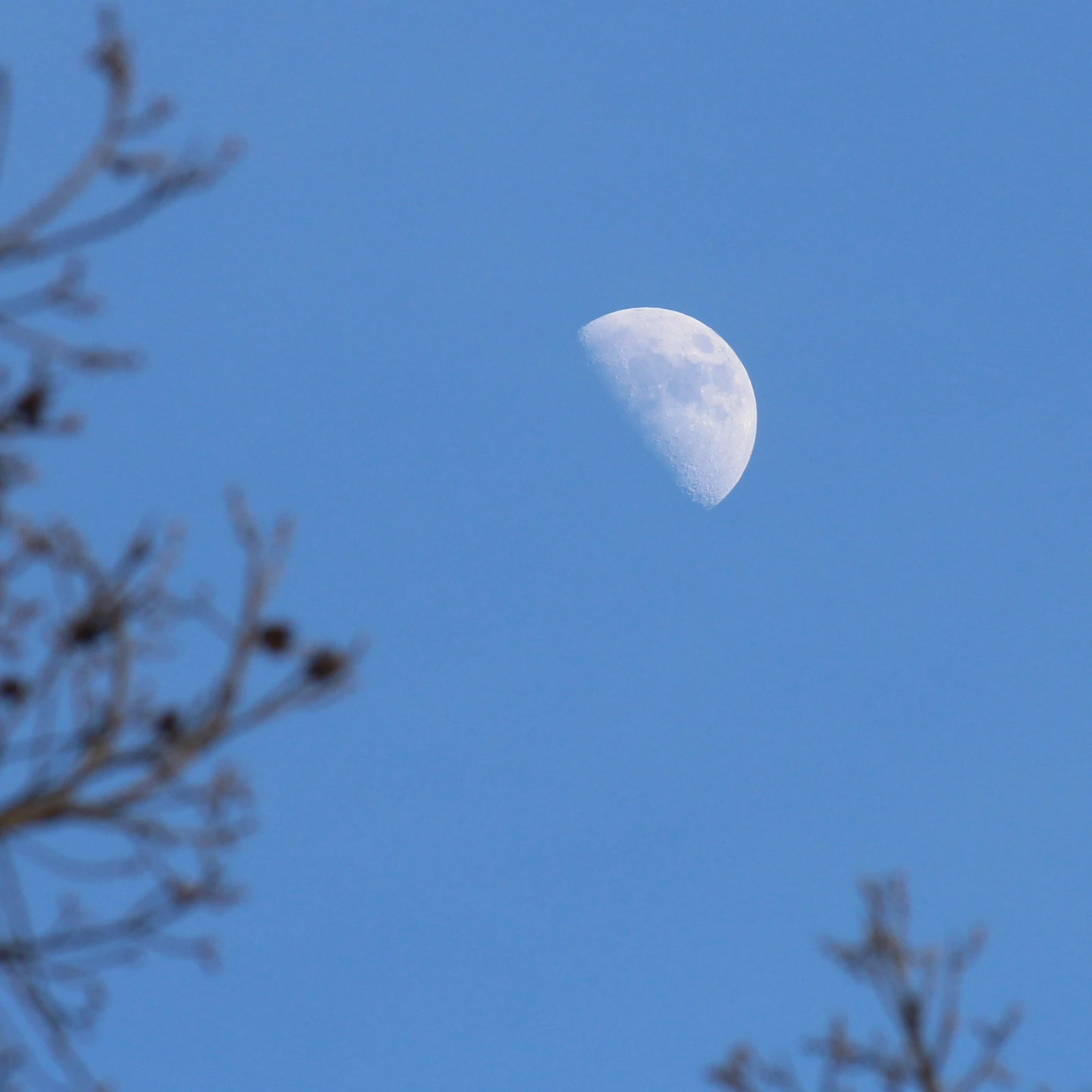
The Moon can be visible during the day because it is above your horizon and bright enough to stand out against the sunlit sky. It reflects sunlight in daytime just as it does at night. Its phase helps explain when to look.
 Open figure at full size ↗
Why the Sun and Moon can share the sky
The Moon does not wait for sunset to rise. As it travels around Earth, its direction relative to the Sun changes. For much of its cycle, some of its time above the horizon falls during daylight. A visible daytime Moon is an ordinary part of that geometry, not a sign of unusual solar activity. NASA’s phase guide [1].
The lit part you see is sunlight reflected by the lunar surface. A blue sky adds a bright background, which makes the Moon look paler and reduces contrast. “Above the horizon” and “easy to see” are therefore different questions.
Morning or afternoon: use the phase as a clue
Schumann Pulse · field notes
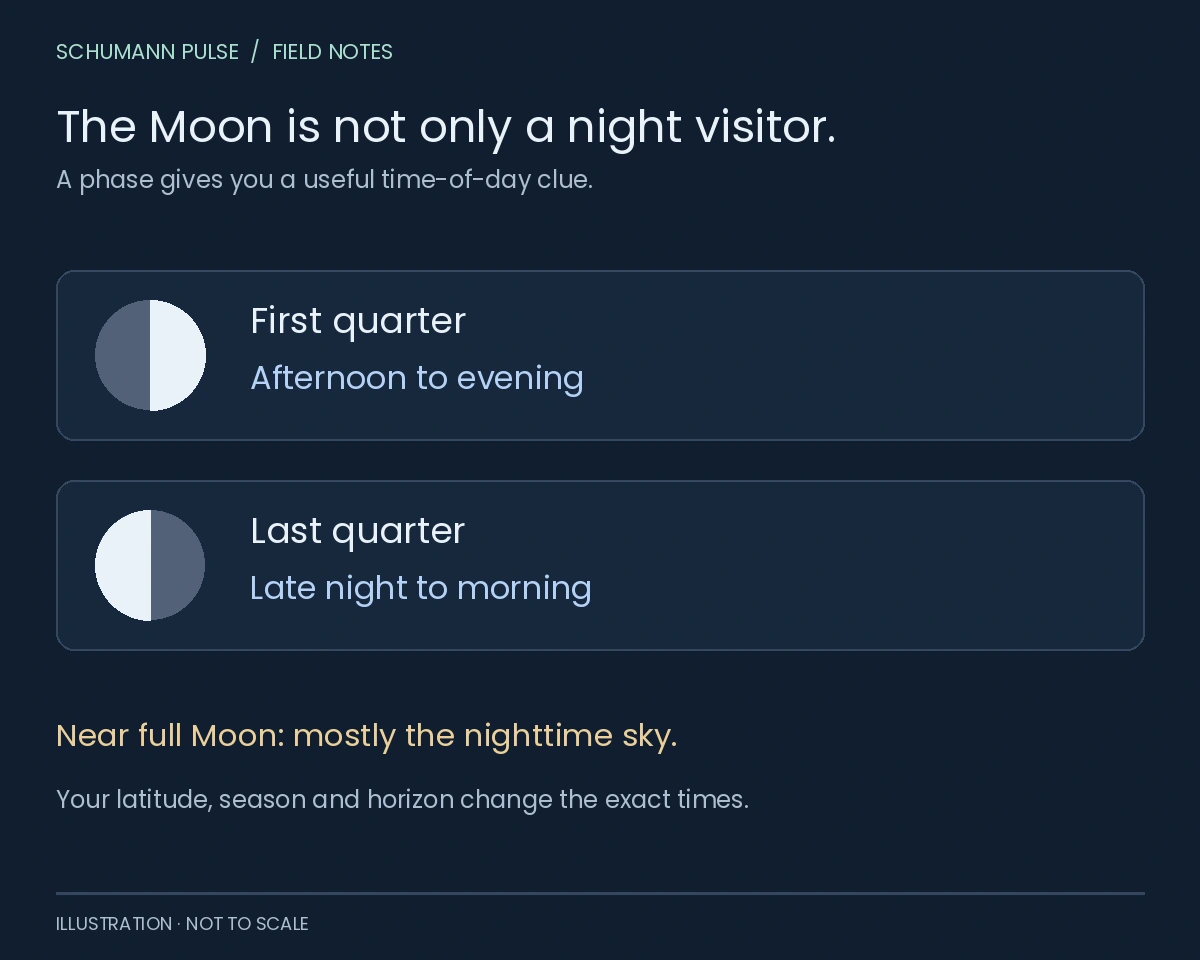
The Moon is not only a night visitor.
A phase gives you a time-of-day clue.
First quarter
Afternoon to evening
Last quarter
Late night to morning
Near full Moon, viewing is mostly at night.
Approximate patterns, not local rise or set times. Latitude, season and horizon matter. Phase sketches do not show a fixed sky orientation.
Try around first quarter.
A half-lit waxing Moon is a useful afternoon target, continuing into the evening.
Try around last quarter.
A half-lit waning Moon can remain in view after sunrise.
These are broad patterns. Near full Moon, the Moon is roughly opposite the Sun and is mainly a nighttime object. Near new Moon, it lies in the Sun’s direction and is generally lost in the glare. US Naval Observatory: phase geometry [2].
The exact rise and set times need your location and date. Latitude, season and the local horizon matter; the simple pattern becomes less useful at extreme latitudes. A phase calendar alone is not a local sky-position forecast. Our Moon today page shows the phase and cycle age, with event times in your selected time zone.
The moonrise and moonset guide explains the average daily delay and why a calendar date can have no rise entry.
A small observation you can try
Choose a clear afternoon around first quarter. Find the Moon with your unaided eyes, well away from the Sun, then note three things: the date and local time, the shape of the lit portion, and a nearby landmark. Return on another clear day at about the same time and make a fresh note.
Your question is simple: has the Moon kept the same place relative to that landmark? Keep “not visible” as a separate observation, with cloud or glare noted if relevant. An empty sketch is useful context; it does not mean the Moon disappeared.
If you take a photograph, keep the original image and its time rather than saving only a cropped screenshot. Tapping the Moon to focus and lowering exposure can preserve its surface detail. Never aim binoculars, a telescope or a camera toward the Sun to search for it. NASA’s lunar photography guide [3].
Does the daytime Moon look different in another hemisphere?
Its phase is essentially the same at the same instant, but its apparent orientation and height in the sky can differ. A bright edge on the right in one illustration is not a universal rule for every observer. Use the hemisphere and orientation guide to separate phase from viewing angle.
Is a daytime Moon connected to magnetic storms?
Seeing it in daylight is explained by illumination, position and visibility. The sight itself is not a measurement of geomagnetic activity or Schumann resonance. For those, use the dated instrument readings on Today.
Sources
References in the text lead here. Original publications open in a new tab; this guide stays open.
- [1] NASA: Moon phases and daytime visibility (opens in a new tab) Back to text ↑.
- [2] US Naval Observatory: phases and the illuminated fraction (opens in a new tab) Back to text ↑.
- [3] NASA: lunar photography, image credit and practical camera guidance (opens in a new tab) Back to text ↑.
Your next observation
Make the Moon part of your daily perspective.
Follow the lunar cycle and keep separate energy, mood and sleep-quality records. Explore available full-Moon comparisons in You when enough suitable history exists; no clear difference is a valid result.
iPhone app coming soon · history and personal comparisons live in the app.