
The field guide · Moon
What is earthshine on the Moon?
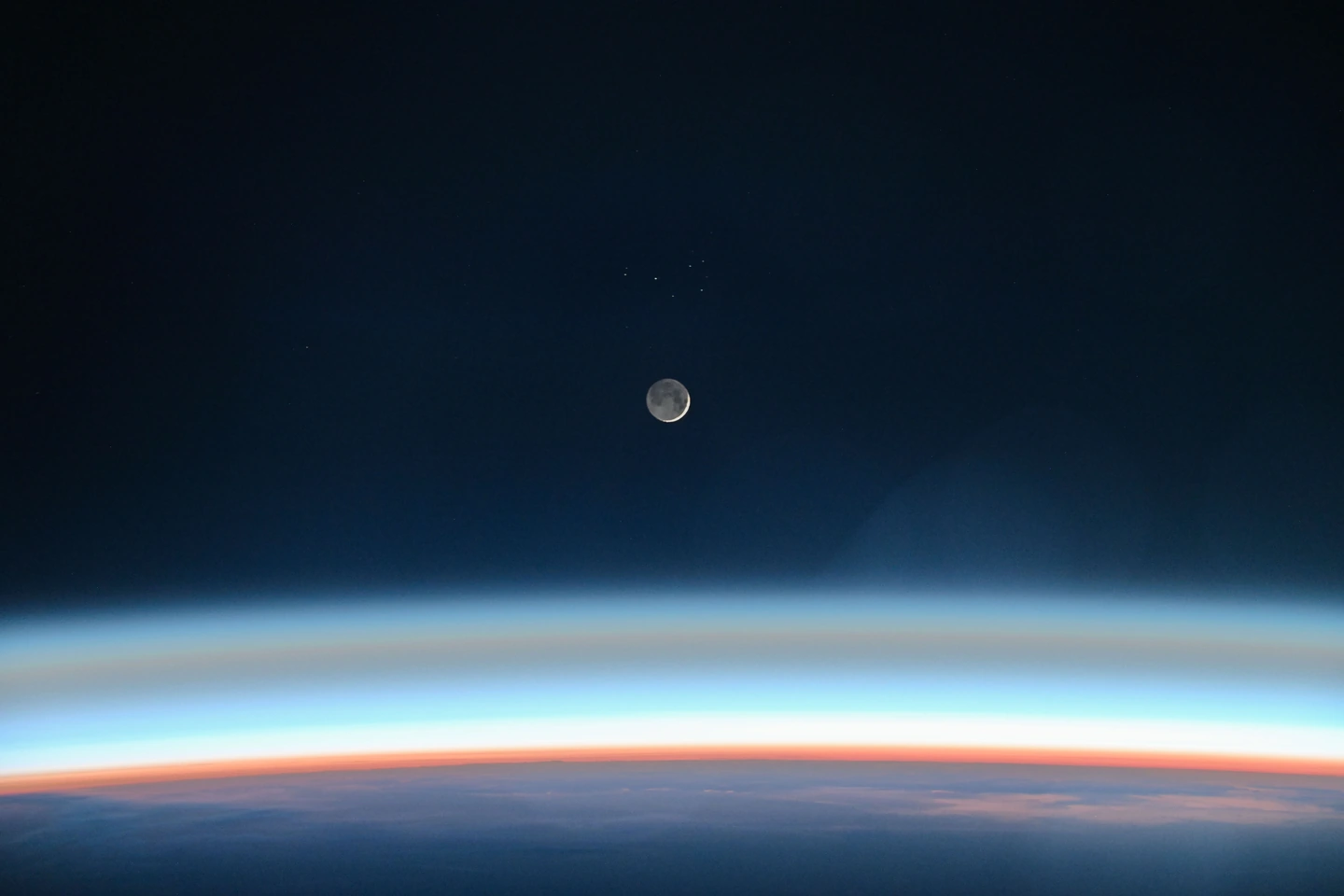
Earthshine is sunlight reflected by Earth onto the Moon’s night side. Some of that light reflects back to us, revealing the faint outline beside a bright crescent. It is reflected light, not a second lunar light source.
 Open figure at full size ↗
Follow the light through three steps
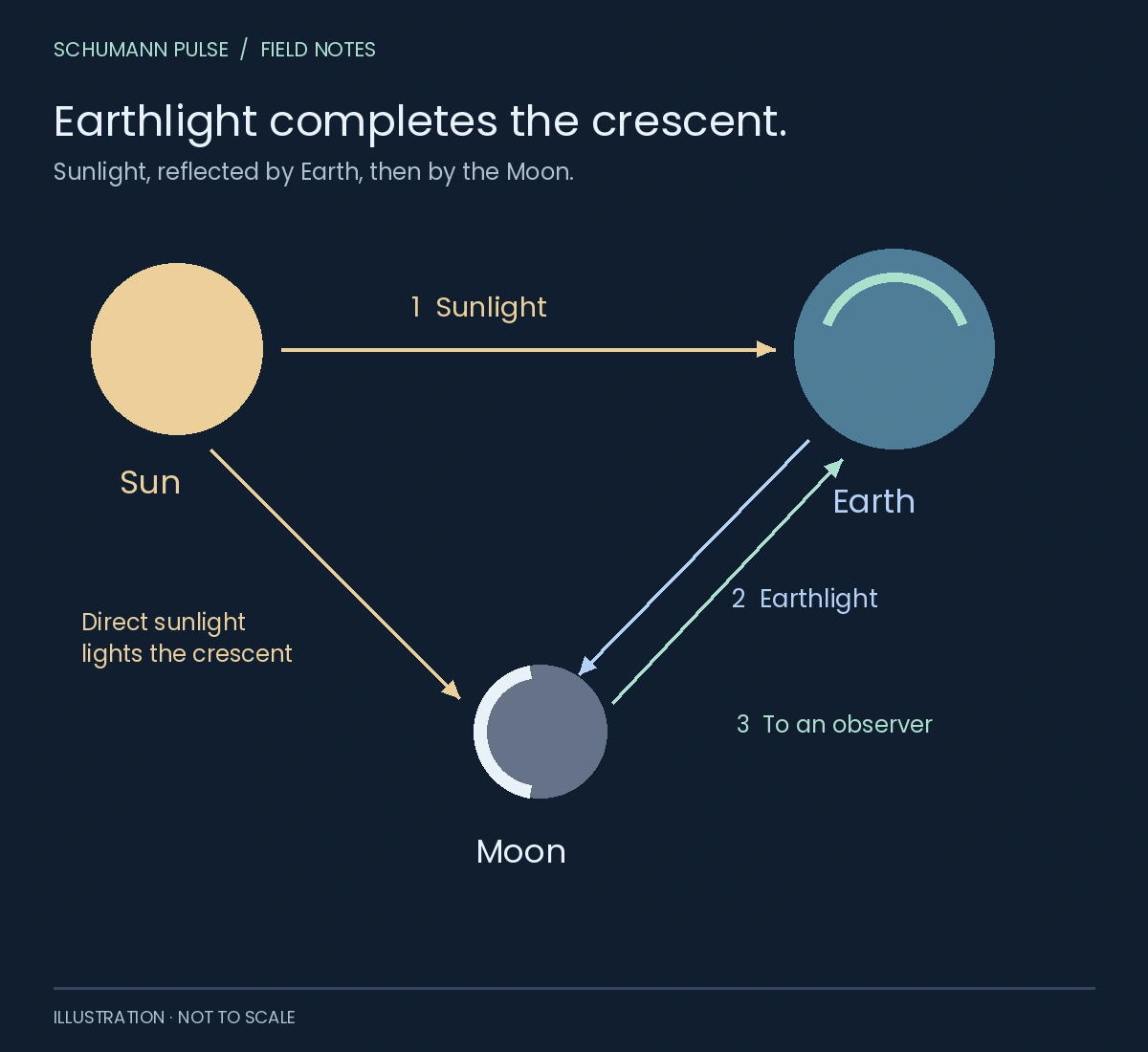
Schumann Pulse · field notes
Earthlight completes the crescent.
Follow the faint glow through three steps.
1 · Sun to Earth
Sunlight illuminates Earth.
2 · Earth to Moon
Earth reflects light onto the Moon’s night side.
3 · Moon to observer
Some light reflects back to an observer on Earth.
Direct sunlight lights the bright crescent.
Simplified light paths, not to scale. The faint area is part of the Moon’s near side in lunar night.
Earth reflects sunlight.
Clouds, oceans, land and ice contribute to the light our planet sends back into space.
That light reaches lunar night.
It softly lights the part of the visible Moon that receives no direct sunshine.
The surface reflects it again.
You see a dim disc beside the much brighter sunlit crescent.
The faint light has made an extra reflection compared with the direct sunlight illuminating the crescent. Our schematic separates the paths so you can follow them; body sizes, distances and arrow spacing are not to scale. NASA Earth Observatory: earthshine [1].
What the ISS photograph records
The header photograph was taken by an Expedition 71 crew member on 10 May 2024, from the International Space Station. NASA identifies it as ISS071-E-67226. A narrow bright crescent sits above Earth’s atmospheric rim, while the rest of the visible lunar disc glows faintly.
NASA’s published version was cropped and contrast-enhanced, with lens artifacts removed. We preserve that supplied frame in an optimized web image. It is a real archival observation, not an illustration of the Moon’s phase today. NASA’s image record and processing notes [2].
Is the faint part the far side of the Moon?
No. Night side describes illumination; far side describes which side faces away from Earth. Earthshine reveals a night portion of the near side. The far side also experiences day and night. Treating “dark side” as a permanent place mixes those two ideas. NASA: Moon facts and synchronous rotation [3].
A useful question for any lunar picture is: does “dark” mean currently unlit, facing away from us, or simply underexposed in the photograph? Those are different descriptions.
When is earthshine easiest to notice?
Look for a thin crescent in a sufficiently dark twilight sky, with the Sun already below the horizon for evening viewing. The bright crescent can frame a much fainter complete disc. A long camera exposure can reveal that disc more strongly while overexposing the crescent, so a photograph need not match its brightness to your eyes. NASA’s earthshine guide [1].
Use Moon today to see whether you are near a crescent phase. That page provides phase and age, not a promise of a clear horizon or an exact local moonset time. A lunar cycle day is useful context; it does not determine whether earthshine will be visible.
Can earthshine tell us about Earth?
Researchers use carefully calibrated earthshine observations to study Earth’s reflectivity, or albedo. Goode and colleagues analyzed a long observing record from Big Bear Solar Observatory; this is an example of learning about our planet by measuring light from the Moon. Goode et al., 2021 [4].
One phone photo cannot establish a change in global albedo. Exposure, sky transparency and observing geometry can all change its appearance. The distinction is useful: an enjoyable sky observation and a calibrated climate measurement ask different things of an image.
Sources
References in the text lead here. Original publications open in a new tab; this guide stays open.
- [1] NASA Earth Observatory: Earthshine, 29 May 2014 (opens in a new tab) First mention ↑.
- [2] NASA Earth Observatory: Earth’s Reflections on the Moon, image and processing record (opens in a new tab) Back to text ↑.
- [3] NASA: Moon facts (opens in a new tab) Back to text ↑.
- [4] Goode et al. (2021): Earth’s Albedo 1998–2017 as Measured From Earthshine (opens in a new tab) Back to text ↑.
Your next observation
Make the Moon part of your daily perspective.
Follow the lunar cycle and keep separate energy, mood and sleep-quality records. Explore available full-Moon comparisons in You when enough suitable history exists; no clear difference is a valid result.
iPhone app coming soon · history and personal comparisons live in the app.