
The field guide · Moon
Why is the Moon orange or red?
A Moon near the horizon often looks orange or red because its light travels through more of Earth’s atmosphere. More blue light scatters away from the direct path to your eyes. A total lunar eclipse can also redden the Moon, but the light takes a different route.
 Open figure at full size ↗
Why does a low Moon change colour?
Moonlight is reflected sunlight. Before reaching you, it crosses Earth’s atmosphere. A low viewing angle means a longer passage through the air than a view high overhead. Shorter, bluer wavelengths scatter more readily, leaving the direct light relatively richer in yellow, orange and red. This is the same broad reason sunsets look warm. NAOJ’s explanation of a red Moon [1].
The effect does not require a full Moon. A crescent or a partly illuminated Moon can also look orange near the horizon. As a rising Moon gets higher, its colour may become less warm; the lunar ground itself has not changed colour.
Orange moonrise or Blood Moon: what is different?
Same colour.
Different journey.
Near the horizon
Moon → local atmosphere → you
Reflected moonlight crosses a long stretch of air on its way to your eyes. More blue light scatters out of that direct path.
Any phase can look orange low in the sky.
During a total eclipse
Sun → Earth’s atmospheric rim → Moon → you
Some sunlight passes through Earth’s atmosphere before reaching the Moon inside Earth’s shadow.
A full Moon, with a specific alignment.
During a total lunar eclipse, Earth blocks direct sunlight from reaching the Moon. Some sunlight passes through the atmosphere around Earth’s edge and continues into the shadow, dimly lighting the lunar surface. The atmosphere filters this light before it reaches the Moon. During an ordinary orange moonrise, the important filtering happens between the Moon and your eyes. NASA’s eclipse explanation [2].
Colour by itself cannot identify an eclipse. Check whether an eclipse is happening and whether its relevant stages are visible from your location. Our Blood Moon guide explains total, partial and penumbral eclipses separately.
A real moonset that looks almost liquid
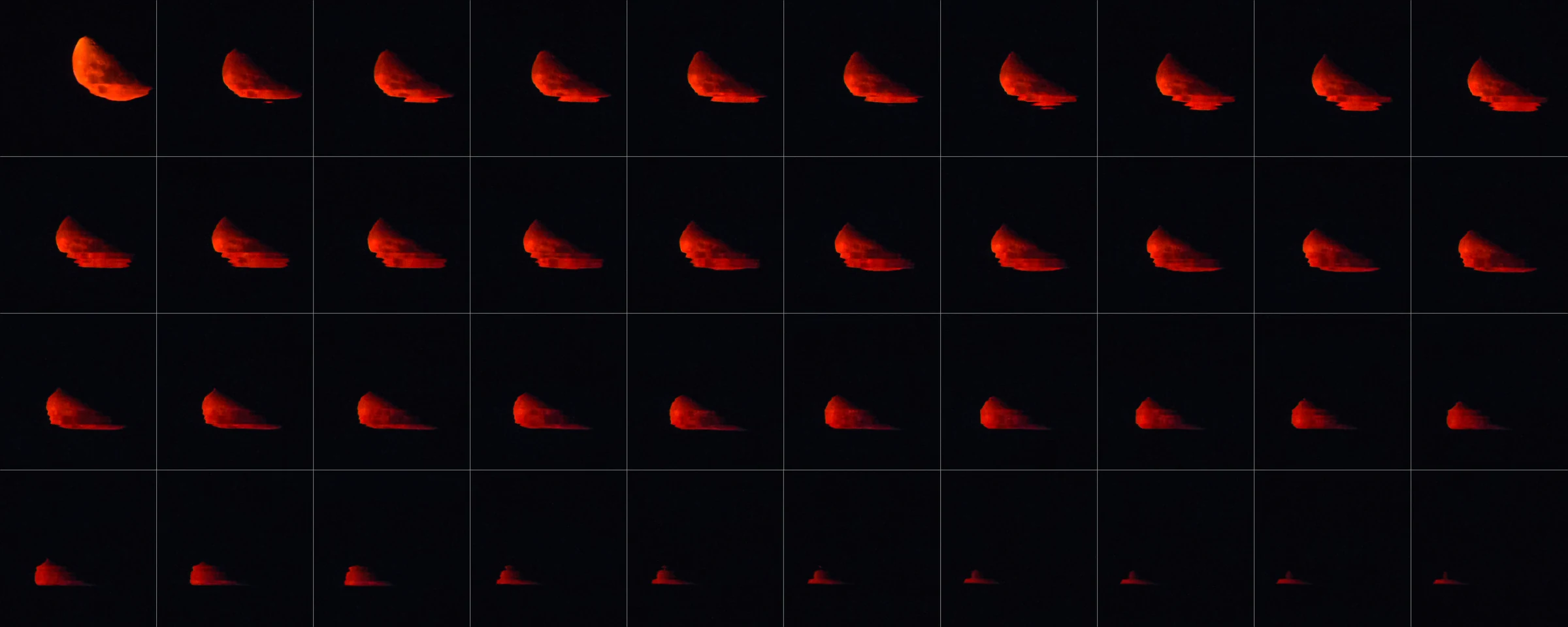
The photograph above is a montage by P. Horálek/ESO, recorded at Paranal Observatory in Chile and published in 2018. Frames were taken five seconds apart and arranged left to right, then top to bottom. It shows a red Moon becoming visibly distorted as it sets. It is a historical sequence, not tonight’s Moon.
ESO attributes the changing outline to uneven atmospheric refraction: air layers bend the light differently. Scattering helps explain the colour; refraction helps explain the shape. Those processes can appear together in one view. The apparent “melting” is not activity on the Moon. ESO’s original image account [3].
Try following one feature across the first row, then compare the last row. The value of a sequence is that you can see a change unfold, rather than guessing a cause from one striking frame.
Why does it also look unusually big?
Size and colour deserve separate explanations. The familiar impression of a huge Moon near trees or buildings is the Moon illusion. Atmospheric refraction can flatten the disc near the horizon; it does not explain the familiar impression that the whole Moon is greatly enlarged. NASA’s Moon-illusion guide [4].
A supermoon concerns orbital distance. An orange Moon, a large-looking Moon and a supermoon are not interchangeable labels, even when more than one description fits an evening.
What should I note when I see one?
Keep a short observation: your location, local time, whether the Moon is low or high, its phase and whether it is rising or setting. If you take a second photo later, keep the framing and camera settings as consistent as you can. Treat the comparison as an observation, not a colour measurement from a calibrated instrument.
Start with today’s phase and calendar, then use the moonrise guide to understand why a phase alone cannot give your local rise time. A colour photograph without that context cannot establish the atmospheric conditions at your location tonight.
Sources
References in the text lead here. Original publications open in a new tab; this guide stays open.
- [1] National Astronomical Observatory of Japan: why the Moon sometimes looks red (opens in a new tab) Back to text ↑.
- [2] NASA Science: lunar eclipses and red illumination (opens in a new tab) Back to text ↑.
- [3] ESO: Swimming Moon, image potw1828a, P. Horálek/ESO (opens in a new tab) Back to text ↑.
- [4] NASA Science: the Moon illusion, colour and refraction (opens in a new tab) Back to text ↑.
Your next observation
Make the Moon part of your daily perspective.
Follow the lunar cycle and keep separate energy, mood and sleep-quality records. Explore available full-Moon comparisons in You when enough suitable history exists; no clear difference is a valid result.
iPhone app coming soon · history and personal comparisons live in the app.