
The Space weather guide
Your guide to
space weather.
A flare on the Sun, a change in Earth’s magnetic field, an aurora overhead. Follow how they connect, learn what each measurement tells you, and put the latest reports in context.
See space weather todayNOAA Kp · storm context · measurement times
A little context first
One sky.
Different kinds of activity.
“Solar storm” is a broad phrase. NOAA reports geomagnetic storms, radio blackouts and solar radiation storms on separate scales. The letter tells you which phenomenon a number describes.
- G · Geomagnetic storms
- Disturbances in Earth’s magnetic environment. Read them alongside the Kp index and its time interval.
- R · Radio blackouts
- Effects of solar X-ray flares on high-frequency radio communication on Earth’s sunlit side. A flare class and a geomagnetic storm level are different measures.
- S · Solar radiation storms
- Elevated fluxes of energetic solar particles. This scale describes a different part of the space environment from G or R.
Background: NOAA’s G, R and S scales (opens in a new tab) and space-weather phenomena (opens in a new tab). The articles below explain the details and link their original sources.
01 / Follow the source
What happened
on the Sun?
Begin with the event itself. A flash of radiation, an ejection of plasma and the solar wind are related but distinct.
- What is space weather?
Get an overview of the environment between the Sun and Earth.
- What do M-class and X-class flares mean?
Read the X-ray classes and the measurements behind them.
- What is a coronal mass ejection?
Understand an eruption of plasma and magnetic field.
- What can solar wind measurements tell me?
Read speed, density and magnetic-field orientation together.
02 / Decode a report
A number needs
its measurement.
Choose the index, scale or bulletin you are looking at. Keep observations separate from forecasts and expected arrivals.
- What does the Kp index mean?
Understand the planetary index, its scale and three-hour intervals.
- How do Kp, Dst and Bz differ?
Compare the locations, units and time windows behind three familiar numbers.
- What is the difference between G1 and G5?
Explore NOAA’s geomagnetic storm levels and their stated effects.
- What is an S-scale radiation storm?
Learn why energetic particles have their own storm scale.
- Watch, warning or alert: what changed?
Separate advance notice from an observed threshold crossing.
- Where do the observations come from?
Follow solar telescopes, upstream monitors and ground instruments.
03 / From reports to the sky
What might you see?
What have we seen before?
Connect the measurements with viewing conditions, then revisit the events and experiments behind today’s understanding.
- What causes the northern lights?
Explore the upper-atmosphere glow and its changing colours.
- Why can’t I see the aurora when Kp is high?
Check location, darkness, clouds and the limits of one index.
- What happened during the May 2024 storm?
Follow an attributed timeline, with arrival and storm levels kept separate.
- What was the Carrington event?
Read the historical observations behind the famous 1859 storm.
- How did Birkeland bring an aurora idea into the lab?
Explore the terrella experiment and its limitations as a model.
 Open figure at full size ↗
Before you look outside
Activity is only
one part of the view.
- Check a current observation and its timestamp.
- Consider your location, darkness and the local weather.
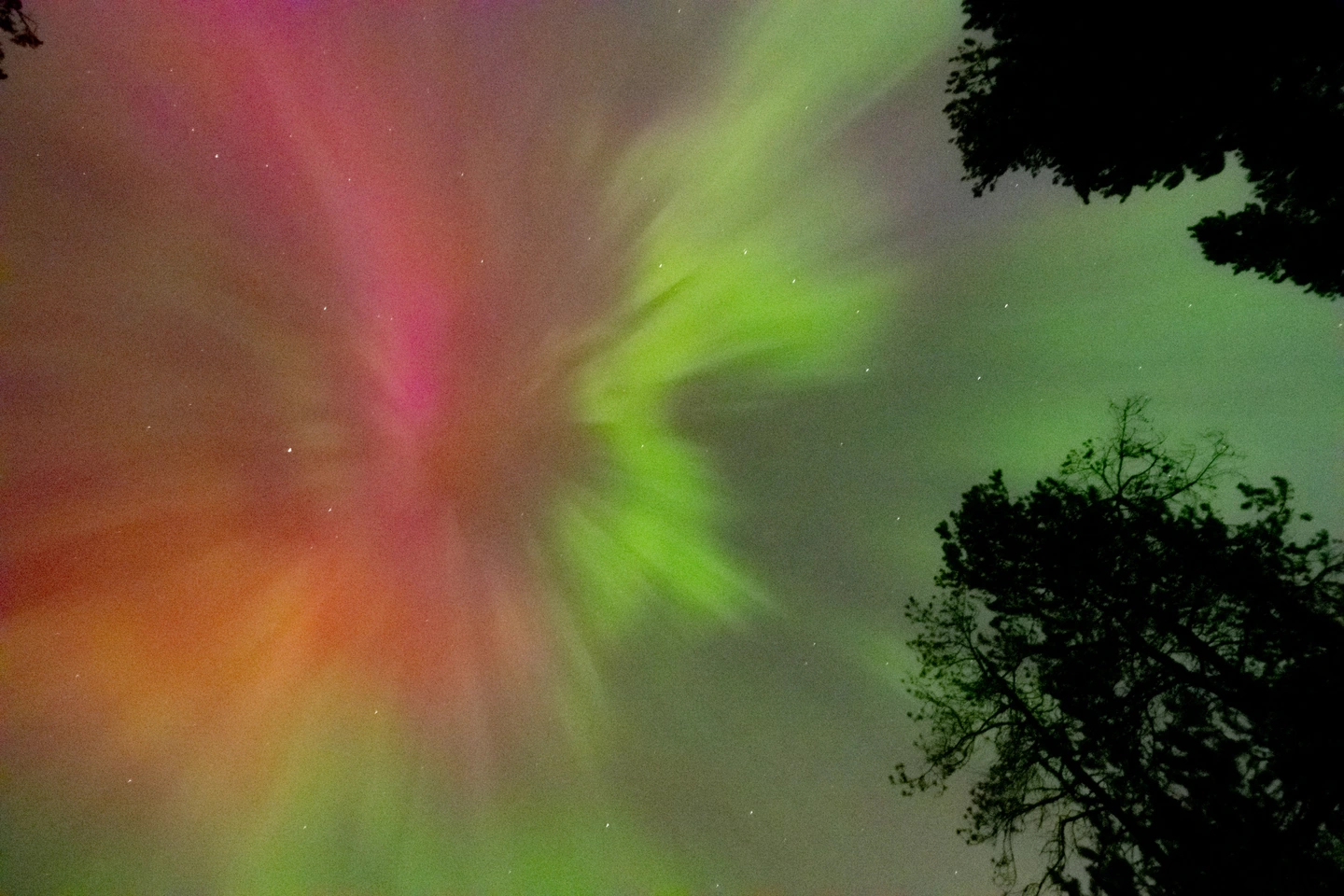
- Treat a photograph as a record of one place and exposure.
This aurora was photographed on 10 May 2024. It illustrates a past event, not a promise of what you will see tonight.
Explore the aurora viewing guideA different kind of question
Questions about health or headaches?
Read the research separately from the storm scales. These guides explain study limitations and why an environmental index is not a personal diagnosis.
- Space weather and health
Compare research questions, findings and the limits of interpretation.
- Magnetic storms and headaches
Explore the evidence without treating timing alone as a cause.
- Keep a useful personal record
Add everyday context and avoid focusing only on storm days.
Your next observation
Stay curious when conditions change.
Choose activity alerts and keep your own feelings, sleep quality and everyday context in a journal. Explore suitable personal comparisons over time; a storm index is not a health score.
iPhone app coming soon · history and personal comparisons live in the app.