
The field guide · Moon
Why does moonrise change from day to day?
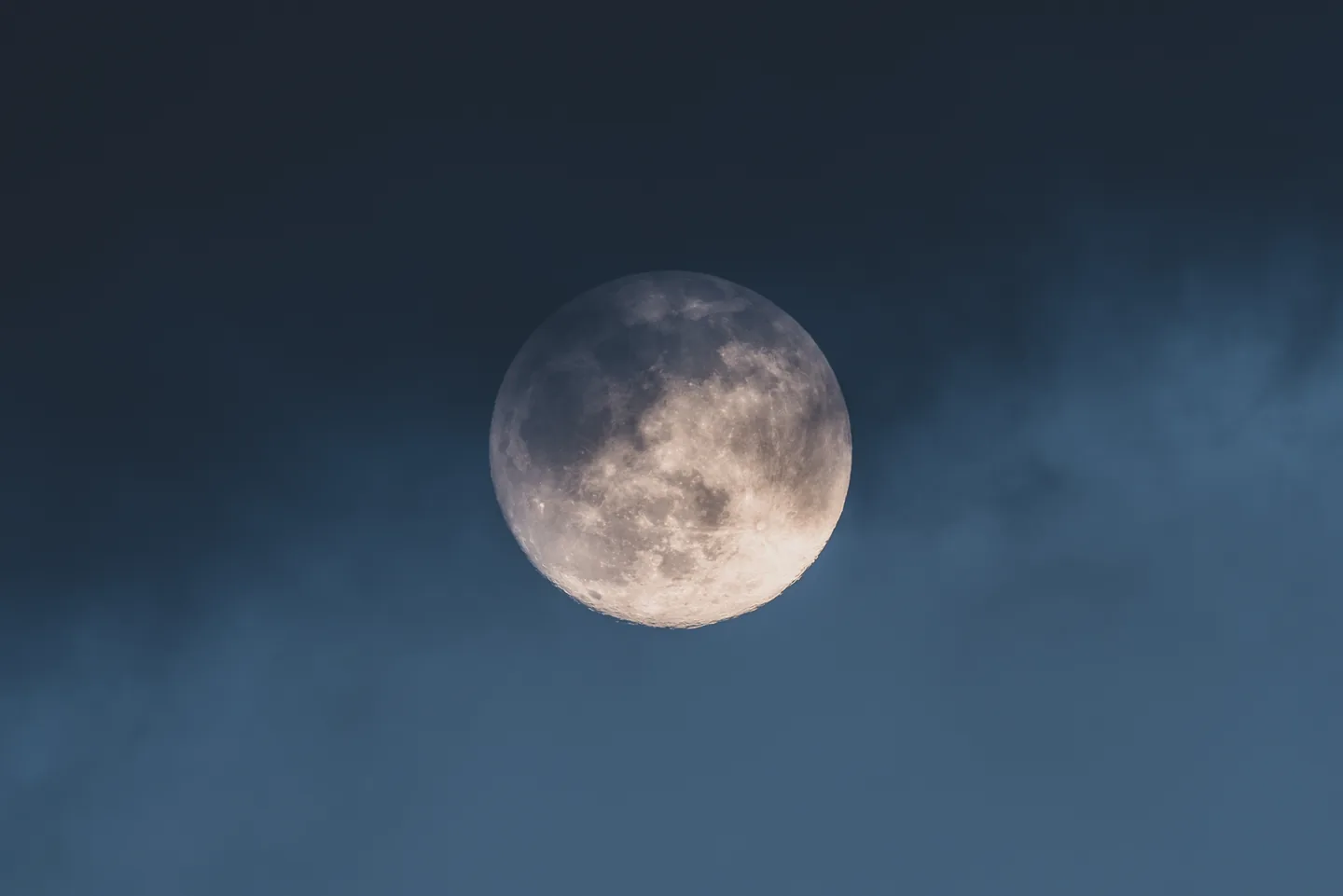
The Moon usually rises later from one day to the next because it moves along its orbit while Earth turns. The familiar 50-minute delay is an average, not a rule for your location. Actual moonrise and moonset depend on the date, position on Earth and local horizon.
Where does the 50-minute idea come from?
Earth’s rotation carries your location around, but the Moon is moving in the same general direction along its orbit. Earth has to rotate a little farther to bring you back into alignment with the Moon. The average lunar day is about 24 hours 50 minutes. NOAA’s explanation of a lunar day [1].
That is a useful picture of why lunar timings drift through the clock. It is not a moonrise algorithm. Rising is a crossing of your local horizon, not simply a return to the same direction. The Moon’s changing position, your latitude and the horizon geometry also matter. USNO explains why accurate rise/set calculations need more than one simple formula. USNO’s computation guide [2].
So if a table says 19:12 today, adding 50 minutes does not give a dependable time for tomorrow. Look up tomorrow’s date and the same location instead.
Why can a date have no moonrise?
A calendar ends at midnight; the Moon’s motion does not. A late rise can be followed by a rise just after the end of the next calendar date. That intervening date then has no moonrise entry. USNO explicitly notes that a place can have a date with no rise or no set. USNO’s rise and set definitions [3].
A date can be empty.
The cycle continues.
These made-up times demonstrate a calendar boundary, not a forecast for any location.
- Day 123:40Moonrise shortly before midnight.
- Day 2No riseThe next rise has not happened by this date’s end.
- Day 300:30The next moonrise falls just after midnight.
Time between these two example rises: 24 hours 50 minutes.
This example explains one calendar-boundary case. At high latitudes, the geometry can also keep the Moon above or below the horizon for extended periods. Do not replace an empty entry with “the Moon disappeared”, and do not assume every rise must have a matching set on the same date.
Does a full Moon always rise at sunset?
Around sunset is a good first orientation. A full Moon is roughly opposite the Sun in the sky, so it is mostly a nighttime object. Around last quarter, the Moon is often visible into the morning; first quarter favours afternoon and evening viewing. These phase clues explain why the Moon can be out in daylight. NASA’s daytime-Moon explanation [4].
“Around sunset” is not an exact clock time or a guarantee of visibility. See the daytime Moon guide for a visual phase-and-viewing overview. For exact planning, keep the phase and the local rise/set calculation separate.
What does a moonrise table actually mean?
Standard calculations generally place the Moon’s upper edge at an ideal, unobstructed horizon, with an assumed amount of atmospheric refraction. A hill, building, elevated viewpoint or different atmospheric conditions can change when you first see it. A listed time is therefore not a promise that the Moon will appear over your particular rooftop at that minute. USNO definitions and accuracy notes [3].
Read a table in this order:
- Place: use the actual coordinates or a sufficiently nearby location.
- Date: keep the local calendar date attached to each event.
- Clock: check the UTC offset and daylight-saving convention.
- Event: distinguish rise, set and transit. Transit is the meridian crossing, not another word for moonrise.
- View: check weather and what obstructs your horizon.
USNO’s daily calculation service takes a date, coordinates and time-zone information. Two people reading different clocks or observing from different places can both have correct tables. USNO’s service documentation [5].
What can the Schumann Pulse Moon calendar tell me?
Moon today shows phase, age, the cycle day, the next full Moon and a monthly phase calendar in your selected time zone. It does not calculate moonrise or moonset for your coordinates.
The calendar’s cycle day counts from new Moon. The roughly 24-hour-50-minute lunar day described above is a different clock; neither should be confused with traditional local lunar-day conventions. Our lunar days and Moon age guide separates those meanings.
Sources
References in the text lead here. Original publications open in a new tab; this guide stays open.
- [1] NOAA National Ocean Service: the average lunar day (opens in a new tab) Back to text ↑.
- [2] USNO: computing rise, set and twilight (opens in a new tab) Back to text ↑.
- [3] USNO: rise/set definitions, high-latitude behaviour and accuracy (opens in a new tab) First mention ↑.
- [4] NASA: why the Moon is visible during the day (opens in a new tab) Back to text ↑.
- [5] USNO: daily Sun and Moon calculation parameters (opens in a new tab) Back to text ↑.
Your next observation
Make the Moon part of your daily perspective.
Follow the lunar cycle and keep separate energy, mood and sleep-quality records. Explore available full-Moon comparisons in You when enough suitable history exists; no clear difference is a valid result.
iPhone app coming soon · history and personal comparisons live in the app.